




The News
CHICAGO — State Sen. Robert Peters found himself in a tricky spot days ahead of his Democratic primary race: dubbed a “corporate pawn” by a corporate-funded super PAC.
He’s an unlikely candidate for the label. Peters campaigned for Bernie Sanders twice, joined the Democratic Socialists of America, and accused Israel of “genocide” for its war in Gaza. Endorsements from Sanders and other top progressives rolled in when he decided to seek an open House seat representing part of Chicago’s south side; Elizabeth Warren joined him on Friday.
But a few weeks before Tuesday’s primary, voters opened their mail to learn that Peters had taken “nearly $140,000” in “corporate money” and a donation from a “hedge fund executive.”
The ad came from Fairshake, the crypto industry’s super PAC, which is spending more than $3 million to attack him and a Democrat seeking the city’s other open congressional seat — both of them voted for state crypto regulation.
“I actually think it’s kind of insulting — not just to me, but to the voters,” Peters told Semafor. “It says bad things about our politics that these crypto folks think that they can spread that type of misinformation and win.”
Peters accepted the specific donations mentioned in Fairshake’s ad, but the PAC’s depiction of a well-known progressive as an industry tool is an example of the biggest trend of the 2026 campaign so far. Super PAC money, much of it from the crypto and AI industries as well as AIPAC, is swamping races and giving candidates bizarro-world branding.
Illinois pop-up groups funded by AIPAC, with innocuous names like “Elect Chicago Women,” have spent millions on ads that falsely portray pro-Israel candidates as anti-Trump warriors and pro-Palestinian candidates as secret right-wingers. The ads have dragged Democrats who otherwise have few policy differences into arguments about what they would owe their donors and whose money they wouldn’t take.
The effect of the outside spending on this spring’s primaries, which in some districts involve the first open-seat contests in decades, is huge. Super PAC spending has dwarfed the fundraising for individual candidates in most of Tuesday’s competitive races, as crypto- and AI-backed PACs go big for candidates who’ve signaled that they won’t over-regulate.
In this article:

Know More
Super PAC money is also flooding into the Senate Democratic primary to replace retiring Illinoisan Dick Durbin. At least $5 million of the spending there has come from Gov. JB Pritzker, who seeded a super PAC to help his lieutenant governor, Juliana Stratton, succeed Durbin.
One of Stratton’s Senate primary rivals, Rep. Raja Krishnamoorthi, spent years building a war chest that funded nearly $30 million in ads. The Pritzker-funded Illinois Future PAC helped Stratton catch up; then Fairshake went on the air, blasting Stratton, whose allies began asking if Krishnamoorthi was a puppet for wealthy and MAGA-curious donors.
“I’m really worried about our democracy,” Warren said at a Friday night rally for Stratton. “I am worried that we have a handful of wealthy folks who think that they’re the ones who are going to call all the shots.”
On the ground, it’s not always that black and white; Democrats are campaigning around and against the super PACs. Peters has gone after Donna Miller, Cook County Commissioner, after she benefited from $4.4 million in super PAC spending from an AIPAC affiliate called Affordable Chicago Now!
“We don’t need electeds who are gonna hide while bombs are being dropped,” Peters said on Facebook, asking if Miller’s early silence on the Iran war was a payoff to the pro-Israel group.
In the suburban race to replace Krishnamoorthi, entrepreneur Junaid Ahmed got caught by surprise when AIPAC affiliate Elect Chicago Women became the biggest-spending supporter of ex-Rep. Melissa Bean. The centrist Bean is incorrectly portrayed in its ads as a progressive architect of Obamacare.
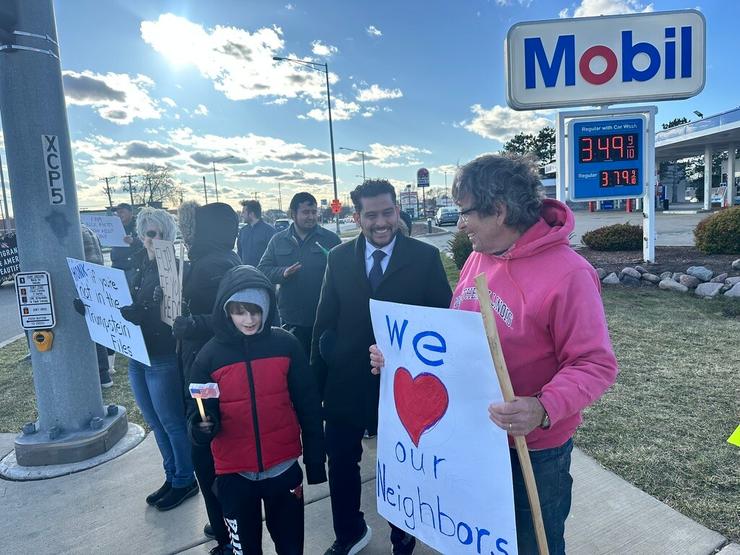
“You’re AIPAC! Just accept that you’re AIPAC,” Ahmed said as he waved pro-immigrant signs with a group of Democrats in Palatine, Ill. “You’re so toxic. You’re going to come under the name Elect Chicago Women, you’re going to call yourselves Chicago progressives? That’s fraud.”
In a third open-seat Chicago-area race, super PAC spending started earlier, and candidates have run more vigorously against it. Elect Chicago Women spent early for Laura Fine, a liberal state legislator who backed AIPAC.
The hope, as local Democrats saw it, was that progressive Israel critics in the race — led by Evanston Mayor Daniel Biss and journalist Kat Abughazaleh — would split their vote. Later on, AIPAC affiliate ads portrayed Biss and Abughazaleh as say-anything phonies with hidden right-wing views.
Both candidates pushed back by attacking Fine’s reinforcements. Biss drove down Fine’s numbers by clipping and promoting a moment from a February forum when the candidates were asked if they took money from Trump donors; every candidate but Fine raised a red “no” sign, while she raised a green “yes” sign.
“Here’s who’s giving the money: It’s AIPAC and Trump donors. Here’s why they’re giving the money: Because Laura Fine promises to offer a blank check of military aid to Israel no matter what they do in Gaza or the West Bank, and I won’t do that,” Biss told Semafor on Friday.
“They are taking a toxic, unpopular position. And the way you can tell is they’re lying about whether or not what’s happening is happening.”

Room for Disagreement
Krishnamoorthi doesn’t easily wear the label of crypto-funded candidate, either. He has not always sided with the industry, and he said Stratton allies were hypocritical in their criticism of his super PAC support.
“The lieutenant governor kicked off this contest with four or five super PACs coming in for her because her campaign couldn’t muster the resources necessary to do whatever she needed to do,” he told Semafor. “All that being said, I’d like to be in a different campaign finance world.”

David’s view
I’ve been covering the role of super PACs in defeating progressive Democrats for five years. The two major developments since then: The flowering of crypto and AI industry PACs, which have essentially limitless resources, and the Democratic base’s souring on the Israeli government thanks to the Gaza war.
What hasn’t changed is that these PACs run on what their strategists believe will play with Democratic primary voters, not what their funders want to achieve. As a result, watching TV in Chicago makes you feel like a cordyceps fungus has taken over the Democratic Party — imitating its messaging to destroy it, just as the parasite does in the wild.
This epidemic of often-manipulative messaging is also, in some ways, shrinking the candidates themselves. As more money gets spent to drive up their negatives, they are spending more money, and calling in more favors, to portray super PAC beneficiaries as shills.
And accountability isn’t easy to achieve here, although Chicago’s suburbs have robust and skeptical media outlets that have closely covered this spending. The AIPAC spinoff PACs are almost completely opaque, setting up copypasta websites and not commenting on their buys or strategy; Fairshake, which has mostly run ads under the main PAC brand, declined to comment for this story.

Notable
- For OpenSecrets, Emma Sullivan profiled the ad firms that have piled up contracts and money from super PACs, already.
- Emma Janssen got inside the Bean-Ahmed race, and the topsy-turvey messaging, for the American Prospect. “When the Affordable Care Act came up for a vote, Bean was still waffling on where she stood.”
- For CNN, Edward-Isaac Dovere went long on the Evanston race, and Biss’s strategy of attacking Fine as an AIPAC cut-out.