



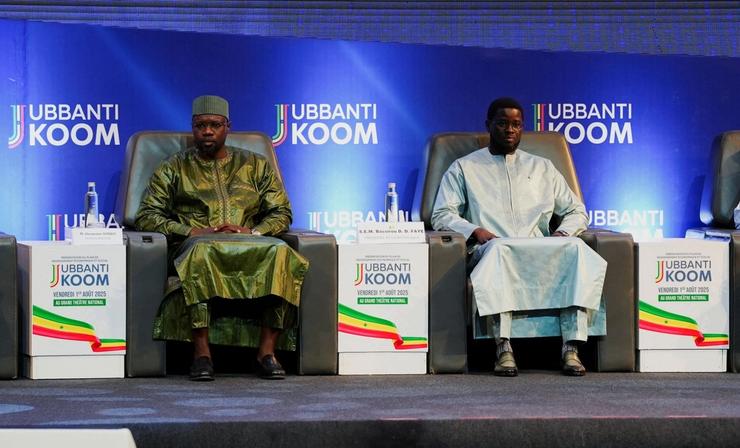

The News
Senegal President Bassirou Diomaye Faye fired his prime minister and dissolved the government, a move that will likely determine how the country manages its debt crisis but could prompt public anger.
Faye’s decision to dismiss Ousmane Sonko, announced late on Friday, follows months of tension between the two men. The pair have disagreed over the handling of public debt that the International Monetary Fund estimates reached 132% of GDP at the end of 2024 after the government said it had discovered undisclosed debts not reported by the previous administration now estimated to be around $13 billion. The disclosure prompted the IMF to suspend a $1.8 billion loan facility to the country.
In this article:

Know More
When Faye won Senegal’s 2024 presidential election, it was widely understood as a victory engineered by Sonko, his political mentor and founder of the Pastef movement, who had been barred from contesting the election himself after a defamation conviction. Sonko’s inability to run prompted him to back Faye — his longtime lieutenant and fellow former tax inspector.
Faye took office in April 2024 after winning a landslide election mostly built on Sonko’s popularity as an opposition firebrand. Over time, tensions emerged over economic policy and the balance of authority between the presidency and premiership.

Alexis’s view
Faye’s bold step will finally provide clarity over the country’s path out of its debt crisis. To govern effectively, an administration needs a sense of direction and an understanding of who calls the shots. Without those basic elements, governments can end up paralysed by indecision. For months, Faye and Sonko have essentially run parallel administrations within the government.
The divergence in their views was clearest — and most damaging — on the IMF’s recommendation for Senegal to restructure its debt. Sonko rejected the idea of a formal program, arguing that the country could meet debt repayments without such a painful move. Faye, by contrast, has signalled a more flexible approach aimed at finding “potential pathways toward a solution,” and this month signalled that he would personally oversee talks with the Fund.
The alliance between the two men was always based on a delicate understanding: Faye would occupy the presidency while Sonko, appointed prime minister immediately after the election, remained the movement’s dominant political force and strategist. That arrangement initially projected unity, but it also created an ambiguous dual power structure inside the government.
Sonko periodically signaled frustration that the government was drifting from Pastef’s original agenda, while Faye sought to assert a more conventional presidential authority. Each made their own policy pronouncements and it became increasingly difficult to see how the government could move forward in the absence of a shared purpose and direction.
Senegal’s president can now rebuild his government in his image, appointing ministers who pledge allegiance solely to him. He can make decisions without his authority being undermined by his prime minister.
But Faye’s gamble also raises the risk that Sonko mobilizes his supporters to turn against Faye, be it through political sabotage or organizing protests. Sonko’s popularity should not be underestimated and nor should his ability to weaponize his support to great effect, just as he did to bring Faye to power.
Sonko has proven himself to be an incredibly effective political insurgent: he created the Faye presidency and could find a way to end it.

Room for Disagreement
There was no immediate sign that the former prime minister planned to mount a campaign to sabotage Faye’s presidency. Following his dismissal, Sonko posted a message on social media that he would “sleep with a light heart.”

Notable
- Senegal’s fuel subsidy bill could exceed its 2026 budget allocation by as much as $2 billion if oil prices rise to $115 per barrel as a result of the Iran war, the then finance minister said on Friday.