




The News
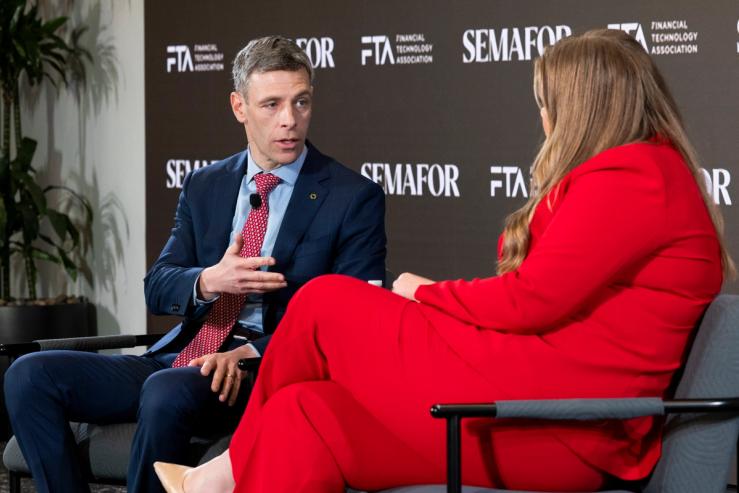
US President Donald Trump’s new executive order that directs banks to take a closer look at their customers’ immigration status is “a common-sense set of reforms,” US Comptroller of the Currency Jonathan Gould said Wednesday at Semafor’s Banking on the Future Forum.
Those reforms “give us tools that we need and preserve bank flexibility around … how they know their customers,” Gould said of the executive order, which was first reported by Semafor. “So it seems to me a reasonable trade-off.”
Gould added that the executive order “syncs up” with the Treasury Department’s Financial Crimes Enforcement Network’s ongoing effort to overhaul how banks monitor for money laundering and terrorism financing, because that effort will empower officials “to highlight certain areas of potential risk and direct the banks specifically to take a look at those things.”
Also on Wednesday, Gould expressed optimism that incoming Federal Reserve chair Kevin Warsh might expedite fintech firms’ access to the central bank’s payment rails. Trump signed another executive order Tuesday, also first reported by Semafor, that seeks to do the same.
“We at the OCC view the banking system as a bit of a walled garden, but of course, you don’t want the walls to be too high or too impermeable, because you run the risk of that walled garden over time decaying and becoming decrepit,” Gould said.

Know More
Gould also delivered an impassioned defense of the OCC’s accelerated approval of charters for nonbanks, like crypto firms, which banks and progressives have warned could place consumers and the financial system at risk.
“What we are doing at the OCC is actually restoring regular working order in doing our jobs on the timeframes that we’ve established consistent with the statutory factors that Congress has given us,” Gould said. “We don’t have a zero risk tolerance anymore; that’s not what the statute says.”
Gould pointed to the Federal Deposit Insurance Corporation, which supervises state-issued charters: “One of the reasons you’re seeing so many kind of national trust bank charter applications is, No. 1, just pent-up demand after 18 years, but also the fact that the FDIC deposit insurance application process has been so laborious and so slow.”
“There are changes underway at the FDIC under Chairman [Travis] Hill’s leadership to make the FDIC process a little bit more thoughtful, a little bit more faster, so that applicants or would-be applicants will have a better sense of how much they’ll have to invest [and] get an indication of, ‘Hey, is this gonna be a go or a no-go?’” Gould added.
The threat of related litigation from banking groups “makes sure that our pencils are a little bit sharpened and we do our job a little better.”
Gould called on financial institutions to help “shore up the political support” for the OCC to argue for federal preemption on issues like swipe fees: “Ultimately the parameters of preemption are all downstream from the political consensus that’s necessary to maintain it.” And he solicited input on where the OCC should dial in: “We depend upon the institutions we supervise to be our eyes and ears.”