




The Scene
When the Class of 2026 arrived on campus four years ago, ChatGPT hadn’t been released. Computer science was among the fastest-growing majors and words like vibe coding and tokenmaxxing hadn’t even entered the lexicon.
Times have changed.
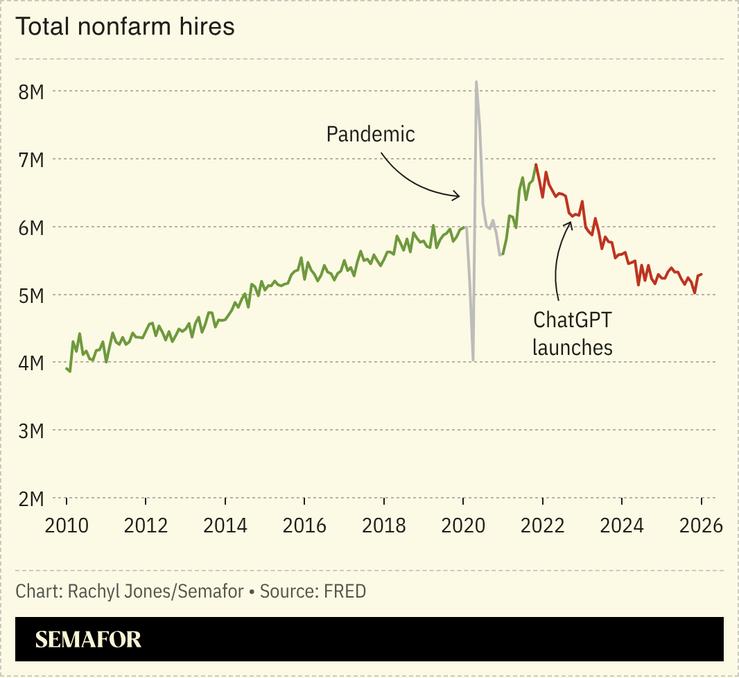
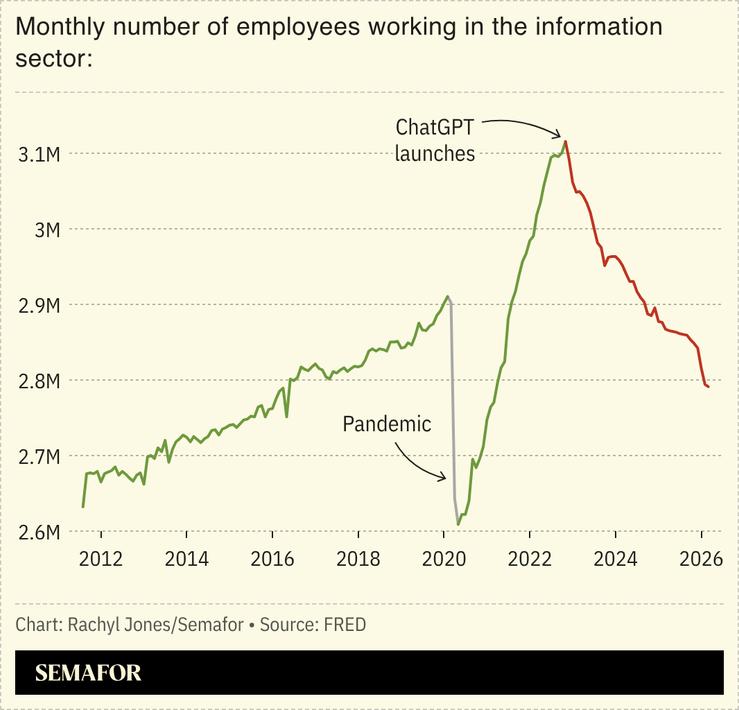
Twentysomethings leaving college this May face a radically different world. AI has contorted hiring, especially at tech companies, which have slashed 100,000 jobs this year. Cloudflare axed a fifth of its staff after realizing that thousands of AI agents can handle the humans’ old tasks.
“Every other day, a new AI agent is being released in the market,” said Vaishali Hireraddi, 23, a University of California, Davis, graduate student who’s applied to 500 jobs so far. “What am I doing with my life?”
Hireraddi is among the dozens of students, companies, and economists who told Semafor they fear the Class of 2026 is, well, cooked. Some graduates say they’ve ditched hopes of landing their dream jobs for anything that pays. Others are settling for unpaid roles. Postings on LinkedIn are getting twice the number of applications compared with 2022.
It’s a “hair-on-fire moment,” Sen. Mark Warner, D-Va., said in an interview at Semafor World Economy last month, predicting recent graduates would face an unemployment rate of 30% in the next two years. “Boy, oh, boy.”

Know More
AI doom has spread from TikTok and Reddit to commencement stages. One executive even got booed by students at the University of Central Florida earlier this week after she tried to tell a crop of arts and humanities graduates that AI was the “next Industrial Revolution.”
“We know that AI exists,” one student told the local TV station. “We’re just having a hard time acknowledging that it’s taking away job opportunities.”
Nvidia cofounder Chris Malachowsky attempted to use his graduation address at the University of Florida to ease some fears: Forget the “noise,” he said. “As graduates, you are not entering this next era as bystanders.”
Some graduates figure that while they search for traditional jobs, they might be able to vibe code their way into startup funding. Theodore Skondras, 23, a master’s student at the Massachusetts Institute of Technology, applied to accelerator Y Combinator with a coding project aimed at making payments between AI agents more trustworthy. “Things change” and you’ve got to adapt, he said.
Hireraddi, who is getting her master’s degree in business analytics, said she recently started paying $100 a month for Claude to spin up AI projects that look just good enough to show to recruiters. One predicts whether an online shopper is looking to make a purchase or just browsing. “It takes a lot of time to actually find investors and then sell it to people and all of that. So rather, I put it on my LinkedIn so that it reaches people, and recruiters see the reach,” she said.
She’s also using Claude to beat the hiring bots. To tailor each application to the advertised job, she drops her resume and the role’s description into Claude, which spits out a new document that includes the right keywords for the role. So far, though, Hireraddi’s only turned up two unpaid offers, one of which said they’d pay her “at some point in the future when they have enough money.”
“They told me the ‘budget was tight,’” she said.

The View From Companies
Graduates right now “feel a profound sense of urgency,” Citadel Securities’ Alex DiLeonardo said at Semafor World Economy, one of many conversations centered on AI and the workforce among the 500 CEOs who attended the Washington, DC, gathering.
Citadel Securities is also overhauling its first-year analyst program to be less role-specific and more focused on critical thinking. Likewise, KPMG is rolling out a pilot program with 1,000 audit interns that focuses on problem solving and communication, and assesses “those interns — those we plan to hire — based on their ability to be critical thinkers,” CEO Tim Walsh said.
Newell Brands CEO Chris Peterson said the consumer products company has gone even further: It’s stopped hiring people who aren’t “AI-proficient or AI-fluent into the company anymore,” he said.
IBM Vice Chairman Gary Cohn had some more practical advice for the Class of 2026: “We need to encourage people to find jobs where there are jobs,” he said. “Who in here can level a cement floor? Because you can earn $260,000 today to go to a data farm and be a cement layer.”

Rachyl’s view
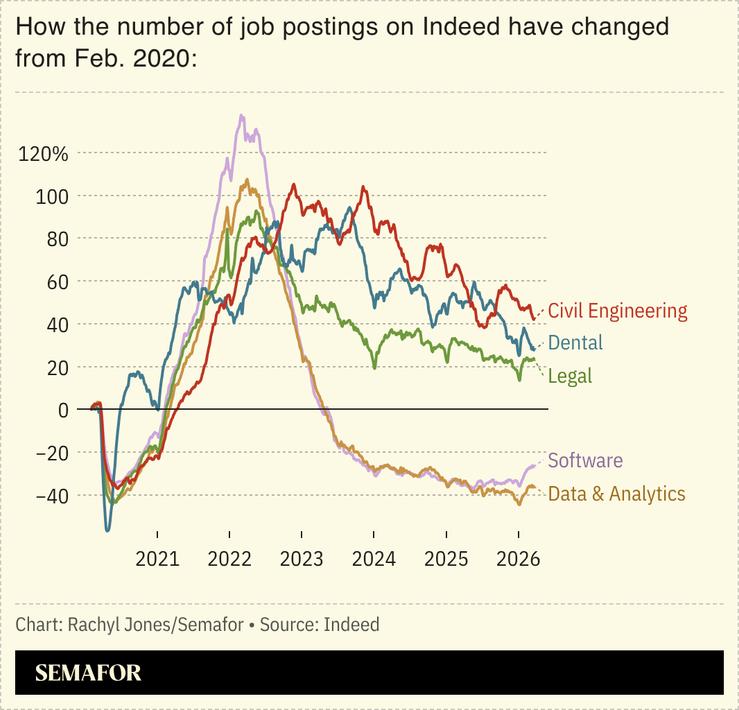
Graduates looking for jobs in computer science, business, and data analytics are facing the worst of it, said Laura Ullrich, Indeed’s director of economic research — but the market for nurses, therapists, and civil engineers is still open.
Nursing might not be for everyone, but if there’s one thing job dislocation does well, it’s forcing people to be creative. It couldn’t come at a better time: Entrepreneurship, once a beacon of American progress, has been on the decline since the 1970s.
Generations of young professionals were taught to go to college, get a 9-5 job, and climb the corporate ladder. The latest generation was inculcated to learn how to code, following the rote path of 1s and 0s that would land them a six-figure job at Google or Amazon, where they could scarf down free sushi and play ping pong in between work.
If AI renders those jobs obsolete, or at least more difficult to come by, the upper hand goes to people who can still come up with big ideas and think abstractly. The VC money is there.
We’ve already seen the number of LinkedIn users who have added “founder” to their profile triple since 2022, as vibe coding and agents lower the cost and technical barriers of creating something great.
The best thing companies can do now is to stop the cycle of overhiring and mass layoffs. The best thing policymakers can do is advance regulation that eases the burden of starting a new business. And the best thing new graduates can do is open up their laptops and build something.

Room for Disagreement
Atlanta-based Ezra Rosser, 22, who graduated from Savannah College of Art and Design with a fine arts degree in December, said he felt “lucky” to ride the AI wave while in college so he could experiment while it was still low stakes.
But the reality is, after applying to 100 jobs he’s ended up with an internship that ends in July. As for what happens after that? “They told me they can’t promise anything,” he said.
Some companies like IBM and Infosys say they’re actually hiring for more entry-level roles. With IBM tripling its hiring for those roles this year, Chief Human Resources Officer Nickle LaMoreaux said: “Where are you going to get mid-career experience people five years from now if you haven’t groomed them?”