



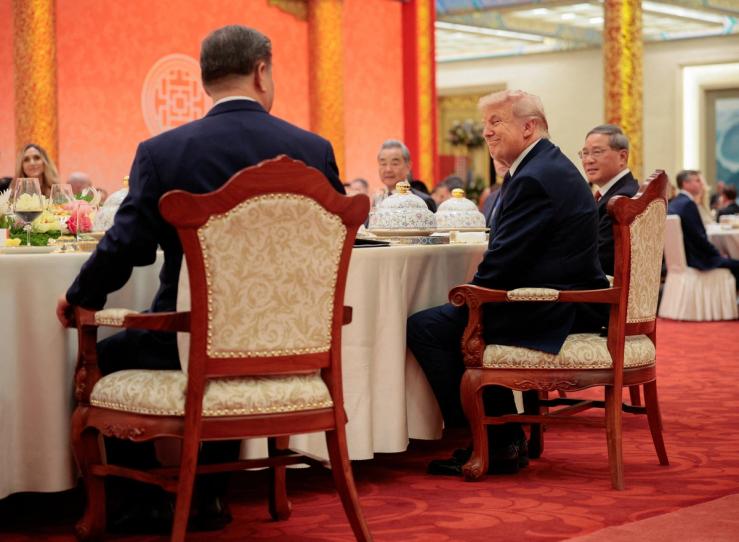
Last night’s glittering summit banquet at Beijing’s Great Hall of the People summoned a distinctly retro vibe, and not just when the People’s Liberation Army band struck up a rendition of YMCA.
US President Donald Trump set the tone just before Air Force One touched down, posting that his first ask of Xi Jinping, the Chinese leader, would be to “open up” China to allow the 17 corporate chieftains on his plane to “work their magic” and bring China to “an even higher level.” Never mind that it was Trump himself in his first term who definitively ended the era of Washington’s starry-eyed engagement with Beijing, Xi played along, assuring the delegation that “China’s door to the outside world will only open wider.” Two countries that had a year ago been raising tariffs on each other to well north of 100%, effectively barring trade between one another, were suddenly behaving like long-lost pals.
The Georgetown scholar Peter Harrell noted how the language sounded like it was coming “straight out of the 1990s and 2000s.”
I had a similar sense of déjà vu.
Deng Xiaoping, then China’s paramount leader, formally declared an “open door” in 1978, shortly after the Cultural Revolution wound down. But it wasn’t until the early 1990s that corporate America started rushing through, spurred by the reopening of the Shanghai Stock Exchange — I watched the guests arrive for the black tie cocktail launch at the old Russian consulate on the waterfront Bund — and the hyperbolic advice of Barton Biggs, the legendary Morgan Stanley chief strategist, who declared himself “maximum bullish” on the country’s prospects.
That was the first big wave of euphoria. Another followed China’s WTO entry in 2001, which brought a stampede of US manufacturers, and equally unrealistic expectations of what lay behind the Chinese portal.
Disillusion with China was building within the US before Trump first arrived in the White House in 2017 but he defined the darkening mood with Cold War-style language: His first National Security Strategy document labeled China a “strategic competitor.”
Today, Trump’s own top aides are constructing a new economic relationship with China that assumes the “open door” will remain forever an illusion; US Trade Representative Jamieson Greer is pushing to create a “Board of Trade” and a “Board of Investment” where bureaucrats from both countries will manage flows of goods and capital between the world’s two largest economies.
That, too, harkens back to a prior era: Ronald Reagan proposed a similar regime with Japan in the 1980s. But US ties with Tokyo were decidedly better, even then, than American relations with Beijing today. The US and China are now structural antagonists; they both aspire to dominate a suite of immensely powerful technologies coming of age — AI, quantum, advanced manufacturing — in a winner-take-all competition for 21st century power.
In the 1990s, the fond hope of the China lobby in Washington — led by corporate cheerleaders — was that the “open door” would transform China into a market-oriented partner. Deng was always worried about the “flies and mosquitos” that would swarm in, by which he meant notions of democracy. Xi has determined to guard the entranceway more tightly and create a self-sufficient “fortress China.” Despite the sudden shift in rhetoric on this trip, there’s no going back to that simpler time.