




Andy’s view
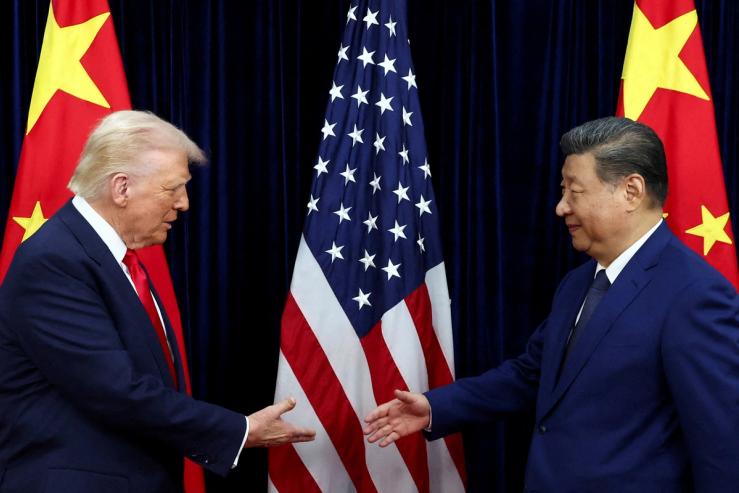
To rebalance US trade with China, the White House is touting a Board of Trade as a major outcome of next month’s summit in Beijing between US President Donald Trump and Chinese leader Xi Jinping.
American businesses should be wary.
US Trade Representative Jamieson Greer says the board will bring together officials from both countries to “pick which products they want to trade with each other.” On Greer’s export wish-list: Boeing planes, pharmaceuticals, medical devices, and agricultural products. In return, the US wants to buy Chinese commodities and “low-tech consumer goods.”
One can argue that China has left the US with little choice: Beijing has made clear it has no intention of adjusting its predatory trade practices that feature massive industrial subsidies — the IMF calculates these equal 4.4% of Chinese GDP — gargantuan state-owned enterprises, and currency manipulation. Last year, China recorded a stunning $1.2 trillion trade surplus, the largest in history.
And in the short term, a Board of Trade may serve a valuable purpose in stabilizing US-China relations and securing a trade truce forged by Trump and Xi last year that both sides badly need. The US in particular needs time to overcome China’s chokehold over rare earths by building out its own supply chains — a project made more urgent by war in Iran; rebuilding the Pentagon’s depleted stock of munitions will require vast quantities of these minerals.
Indeed, managed trade isn’t a new idea in Washington. In the 1980s, then President Ronald Reagan struck a “Voluntary Export Restraint” agreement with Japan under which Tokyo agreed to limit its car exports to the US in return for avoiding tariffs. He took a similar approach on Japanese semiconductors. And, for what it’s worth, the Biden administration was no stranger to trying to put its thumb on the scale when it came to trade.
But this is different.
Reagan sought to give specific US industries breathing room to survive a Japanese export onslaught, and figure out how to become competitive. Biden opted for subsidies and other financial incentives to induce investments in critical industries, including semiconductors and green tech, to counter the growing economic and military threat from China.
By comparison, a Board of Trade — in which bureaucrats, rather than markets, determine the shopping basket — looks more like industrial policy on a grand scale. The irony here is that after spending decades lecturing China about the merits of free trade, the US is taking a page out of Beijing’s own state capitalist playbook.
Already, the Trump team has taken state intervention to another level, grabbing “golden shares” in companies like Intel and US Steel in strategic industries, and strong-arming CEOs: To secure tariff exemptions for its China-made iPhones, Apple pledged $600 billion in investments in the US over four years; Nvidia had to promise to pay an export fee to the government to secure approval for sales of its high-powered H200 chips to China.
A Board of Trade would give Washington a tool to exert even more leverage over corporate America. Chad Bown, a trade expert at the Peterson Institute for International Economics, raises the question of how businesses would get onto the White House’s preferred list. Indeed, it’s not difficult to envisage a lobbying scramble that would favor large, politically connected companies, raising broader concerns about the longer-term impact of managed trade on US economic dynamism: Jami Miscik, Peter Orszag, and Theodore Bunzel of Lazard warn that what they call “discretionary state capitalism” will lead to “favoritism, inefficiency, higher costs, and lower growth.”
And that’s if the idea can be made to work at all: Bown told me he understood the temptation of using managed trade to ensure commercial outcomes, but “how you operationalize that is really hard.” It’s far from clear, for example, whether Beijing will be content to act merely as a supplier of jeans and toys to American consumers, as Greer would like. Certainly, China will want to add a long list of high-tech items, currently embargoed, to the US export list.
US businesses have long complained of the time, money, and personnel they have had to devote to lobbying Beijing for market access. Increasingly, they are having to do so in Washington, too. In a world of managed trade, that push would be put on steroids.
In this article:

Room for Disagreement
Ultimately, it’s China’s export juggernaut — built on state power — that has blown up the global rules-based trading system, not Trump and his tariff wars. Peter Harrell, a trade expert at Georgetown’s Institute of International Law, points out that the US and its allies now “face a situation in which even if China abided by the rules, other countries would need to violate them to compete.”
Correction: A previous version of this story incorrectly stated that Nvidia paid a fee to secure approval of its most advanced chips to China. That chip, the H200, is not the company’s most advanced.

Notable
- The Trump administration is creeping towards state capitalism, as it acquires equity stakes or a “golden share” in companies ranging from Intel Corporation and US Steel to Westinghouse nuclear reactors and Lithium Americas, Bloomberg wrote.