




The News
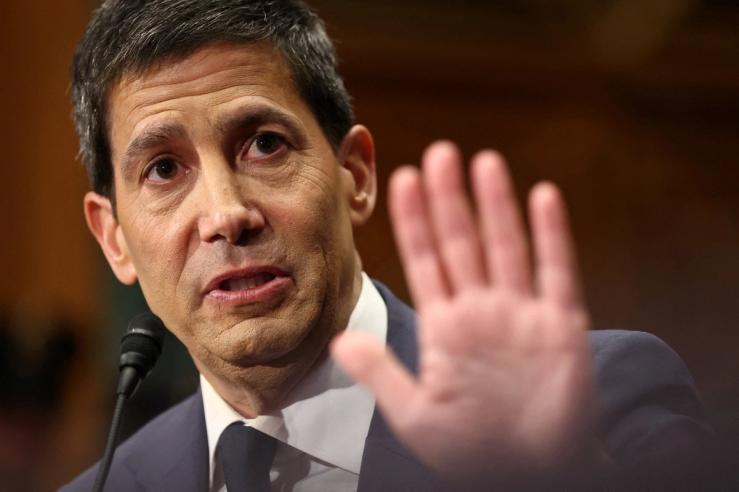
Kevin Warsh is headed for confirmation as Federal Reserve chair on Wednesday with more cover than ever to hold off on rate cuts as Wall Street tempers its expectations.
It still won’t be enough to persuade the president to sit tight.
Warsh will take over at the central bank as the Iran war drives US prices up at their fastest clip since May 2023, spurring still more economists to delay their forecasts for interest rate cuts. Those projections further pad the protective bubble that some Republicans have built around Warsh in recent weeks, giving him rhetorical runway to hold off on the cheaper borrowing costs that Trump has pushed for.
But Warsh’s honeymoon may not last long after senators cast their final votes to install him as chair.
The president has “put this guy in for a firing squad,” Access/Macro chief economist Tim Mahedy told Semafor. “It’s going to be brutal; Trump’s going to turn on [Warsh] in two months.”
Trump, who has spent much of his second term lobbying for lower rates, tapped the once-hawkish Warsh amid growing political pressure for his administration to lower costs for Americans ahead of the midterms. The former Fed governor made the case for faster cuts at his confirmation hearing, defending his argument that artificial intelligence will boost productivity enough for the economy to grow without accelerating inflation.
But the longer the war drags on, the harder that case is to make — not least because a longer war means greater chances that costs remain elevated even after the conflict ends. Inflation, already stubborn before the war began, outpaced wage gains Tuesday.
“We’re going to have to deal with inflation,” Sen. John Kennedy, R-La., told Semafor Tuesday. “I happen to think it’s temporary [and] a lot of it will be reduced when the conflict is over — but it’s 3.8[%].”
The White House did not respond to a request for comment.
Warsh also needs to bring along the Fed’s other voting members in order to cut rates, an already-difficult task made tougher still by outgoing Chair Jerome Powell’s decision to remain at the central bank as a governor. Three Fed bank officials last month pushed back on the Fed’s decision to signal a rate cut as its next most likely move.
“Look, we’re only within $1 of where [gas] was under Joe Biden, and that’s a very serious issue — so for us, we can’t ignore that,” Sen. Mike Rounds, R-S.D., told Semafor Tuesday. “The one thing that we learned about the Fed is that they base their decisions on facts — and that means they will have to take that into account.”
The Senate voted 51-45 Tuesday to confirm Warsh as a Fed governor; Sen. John Fetterman of Pennsylvania was the only Democratic “yes” alongside Republicans. Lawmakers are expected to vote Wednesday to confirm Warsh as chair.
In this article:

Know More
The Bureau of Labor Statistics said Tuesday that prices rose 3.8% in April, which was 0.5% more than the previous month and 0.1% more than economists had predicted. So-called core inflation, which excludes more volatile food and energy prices, rose 2.8%; that was also 0.1% more than economists expected.
“There is no reason to cut interest rates in these data,” High Frequency Economics chief economist Carl Weinberg said.
A number of Wall Street banks had pushed back their forecasts for rate cuts even before Tuesday’s data. Bank of America and Goldman Sachs recently joined Morgan Stanley and Barclays in predicting the Fed would be in a holding pattern until at least December.
“A combination of lower monthly inflation prints after the oil shock fades and further labor market softening will likely be needed for the FOMC to cut this year,” Goldman Sachs chief US economist David Mericle wrote on Friday. “We still expect that bar to be met but now expect it to take a bit longer.”

Room for Disagreement
Sens. Bernie Moreno, R-Ohio, and Bill Hagerty, R-La., joined Kennedy in predicting on Tuesday that prices will decrease after the Iran war ends.
But they also said they were still hopeful inflation would ease in the near future, clearing the way for Warsh to cut interest rates quickly (and appease Trump).
“I believe that [the Iran war] ends very soon; gas prices crash; we’re back to 2%-type inflation,” Moreno told Semafor. “I think, at that point, it’s perfectly reasonable to cut interest rates — probably by 50, 75 basis points.”
Said Hagerty: Inflation “is clearly much more transitory than it was in 2021, so my hope is that we’ll be able to look through it.”

Eleanor’s view
The question isn’t whether Trump squeezes Warsh, but how quickly.
Kevin Hassett, director of the White House’s National Economic Council, signaled on Monday that the president might extend Warsh more grace than Powell when it comes to lowering interest rates, telling CNBC: “We respect the independence of the Fed, especially now that there’s an independent-minded person” at the helm.
But Powell was once Trump’s guy, too; the president nominated him to replace Janet Yellen as chair in 2017. So there’s little reason to think that buys Warsh much time, particularly as an end to the war remains elusive and Republicans prepare to face voters with gas prices rising.
Mahedy said he feels “confident” in predicting that “there is no world” in which, without a rate cut by September, “the president’s going to be like, ‘That’s cool — going into election with inflation at 3.5, 4%, borrowing costs high, and consumer spending basically bottoming out.’”
He added, for emphasis: “No world.”

Notable
- “Kevin Warsh is the dog who caught the car,” the Hoover Institution’s John Cochrane told Politico.