




The News
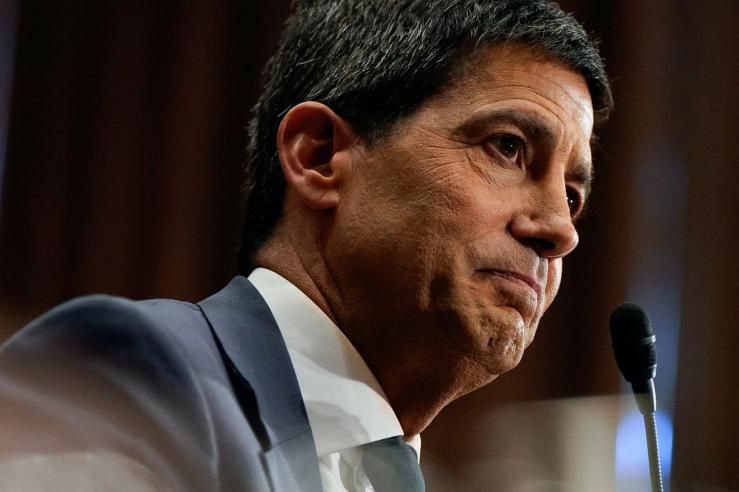
President Donald Trump’s pick to chair the Federal Reserve is finally on the fast track — to even harsher White House pressure than Jerome Powell.
The Senate Banking Committee advanced Kevin Warsh’s nomination along party lines on Wednesday, putting him on track for confirmation before Powell’s term as chair ends May 15. Like Powell, Warsh will helm a central bank taking a wait-and-see approach to inflationary shocks like the Iran war and Trump’s tariffs, even as the president tries to bend its members to his drive for rate cuts.
But Warsh will be in a tougher bind than Powell, who has withstood a Justice Department investigation into the bank’s renovations and a Trump attempt to fire another Fed governor over mortgage fraud allegations. Powell, who said Wednesday he would remain at the Fed until the latter is “well and truly over,” has shown no interest in heeding the preferences of a president who recently sought assurances that Warsh, if selected, would support lower interest rates.
“I’m sure the president’s going to get annoyed with him if he doesn’t move as quickly on easing interest rates,” retiring Sen. Thom Tillis, R-N.C., who agreed to support Warsh after DOJ started to wind down its probe, told Semafor.
Part of Warsh’s “challenge may be just managing expectations back in the White House,” Tillis added, “about data-driven decisions that this consensus body has to do.”
It’s not just the president watching Warsh: Investors and lawmakers will also keep careful tabs on whether he’s demonstrating the independence from Trump that he publicly pledged. Markets are currently “pricing in Fed credibility,” as Powell termed it on Wednesday, but that goodwill — and Warsh’s relationship with Capitol Hill — could both suffer if the new chair appears too much a creature of the White House.
Complicating things further: Warsh previously embraced a more hawkish approach to monetary policy that’s explicitly at odds with Trump’s call for cheaper borrowing costs.
“He can fudge the issue a bit in the early going, but he can’t fudge it for long — and he’s coming in in a situation that makes the question particularly sensitive and particularly difficult,” said David Wilcox, a former Fed economist now with Bloomberg Economics and the Peterson Institute for International Economics.
Key administration allies may be trying to help Warsh dodge reproach for splitting off. Among them: Treasury Secretary Scott Bessent, who said at Semafor World Economy earlier this month that “the Fed is doing the right thing by sitting and watching” as the Iran war drives oil prices up (a comment Trump promptly pushed back on).
Bessent’s remarks “give Warsh cover to come in and stay on hold for a few meetings,” former Richmond Fed President Jeffrey Lacker said in an interview.
“The extent to which [administration allies] can persuade [Trump] to give Kevin the benefit of doubt in situations that might be coming up in which interest rate cuts wouldn’t be advised or indicated by the data — I think that’s going to be the key,” Lacker added.
Sen. Kevin Cramer, R-N.D., told Semafor that Warsh “knows it’s a hard job,” adding with a chuckle: “I think he’ll be fine. But if not, it’s too late.”
The White House did not respond to a request for comment.
In this article:

Know More
At his confirmation hearing, Warsh fielded several questions from Democrats concerned over how he would keep his distance from the president — including Sen. Elizabeth Warren, D-Mass., who nudged him on which of Trump’s policies Warsh disagreed with. Though Warsh dodged that, Republicans signaled they were satisfied with his responses.
“He testified very strongly to that effect,” Powell said Wednesday of Warsh’s commitment to Fed independence, “and I’ll take him at his word.”
But the central bank’s latest meeting illustrates the quagmire Warsh is about to wade into. As the labor market chugs along, the Fed on Wednesday teased a more hawkish bent, with three presidents dissenting on its bias toward future cuts.
“The question about looking through energy [prices] really is not in front of us right now; it hasn’t even peaked yet,” Powell said Wednesday. “And I think we’d want to see the backside of that and progress on tariffs before we even thought about reducing rates.”
The US government is expected to report Thursday that inflation continued accelerating away from the Fed’s 2% target in March. Sen. John Kennedy, R-La., posited following Warsh’s committee vote that the Fed might soon have to raise interest rates, rather than cut them.
Inflation “is going to remain elevated until we get the [Iran] conflict resolved — and I think most people understand that,” Kennedy said. “But having said that, inflation is very pernicious, and it’s kind of like a tick: You know, if you get a tick, the best way to handle it is just to get that SOB off of you immediately.”
Sen. Cynthia Lummis, R-Wyo., suggested to Semafor after the vote that Warsh’s plan to shrink the Fed’s balance sheet could open the door to rate cuts. Warsh also recently doubled down on his argument that artificial intelligence will boost productivity enough to pave a path to lower rates.
Yet as Tillis underscored, Warsh can’t cut without bringing along a majority of the Fed to vote with him. Getting that buy-in may be harder for Warsh than it was for Powell, who served at the Fed for six years before becoming chair. Warsh hasn’t served at the Fed since 2011, so his opinion could carry less weight at first with other policymakers.
As a governor, “I had real sympathy for how hard it is to get that group to consensus,” Powell said on Wednesday. “I always felt like I don’t want to add to that unnecessarily.”

Room for Disagreement
Democrats are insistent that Warsh will wind up doing Trump’s bidding and thus face little tension with him. Warren warned Wednesday that Warsh’s confirmation would translate to a Fed “dancing on the end of Donald Trump’s string.”
But the more subtle argument against Trump’s pressure campaign working on Warsh, some former Fed officials suggested, is the failure of the president’s efforts to influence the Fed so far. Unsuccessful attempts to remove Governor Lisa Cook and probe Powell may mean Trump is less likely to try a similar tack down the road.

Eleanor’s view
Warsh can’t risk looking like he’s in Trump’s pocket without unnerving investors and lawmakers, particularly after Powell said Wednesday that he was concerned enough about the attacks “battering the institution” that he had “no choice” but to stay past May 15.
“We’re having to resort to the courts” to protect “the ability to make monetary policy without political considerations,” Powell said. “We’ve been successful so far, but that’s not over; none of that is concluded.”
Indeed, if Warsh does forge his own path, pointing to data and the rest of the Fed won’t keep Trump at bay for long.
