




Liz’s view
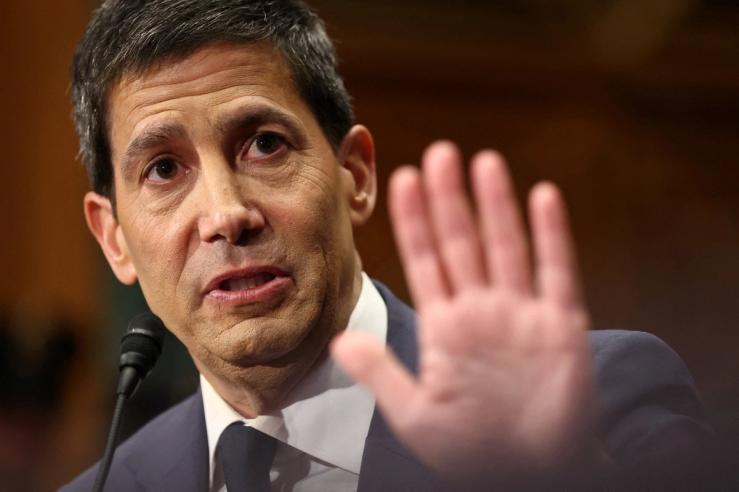
Kevin Warsh is expected to be confirmed this week as Federal Reserve chairman after signalling a willingness to lower interest rates — either because the president wants him to, or because he thinks current conditions justify it. It’s not entirely up to him, and the market is losing faith in that outcome anyway, but the bigger question is whether it would matter.
The US economy is less sensitive to interest rates than it used to be. The long shift from manufacturing — which responds to higher borrowing costs (factories are expensive) in a way that services don’t — has blunted one of the Fed’s most powerful economic levers. The ultrarich, whose spending has ballooned, don’t care what money costs. Neither do the tech companies fueling the AI boom, which they see as an existential moment they can’t risk missing out on.
“Most of our economic models today … were designed for completely different economic times,” Anne Walsh, Guggenheim’s macro-investment guru, told me last week to explain the limits of the Fed’s playbook in the face of today’s inflation. “I think they’re stale.”
Another kink in that policy-transmission hose is that the Fed only controls overnight interest rates, not the longer-term levels that determine what money costs in the real economy. Expectations of inflation (if you’re a pessimist) or growth (if you’re an optimist) have kept longer-term borrowing costs higher than you’d expect after six rate cuts.
And as Bloomberg’s Joe Weisenthal offers in a related diagnosis this week, the economy is being tossed around by supply shocks, which central bankers can’t control, rather than the demand shocks they can. The Iran war is a shock to the supply of oil. AI is a shock to the supply of knowledge. The Trump administration is a shock to the supply of certainty.
Put it together and central bankers are pushing on a string, and getting less bang for their buck on interest rates. Huge swaths of the economy care only that money is available, and it is. By the Fed’s own measure, financial conditions are looser than they were before it started raising interest rates 38 months ago, meaning it’s easier (if not cheaper) for people to borrow to start businesses or build factories or make leveraged bets on stocks.
Which makes Warsh an interesting choice at this moment. “He’s more of a monetarist,” Guggenheim’s Walsh said, focused more on the availability of money than on what it costs. Warsh has said shrinking the Fed’s balance sheet and “run[ning] the printing press a little quieter” — a jab at stimulus-happy electeds of both parties — is as important as anything the central bank might do on interest rates. (That’s also the more politically tenable position, since quantitative tightening is less likely to generate the same angry call from the White House as failing to cut interest rates.)
Warsh “views monetary policy differently than Jay Powell, and frankly, his predecessors,” Guggenheim’s Walsh said, and is “of the view that rates [are] a blunt instrument at best, and probably not nuanced enough to deal with a more complicated economic storyline today.”

Notable
- Warsh is missing one big thing on inflation: AI, which might bring prices down in the long-term is making lots of things more expensive, Janet Yellen and Jared Bernstein write in The New York Times today: “This omission makes his argument that AI provides a rationale for rate cuts a lot less convincing.”
- “Kevin Warsh is the dog who caught the car,” one of its friends tells Politico in a watch-this-space profile published over the weekend. “I say that with great affection and sympathy.”