




David’s view
The growing conventional wisdom is that the “gerrymandering wars” of 2025-2026 will end in a draw. That’s better than Democrats expected at the start, but they shouldn’t celebrate yet.
In two elections — last night’s Indiana primaries, and last month’s Virginia referendum — both parties learned that their voters will, if given the chance, eliminate the other party’s seats. That brings up an important reminder: There will be more chances to draw maps again for 2028, thanks in part to the tit-for-tat President Donald Trump started in Texas last year.
And Republican-led states which aren’t re-districting right now, because they ran out of time, are expected to jump in come 2027. It may start with Indiana; it will definitely take advantage of the Supreme Court’s Callais decision, which ended the 40-year old requirement for map-makers to create majority-minority districts and put a ceiling on the number of seats southern Republicans could draw for themselves.
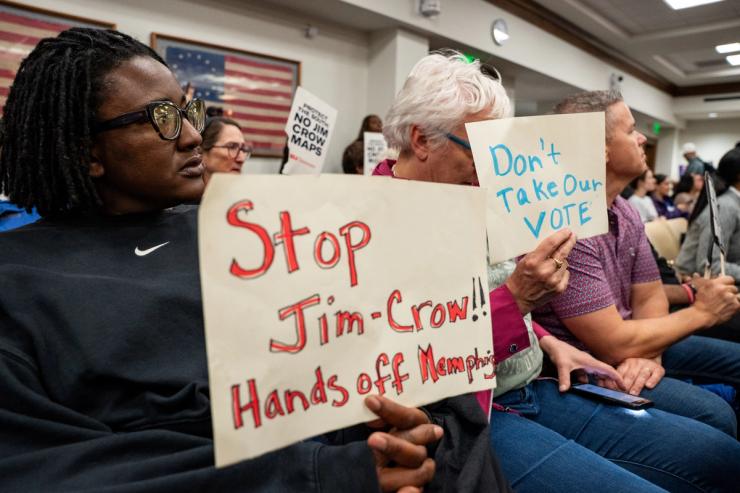
“To paraphrase Nathan Hale, I only regret that we have but one seat to take from the Democrats,” said Tennessee state Rep. Gino Bulso this week. He was gleeful about the forthcoming special session that will eliminate the Memphis-based 9th Congressional District and split the 63% Black city into multiple Republican seats.
His quote captures the near-religious confidence Republicans have about their electoral project. Their goal isn’t just winning seats in the next few elections; it’s to make a House majority impossible for the current version of the Democratic Party by undoing what they see as the errors of 1965 — the Immigration and Nationality Act and the Voting Rights Act.
So, while House Minority Leader Hakeem Jeffries has quieted some rebellious voices by campaigning for aggressively redrawn congressional maps, Democrats should be aware of how dogged their opponents are willing to get. We may be getting a picture of it in Virginia, where Louise Lucas, the state-level Democratic leader who spearheaded a favorable new map, had her office raided by the FBI on Wednesday.
In this article:

Know More
Before 1965, American elections pitted two majority-white parties against each other, with significant regional variations. Black voters comprised most of the non-white electorate; there were no Latino members of Congress outside of states that had been part of Mexico, and no AAPI members outside of majority-AAPI Hawaii.
Most Black voters lived in the South, where Democrats ran every state legislature and did not draw seats where Black voters could win.
The Voting Rights Act and its legislative updates broke the stranglehold of conservative southern Democrats, who were wiped out fully during Barack Obama’s presidency. The Immigration and Nationality Act changed who came to America — Asian, Latin American, and African migrants, whose entry into the US was limited under old rules that favored European migrants.
And the decennial Census counted new arrivals to determine congressional allocations, whether or not those new immigrants were citizens who could vote. (Republicans can overstate the effects of non-citizens getting counted for congressional apportionment, but it obviously helped the party that most non-white voters support.)
By 2020, this meant that Democrats could win just 41% of the white vote, take the Electoral College, and control the House and Senate. The safest seats in the Democratic House were majority-minority districts, which even deep-red states like Alabama were required to draw to comply with the Voting Rights Act.
All of that enabled a much uniformly progressive Democratic Party — pro-choice, pro-LGBT, pro-gun control, pro-amnesty for non-citizens — to win a governing majority. The premise of the Trump-era GOP is that this majority is a mirage enabled by law.
Take away the VRA districts, Republicans argue, and the current version of the Democratic Party can’t win the House. Halt immigration and stop counting non-citizens in the Census, and its current coalition can’t get to 270 electoral votes.
“It is hard to find pertinent evidence relating to intentional present-day voting discrimination,” Justice Sam Alito wrote in his Callais opinion.
Republicans haven’t mustered the votes to undo the 1965 bills, but Alito and the conservative Supreme Court did the job they wanted on redistricting, and the Trump administration is taking a similarly restrictive approach to immigration. Liberals see what’s happening as the “death of the fourth American republic” — the one founded in 1965, the only one with fair electoral competition.
Legislators built this system, and judges are dismantling it. At the request of Sen. Eric Schmitt, R-Mo., the Justice Department is reviewing “districts created, preserved, or defended under the old Section 2 [of the VRA] regime.” His request could speed up the redrawing of seats that underpinned the last few Democratic majorities.

Room for Disagreement
The short-term Democratic plan is to fight in court and win as many midterm votes as possible, aided by Trump’s unpopularity.
“We will not allow them to artificially hold power as a result of a racial gerrymander, a partisan gerrymander or DeSantis dummy-mander,” Jeffries told reporters at the Congressional Black Caucus’ press conference after the Callais decision was handed down. “Doesn’t matter what it is, we’re not going to let them prevail.”
Democrats anticipated the Callais decision would go Republicans’ way since oral arguments last year, and some are holding out hope that the aggressive GOP maps can get struck down in court over technical details.
If all else fails, they’ll keep contesting new southern battlegrounds; Rep. Steve Cohen, D-Tenn., told Semafor that he’ll still try to win in whatever Republicans turn his district into.

Notable
- In Mother Jones, Ari Berman laid out the liberal doomer view of the new voting rights regime. “As much as 30 percent of the Congressional Black Caucus could lose their seats.”
- On X, conservative scholar and unsuccessful Trump nominee Jeremy Carl shared the optimistic view of Callais: “If we combine this with electoral reforms like the SAVE act, it will be very, very difficult for the Democrats to have a durable House majority at any time in the 2030s.”
- In The Atlantic, Marc Novicoff predicted that state congressional elections could resemble the winner-take-all electoral college, with Indiana-style efforts to wipe out the opposition party.