




David’s view
There were many losers in Virginia’s vote to approve a gerrymandered, Democratic map.
President Donald Trump kept his super PAC wallet closed, quietly angering Republicans. Four members of House Speaker Mike Johnson’s GOP majority now face near-certain defeat in November. And Virginia Republicans, who wanted to prove that they could win again, proved that they can’t.
Democrats feel more conflicted about another loser: The editorial board of The Washington Post. The publication was an early critic of their power play, publishing take after disappointed take about the “brazenly dishonest” campaign for “fair” elections.
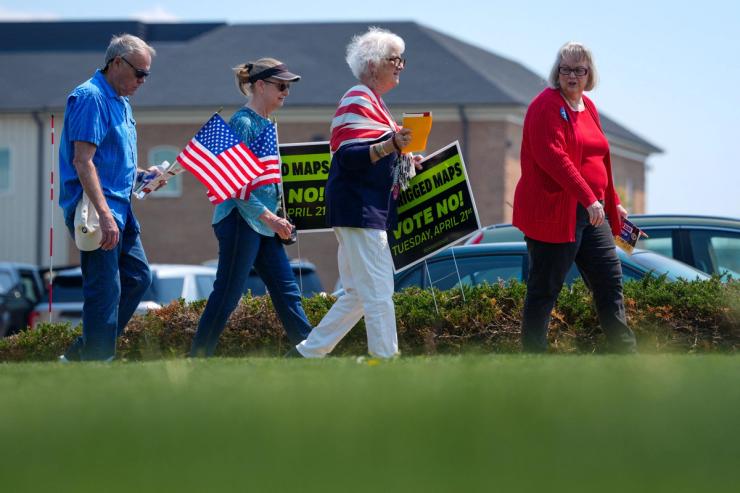
“Even The Washington Post has said the ‘yes’ campaign is, in their words, brazenly dishonest,” Former Virginia Attorney General Jason Miyares said at an April 11 rally in Rockingham County, which backed the “no” campaign by 50 points. “Think about that. The Washington Post covers DC politics, and it even shocks them!”
The argument didn’t move votes in the DC suburbs, where the Post is the hometown newspaper, and where “yes” won by a landslide. The consensus among Democrats is that a Post editorial against one of their priorities and amplified by Republicans, would have mattered five or 10 years ago. Maybe they’d have scrambled staff to figure out a response, and gamed out days of bad news cycles. Not in 2026.
“They’re very much living in the past,” Rep. James Walkinshaw, D-Va., who represents Fairfax County, told me last week. “It’s unfortunate, because I’m someone who grew up reading the print edition of The Washington Post. I feel the loss. But they’re not taken seriously anymore. And I don’t want to be negative to the people still there working on metro coverage, but they’ve walked away from that, too.”
The Post’s own story has been told and re-told, then told some more. Owner Jeff Bezos directed the newspaper to nix its endorsement of Kamala Harris. Left-leaning subscribers bolted. His publisher hired a new editorial team that pushed out liberals and hired conservatives. More subscribers quit, replacing the Post with The New York Times in their “Stand With Ukraine” tote bags.
I’ve avoided talking much about it for two reasons. One: I worked for the Post for seven years and love it with a convert’s zeal. Two: With few exceptions, media people commenting on the media makes eyes glaze over.
But this is a story about Democrats, who are adapting to the collapse in trust of traditional media and the seemingly unstoppable rise of influencers and podcasters. Some of these commentators are more partisan and friendly, and will ask questions Democrats don’t mind answering. Some have fresh, independent reputations, and their clips travel much further than a 20-minute grilling with a print reporter, or a TV station that won’t use the whole interview.
Even before Bezos made his endorsement call, and before Larry Ellison put Bari Weiss in charge of CBS News, younger voters lacked their parents’ trust in local newspapers and big media brands. High-profile decisions to cancel Stephen Colbert’s late night show and briefly suspend Jimmy Kimmel’s program convinced many Democrats that the materialist critique of “corporate media” — that it shapes stories for owners’ interest — is true.
“This is the most dangerous kind of cancel culture: The kind that comes from the very top,” Texas state Rep. James Talarico said at a rally before he won the state’s Democratic Senate primary, after Colbert told viewers that the FCC was not letting him air a Talarico interview.
“They went after Stephen Colbert for telling the truth about Paramount’s bribe to Donald Trump. Corporate media executives are selling out the freedom of speech to curry favor with corrupt politicians,” Talarico said.
Where Democrats see a heavy hand, Republicans see owners trying to balance the scales. It’s a truism, backed up by research, that college-educated liberals who don’t vote for Republicans are more likely to end up in the biggest newsrooms. Replacing that media, and driving their most liberal figures to unemployment or Substack, is a decades-long conservative project that has been accelerated by a president who agrees with it.
Democrats have their own media-replacement dreams. But they sound a little sad about the collapse of local media and the disappearance of reporters who would cover the unglamorous work of community and government without ever walking the carpet at a White House Correspondents’ Dinner. (Democrats are skipping that this year, too.)
Democrats aren’t quite becoming Republicans, who genuinely enjoy tweaking the media, but they’re evolving. Liberals are more dismissive of the press’ influence and more likely than ever before to name an outlet’s corporate owner if the coverage is bad for them. Maryland Gov. Wes Moore, who has accused the Baltimore Sun’s conservative owner of waging a vendetta against him, was almost as critical when I asked about Maryland’s other local paper.
“When I think about The Washington Post and its local coverage, this was something that people relied on,” Moore said. “It’s where they got their news from. When they gave an endorsement, it mattered, because it was generally incredibly thoughtful and did not have a partisan bent. It was just about who was the person that they felt was best able to represent voters. And it really used to matter to people, as someone who did not receive their endorsement when I first ran.”
That balance had been wrecked, he said, by “MAGA billionaires” — including Bezos, who Democrats would not have described that way before the 2024 endorsement drama. When Moore headed to Virginia to campaign for “yes” on Saturday, he was ignoring the Post’s condemnation of both the gerrymander campaign and his own effort to erase a Republican seat in Maryland. He did so with confidence that liberals were ignoring it, too.

Notable
- In The Bulwark, one of the new outlets benefiting from liberals’ declining trust in corporate media, Bill Kristol offers “two cheers” for the gerrymandering win.