




The News
BRIDGEWATER, Va. — Democrats are almost apologetic when they campaign for next week’s ballot question that could delete four Republican House seats in Virginia this fall. Republicans have a simpler pitch: How dare they?
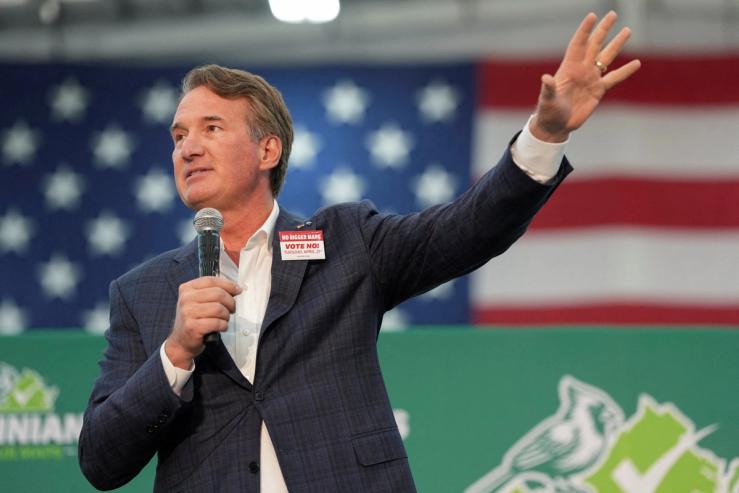
“What Abigail Spanberger has done is lie to everybody in the Commonwealth,” former Virginia Gov. Glenn Youngkin said at a Saturday rally here, 84 days after his term ended and Spanberger’s began. He called the redistricting measure “the most blatant seizure of individual rights that any of us have seen in the Commonwealth.”
The question before Virginia voters on April 21 is 40 words long, promises that the new congressional map is temporary, and claims that it will “restore fairness.” Democrats portray it as painful therapy for an “extraordinary moment,” forced upon them by President Donald Trump and his push for unprecedented mid-decade redistricting in red states to help Republicans in the November midterms.
Republicans — who first sued to stop the vote, and now hope to win it — would rather not make the campaign an up-or-down referendum on Trump’s push, which they would likely lose. They want a fight over fairness and Spanberger, the incoming governor. And if those are the terms, they think they can win.
Both parties expected a more competitive vote in Virginia than California, where 59% of voters backed Kamala Harris for president and 64% endorsed Gov. Gavin Newsom’s new map designed to punish Republicans. The president’s party is more vigorous in Virginia, where Harris prevailed by just 6 points but Spanberger won by a landslide.
The new governor’s Democratic sweep of Virginia races came days after her party announced plans for a congressional map that gives it four more winnable seats, with the blue DC suburbs overwhelming red, rural Youngkin Country.
But Republicans got off the mat quickly, forming Virginians for Fair Maps to battle the other team’s Virginians for Fair Elections. To Democrats’ surprise, the GOP went full-bore after Spanberger, effectively canceling her political honeymoon and boosting the “no” vote.

The View From Republicans
The GOP’s counterattack started even before Spanberger won. Then-Virginia Attorney General Jason Miyares wrote in a finding that it was “unconstitutional,” an effort to stop the Democratic-led legislature from starting the process. After Miyares lost reelection, state and national Republicans sued in a friendly court to halt the amendment. They won a restraining order, which was reversed; they sued again, got another friendly ruling, and another reversal.
The ballot measure went ahead, but its opponents had highlighted how fraught it was.
Republicans and friendly conservative outlets also crafted a compelling and somewhat misleading story about Spanberger: She had run as a moderate, then bait-and-switched voters.
The first part of that attack grew from Spanberger’s past takes on redrawing Virginia’s congressional maps — though the proposals were different, her opponents glossed over that to cast her as a flip-flopper.
“We had a million people vote before they decided to disenfranchise these voters,” Rep. John McGuire, R-Va., told reporters after the Saturday rally. “We have many people that will testify that they would have changed their vote if they knew that Abigail Spanberger was lying about her support for redistricting.”
Republicans’ second attack was more obscure, based on bills that were DOA in Richmond. Spanberger ran on “affordability,” like most Democrats last year, and blamed the Trump administration’s tariffs for rising prices. Her opponents responded by fixating on dozens of bills from Democratic legislators — bills that Spanberger didn’t support — and claiming that she was punishing Virginians with sneaky new tax hikes.
None of those tax increases became law in the legislature’s first session. The governor’s office even said on Monday that “the volume of misinformation” required “a clarification” that the taxes didn’t pass.
But they remain central to the GOP’s argument ahead of next week’s redistricting vote: that Spanberger is attempting a left-wing power grab she didn’t run on.
The View From Democrats
The pro-redistricting strategy has taken what worked in California: Super-charging Democratic turnout by offering anti-Trump voters a chance to hurt him. It piled up money, went on the air early, and was apologetic about the need to even do this.
“Since President Trump’s been back in office, people have said to me: ‘You’ve got to fight back,’” said state Sen. Creigh Deeds, who like Spanberger had supported nonpartisan redistricting before this year. “We’re working to make sure Virginia works right. But this is the way we can fight back.”
Democrats had less room for error, and Republicans had more money and more time to message. While Barack Obama went on the air to endorse “yes,” a Peter Thiel-funded group sent mail to Black voters, using Obama’s previous opposition to gerrymandering and warning that the new maps would disempower them.
Democrats don’t expect that to work, but they’ve been rattled by the GOP’s Youngkin-Spanberger popularity contest. A Washington Post poll last week, which found a narrow majority for “yes,” found that Spanberger’s approval rating was under 50%, the lowest for any new governor in the state’s recent history.
“I don’t want to read too much into one poll of the governor’s approval ratings,” said Rep. James Walkinshaw, D-Va., whose district will stretch down to the area where Youngkin rallied on Saturday if Democrats win. “I think once the dust settles, those numbers will revert to something that’s more typical for a governor at this point in her term.”
Spanberger appeared in a pro-redistricting ad that is now off the air, but she’s engaging more on the measure now that the legislative session is over. Her office told Semafor she would campaign in person for it this week.

David’s view
Newsom ran his campaign in a state where Republicans have been winless for 16 years. Virginia Democrats are working with a more divided electorate, opponents who’ve been winning until very recently, and a DC media market that’s been fairly hostile to their campaign.
So it’s surprising to see them verge on overconfidence about the GOP’s ability to fight back. Newsom made it look easy to turn a redistricting (or, more accurately, gerrymandering) vote into a partisan commentary on Trump. Republicans, who would have lost such a vote here, tried to make it about a new governor’s focus on maps, not the cost of living.
Here’s a truth Spanberger’s party is digesting: Voters really don’t enjoy voting on gerrymanders. (Consider that Texas and North Carolina Republicans didn’t ask the electorate before they deleted Democratic seats last year.)
And Republicans have their own painful reality: Trump started this. I was intrigued to hear Rep. Rob Wittman, another Republican whose seat could be eliminated, crediting Indiana Republicans on Saturday for doing “the right thing” by not gerrymandering.
The president and his allies are urging Indiana GOP voters, right now, to purge the state legislators who refused to turn their 7-2 GOP map into a 9-0 sweep against the Democrats.

Notable
- In National Review, Audrey Fahlberg had an early analysis of whether Spanberger was playing the vote right, and whether Democrats trusted her instincts.
- In The Atlantic, Russell Berman looked closer at the difficulty of Democrats convincing themselves and voters that they had to do something unfair in order to beat Trump.
- For Cardinal News, Elizabeth Beyer broke down the funding for the yes and no campaigns – most of it from donors whose names won’t be known until after the vote, if ever.