



The News
The rise of Bernie Sanders’ preferred Senate candidate in Michigan is frustrating moderates, delighting progressives, and testing the sway of Democratic leaders in a race that will likely determine the party’s shot at a Senate majority.
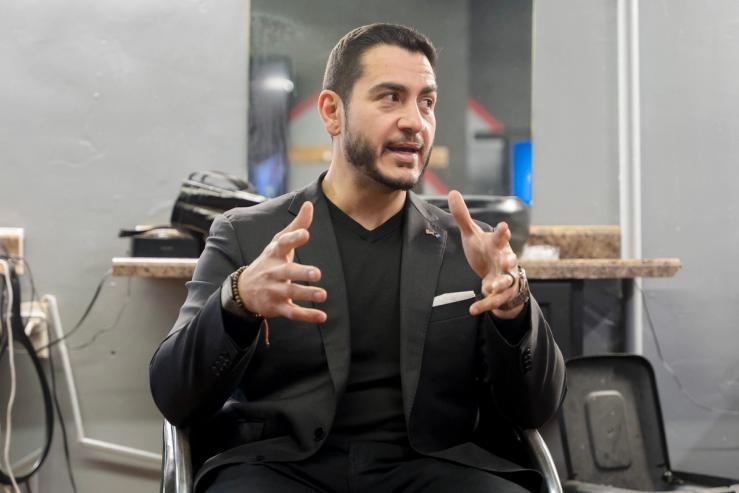
Abdul El-Sayed is gaining momentum in a divisive three-way Democratic primary with an uncompromising argument for clarity on progressive priorities — Medicare for All, abolishing ICE, and ending US military aid to Israel. The nomination is up for grabs among him, Rep. Haley Stevens, and state Sen. Mallory McMorrow, but El-Sayed is catching on with the base and just had his best poll.
Scattered general-election polling shows El-Sayed with the toughest path to beat the GOP’s consensus nominee, former Rep. Mike Rogers, whose lack of a serious opponent is letting him build his case for November ahead of the Democrats. But the party has to stay invested in Michigan, no matter who is the nominee, to keep its hopes for a Senate majority alive.
Which has left some Democrats sweating the prospect that El-Sayed prevails in August, only to get hammered by Rogers as too far left for a swing state.
“Of course,” one Democratic senator said when asked whether the party worries about El-Sayed losing in November. “Elissa Slotkin won by 19,000 votes against the same opponent. He’s pretty well-established, there’s not a divisive primary on the Republican side, and there are some really tough issues.”
Strategists who support Stevens and McMorrow said that as the state party held its convention this month, the Democratic chatter shifted from an expectation that Stevens or McMorrow would prevail to fretting that El-Sayed could win. An Emerson poll showed El-Sayed jumping into a first-place tie with McMorrow; the spiking unpopularity of AIPAC has complicated its expected involvement on behalf of Stevens.
Senior Democrats still see Stevens as the best bet against Rogers and see her as viable in the primary via her base of support in the Detroit area. Sen. Catherine Cortez Masto, D-Nev., is backing Stevens because of her support with labor and Black voters, but also because she “will focus on talking to everyone in a state like that. Not just your base.”
“That’s my concern in a primary like that. In a swing state, it is the moderate over the progressive that wins,” Cortez Masto, a former campaign committee chair, told Semafor.
Minnesota Sen. Tina Smith, who met with both the “really skilled” El-Sayed and McMorrow, said she’s heard from colleagues concerned about El-Sayed’s electoral prospects. But she urged that other Democrats’ predictions “be taken with a grain of salt,” pointing to the neutrality of Michigan’s senators.
Sanders endorsed El-Sayed on the first day of his campaign and will rally with him on May 3. The Vermont independent told Semafor that voters “want men and women who have the guts to stand up and take on big money and interests.”
“He has a good chance to win the primary and an excellent chance to win the election,” Sanders added.
McMorrow, who built a large online following after a viral 2022 speech, got the harshest social media blowback of her career after comparing left-wing commentator Hasan Piker (an El-Sayed fan) to antisemitic white nationalist Nick Fuentes. She also has the most support among sitting senators and could bridge the divide between El-Sayed and Stevens.
Sen. Chris Murphy, D-Conn., said all three candidates are “strong” but that “she’s the strongest. I think she gives us the best chance to win.”
“I’m not here to criticize any of the Democrats. I’m for Mallory because she has built a strong grassroots campaign based on her demonstrated excellence as a fighter,” said Sen. Elizabeth Warren, D-Mass.

Know More
El-Sayed’s been touted as progressives’ next big thing since his longshot 2018 bid for governor. He was followed by a documentary film crew and drew comparisons to Barack Obama; Sanders and Rep. Alexandria Ocasio-Cortez, D-N.Y., backed him early.
At age 35, he lost the nomination but grabbed 30% of the vote and stayed visible in the party.
“I always thought he’d be competitive. So that’s not surprising to me at all,” said retiring Sen. Gary Peters, D-Mich., of El-Sayed’s success so far. He and Slotkin both said they are staying out of the primary.
Democrats backing Stevens and McMorrow believe that El-Sayed has taken the wrong lessons from successful progressives. His supporters touted video of Stevens being booed at the convention, only to watch other Democrats openly resent the disruption — likening it to activists on the left who refused to vote for Democratic nominees in 2016 and 2024.
In a Monday video, El-Sayed sent his camp a message by criticizing the “unkind and unnecessary” jeering.
El-Sayed’s critics believe there’s time to define him as a risky choice. Rep. Hillary Scholten, D-Mich., who is backing Stevens, said all three candidates are qualified, but dinged El-Sayed for campaigning with Piker and said “we are continuing to see consistent polling that suggests that Haley is the only one that can win in a general election.”
El-Sayed believes he’s underestimated and ignored by Washington Democrats. He starts speeches with a concise affordability message, saying he wants “money out of politics and money in your pocket” — and his campaign believes that’s what’s helping him.
“There has been an increasing gap between what DC assumes is electable and what voters are actually responding to,” said El-Sayed spokesperson Roxie Richner. “To both energize the base and win back the voters Dems have lost, we need an authentic candidate with a clear vision for the future.”
Still, Republicans have trouble containing their glee about running against El-Sayed. Alyssa Brouillet, a Rogers spokesperson, said his success is “further proof that the far left is no longer the fringe of the Democrat Party; it is the Democrat Party.” National Republican Senatorial Committee spokesperson Samantha Cantrell said “El-Sayed’s radical wing of the Democrat Party is taking over in Michigan,” dismissing Stevens and McMorrow as “wannabes.”
“In 2024, Donald Trump won Michigan, and those same voters are not interested, I believe, in America-hating zealots. And more and more, that’s who the Democrat Party is attracted to,” said Sen. Ted Cruz, R-Texas.
Former Rep. Andy Levin, D-Mich., who is supporting El-Sayed, said tying him to Piker, whom Republicans call antisemitic, “is all a distraction and an effort to undermine a campaign” that’s picking up steam.
“He’s an Egyptian American. If he’s a Jewish American, everyone would be pinching his cheek and saying, ‘look at this young man,’” Levin said.

Room for Disagreement
Some Democrats are still smarting over the early (and subtle) preference the Democratic Senatorial Campaign Committee had for Stevens.
In an interview, Sen. Chris Van Hollen, D-Md., a former DSCC chair whose committee waded into several primaries, told Semafor that “it was a mistake for the DS to weigh in early on on behalf of Stevens.”
A spokeswoman said the “DSCC’s strategy is guided by one goal: winning a Democratic Senate majority.”

Burgess, Nicholas and David’s View
It wasn’t too long ago that the most progressive candidate in a Democratic primary like this would never take off; El-Sayed’s rise is proof that, on US-Israel relations at a minimum, the party’s norm has shifted.
And if El-Sayed prevails, it will show Democratic voters are done being instructed by their leaders. Both Stevens and McMorrow have more institutional support, although from different wings of the party.
An El-Sayed nomination will also probably make the general election more expensive and more competitive. Before Republicans gloat too loudly, though, we’d remind them the primary is three months away — an eternity in politics.