




Sam’s view
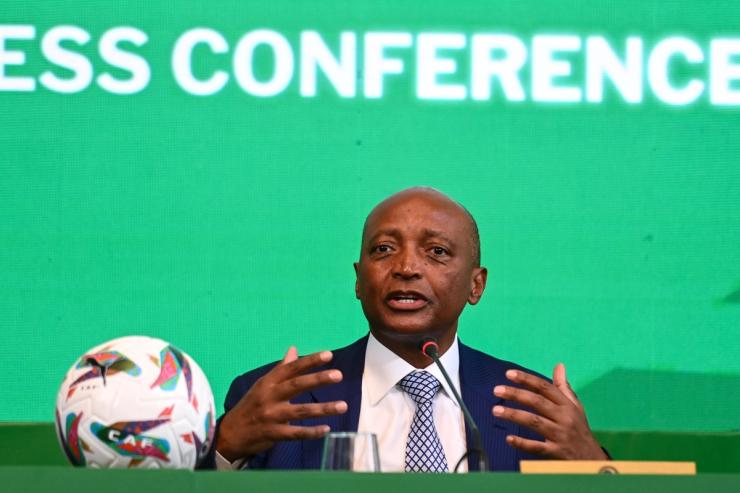
There is a question doing the rounds in South Africa’s political circles, often in lowered voices and with careful disclaimers: could the billionaire Patrice Motsepe be the man who stabilizes — perhaps even saves — the African National Congress?
Motsepe’s name as a future ANC leader often appears in fragments — in business conversations, in official corridors, in the soft intelligence that travels ahead of formal politics. The ritual is familiar: denial first, alignment later.
Through African Rainbow Minerals and African Rainbow Capital, Motsepe has built a diversified platform across mining, finance, and investment. Through his football team, Mamelodi Sundowns, he has cultivated mass appeal. And as president of the Confederation of African Football, he operates within a continental network that blends politics, diplomacy, and commercial influence.
With an estimated net worth of about $3 billion, he is not just one of the country’s richest businessmen, but a figure with unusual capacity in the ANC’s internal political economy. Leadership contests require logistics, endurance, coordination — and money: travel across provinces, accommodation for delegates, campaign infrastructure, and the quiet maintenance of networks that must hold over years.
His potential candidacy exerts a kind of gravitational pull. Recent remarks by ANC Secretary-General Fikile Mbalula about “business figures” entering politics have been read more as a signal than speculation. Within the orbit of Deputy President Paul Mashatile — a potential successor to current President Cyril Ramaphosa — the calculation is starker: if Motsepe runs, the balance shifts. Not because Motsepe is universally popular, but because he is structurally difficult to compete against.
To be fair, Motsepe doesn’t do too badly on the popularity stakes. A March survey by the Social Research Foundation shows that Motsepe has a 33.1% favorability rating, compared with 22% for Mbalula and 11.4% for Mashatile. Among ANC voters, Motsepe commands 47% support. Across all voters, he leads with 39%.
Beneath these figures lies a harder reality, however. The ANC is no longer the dominant force it once was. From the 70% it secured in 2004, it has steadily slipped, losing its outright majority in 2024 and returning to power only through a fragile, 10-party coalition stitched together out of necessity rather than design.
The question is no longer how to grow, but how to arrest decline.
As one of Africa’s oldest liberation movements in power, the ANC modeled aspects of its post-1994 system on the Indian National Congress — another omnipresent force that lost its hold. The trajectory is familiar, from India to Mexico’s Institutional Revolutionary Party: dominance, fragmentation, then a long struggle against marginalization.
That is where the Motsepe question begins to make sense. But running a political party is fundamentally different from running a corporation. Money can buy power, but on its own it is not a governing philosophy. The ANC is not a corporate entity that can be stabilized through capital and managerial discipline. It is a political organization with deep historical roots, competing ideologies and entrenched provincial loyalties — a system where financial power can shape outcomes, but cannot by itself confer legitimacy.
Sam Mkokeli is a freelance journalist based in Johannesburg, South Africa.

Notable
- Patrice Motsepe is African football’s most powerful man and could be the next head of FIFA, the sport’s global body.