




The Scoop
A successful media pressure campaign from the right torpedoed Jeff Zucker’s attempt to buy the Telegraph. Axel Springer’s Mathias Döpfner is making sure that doesn’t happen again by personally courting regulators and the country’s influential conservative political figures as he attempts to get his bid to buy the paper approved.
During a swing through London earlier this month, he embarked on a get-to-know-you tour with the British political elite, partially put together by FGS, the global advisory PR firm that is helping Axel Springer steer itself through British regulatory waters.
Two people familiar with the conversations said the German media mogul sat down with Kemi Badenoch, leader of the Conservative Party, and Peter Kyle, secretary of state for business and trade. Both conversations were aimed primarily at ensuring that the path to regulatory approval would be swift after years of uncertainty around the Telegraph’s ownership, these people said.
But the meetings were also about Döpfner ingratiating himself to the right-of-center political leaders that make up some of the UK broadsheet’s audience (and source base). He sat down with Nigel Farage, the leader of the pro-Brexit Reform party, and got together with Boris Johnson, a former prime minister and conservative media figure, according to people familiar. (Johnson’s meeting in particular sparked interest among the London media set; the former PM is currently a columnist at the Daily Mail, which unsuccessfully bid for the Telegraph before Axel Springer swooped in.)
A spokesperson for Axel Springer confirmed to Semafor that the meetings came after the billionaire’s visit to the Telegraph offices, where he introduced himself to the paper’s staff.
In this article:

Max’s view
Over the last several months, Döpfner has worked to ensure that his presence is felt, quite literally, among the right-of-center leaders across Europe and the US.
Earlier this year during a swing through Washington, Döpfner stopped by the White House for a meeting with President Donald Trump’s chief of staff, Susie Wiles.
While Döpfner is no stranger to mixing it up with global political and business elite (his average week is stacked with meetings with famous musicians and business leaders, many of whom end up posing for photos or participating in podcast interviews with the towering German billionaire), there’s a strategy to keeping close relationships with the political right, which has made media-bashing a key pillar of its ideology.
Döpfner’s media companies have occasionally found themselves the target of political controversy, such as during DOGE’s successful push for Trump’s federal agencies to cancel their pricey Politico Pro subscriptions. The company is still reeling from the ramifications of that decision: In a meeting earlier this year, Politico’s leadership said the news organization has not seen federal government subscriptions return in a “meaningful way” after DOGE pressure forced many agencies to cancel their Politico Pro subscriptions.

The View From Berlin
After years of looking under the hoods of most English-language media companies (at least, the ones for sale), Döpfner finally landed on a deal that he liked in the Telegraph. The paper’s centrality in the British media market elevates Axel Springer to being a major player in the UK. It also offers another opportunity to grow in the US; the Telegraph, like many British media companies, has in recent years looked across the Atlantic for expansion opportunities.
Publicly and privately, Döpfner has said he is interested primarily in digital media properties, not legacy media projects that would require major transformations. But despite his vocal disinterest in acquiring old legacy brands, the Axel Springer CEO has repeatedly attempted to do the opposite. The company tried to buy the Financial Times before purchasing Business Insider in 2015, and has expressed interest in The Wall Street Journal and even other legacy news organizations like CNN.
One person familiar with the rationale behind the deal said the company saw the Telegraph as something in the middle: a prestige legacy outlet with a solid digital business that would not need a dramatic transformation to make it an even bigger player in global media, with a reliable audience in the UK to fall back on.
Telegraph staffers have viewed Döpfner with cautious optimism. They’ve grown weary from a brutal yearslong sale process that left the paper in limbo at a moment when competitors are aggressively expanding. While he is not as well known in the UK as he is in United States media circles, Döpfner is seen as a heavyweight whose papers in Germany exist on a similar ideological footing to the center-right Telegraph.
Still, there may be some awkwardness. Axel Springer has made pro-European, pro-markets and free trade a cornerstone of its editorial view, while the Telegraph has been critical of the European Union and was one of the most notable UK media outlets supportive of Brexit.
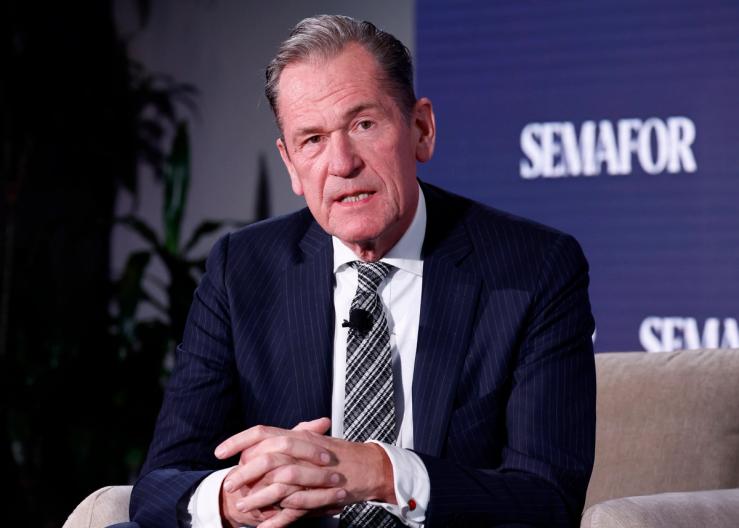
When I asked him about this seeming discrepancy at Semafor’s Trust in Media event in February, he downplayed the differences between the Telegraph’s UK isolationism and the aggressively pro-European viewpoint that Axel Springer has staked out.
“We have a very clear stance: We are believers in centrist politics,” he told me. “We think that freedom of speech and freedom of expression is a fundamental part of that. So we should not narrow the corridor of public discussions. We should widen it.”