




The News
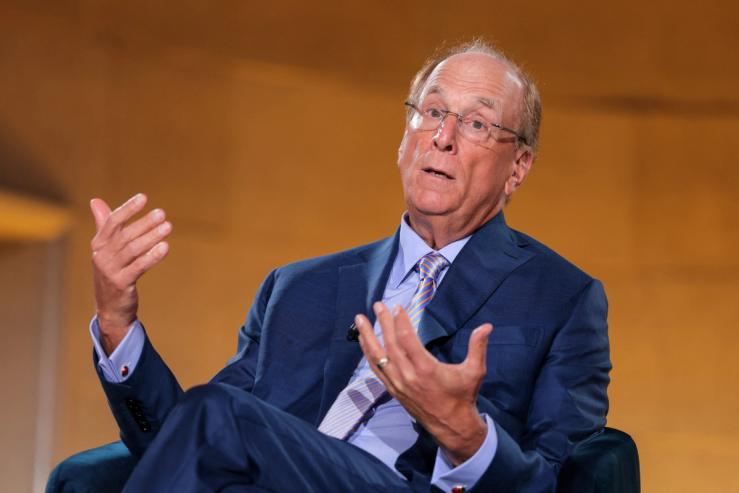
Global economies’ hawkish pivot will require investors to stop seeking financial profits around the world and deploy more money at home, said BlackRock CEO Larry Fink.
“Self-reliance is costly,” he wrote in his annual letter to shareholders, a dispatch closely read across the financial world. “There’s a natural logic to making sure more of [the money] comes from domestic investors.”
Building out AI, energy production, and national defense will cost more than debt-strapped governments can pay for, and bank savings won’t be enough, Fink said. He said private investment will fill the gap and suggested that governments explore ways to nudge more of that money to stay local.
“For decades, capital chased returns around the world — often without enough benefit to the people back home. Money should still move freely toward opportunity,” he wrote. “But it doesn’t mean countries can’t also do more to help channel capital into their own growth.”
In this article:

Know More
Wall Street and Silicon Valley are voluntarily putting trillions of dollars into building America’s energy and defense sectors; see JPMorgan’s Security and Resiliency Initiative or Andreessen Horowitz’s American Dynamism fund. The Pentagon is hiring investment bankers to scout national security deals and marshal (presumably American) sources of capital to finance them. But the UK has tried for years to nudge its pension funds to buy British stocks without much success, and China relies heavily on capital controls to keep its money invested locally.
Fink sees retirement accounts as a key source of investment. The Trump administration is working on a proposal to allow 401(k) plans to own nontraded products like real estate and infrastructure — though that effort has been delayed by concerns, voiced by Treasury Secretary Scott Bessent, that individual accounts might become a “dumping ground” for assets Wall Street is having trouble selling.

Liz’s view
The world Fink describes is a less efficient and more expensive one. It adds redundancy and moves economic activity away from the lowest-cost providers. The US is restarting its copper mines not because American copper is the cheapest in the world — it isn’t — but because it’s here. The same goes for its efforts to push Intel to manufacture chips here, instead of the US relying heavily on Taiwan. European governments that don’t trust NATO to protect them will spend billions of dollars remilitarizing.
Fink articulated this in late 2024, when he said — at an investment conference in Saudi Arabia, which is busy redirecting its own capital back home — that “we have government policy that is much more inflationary, whether it’s immigration, our policies of onshoring. No one is asking the question of: ‘At what cost?’”
Ironically, the US, the most rabidly free-market country in the world, may be the beneficiary of a more balkanized and politicized global economy that President Donald Trump is doing much to spur, simply because it has more money to put behind its own priorities than developing nations do.

The View From Larry Fink
Other takeaways from the letter:
- Nothing to see here: Fink avoided mention of the current wobbles in private markets, where concerns about bad loans are rising and retail investors are rushing to pull their money. BlackRock last year acquired private-credit giant HPS and managed $676 billion of alternative assets as of year-end. Fink reaffirmed the firm’s plans to raise another $400 billion by 2030.
- Pensions for all: Trump’s efforts to expand the federal workers’ public pension would “let people grow their benefits along with the broader economy.” He suggested he’s in favor of administration and congressional efforts to complement — not replace — Social Security, which only owns ultrasafe Treasury bonds but grows more slowly than the economy as a whole.
- AI riches for more: “There’s a real risk artificial intelligence could widen wealth inequality if ownership does not broaden alongside it,” he writes. Five-year-old Anthropic is as valuable as Google was at 15 and Amazon was at 22, long after those companies had gone public. Allowing individuals to buy into these companies is the only solution, though as London Stock Exchange Group CEO David Schwimmer told Semafor last year, it may already be too late. “Those early gains [are] gone,” he said.

Notable
- Bridgewater’s investment team coined the term “modern mercantilism” last fall to describe the government-led push for autarky.