




The Scoop
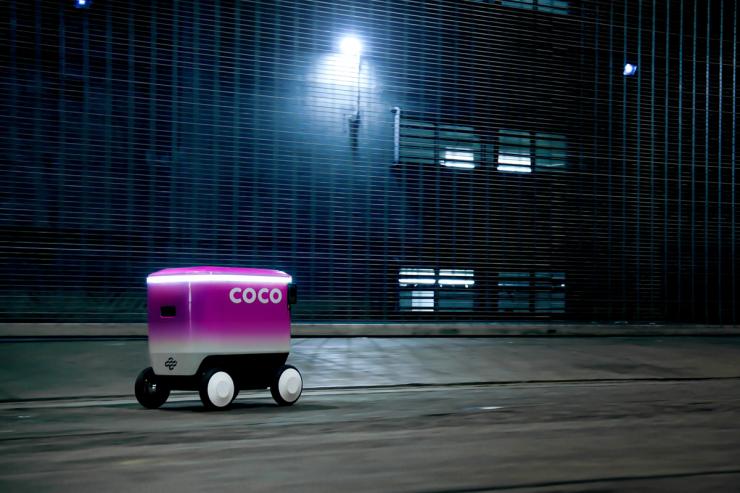
Delivery robot creator Coco Robotics is launching its next-generation bot that operates fully autonomously rather than leaning on remote human drivers, and it can move across new terrain, the company exclusively told Semafor.
The new Coco 2 robot will be able to branch out from the sidewalk onto streets and bike lanes, where legal and appropriate. They can travel up to 13 miles per hour on those terrains, much faster than their sidewalk speed. To avoid significant disruptions in traffic patterns, the company tracks congested areas in real time using on-board sensors and human workers, and the robots prioritize routes with the best infrastructure and lowest traffic.
Having smarter, fully autonomous robots means Coco Robotics can deploy its bots in more neighborhoods and at a lower cost than what consumers would pay for traditional delivery services — with availability during extreme weather, late at night, and when it’s difficult to get human workers, the company said. The new models are more durable in snowstorms, floods, and hurricane-level winds, situations that have drawn the public’s attention and tested the technology in the past. But the expansion also means neighborhoods will share spaces with robots where they haven’t previously inhabited, forcing people to change their expectations of urban norms.
“While it is challenging, and we need to take safety incredibly seriously, and we need to make sure the technology is ready before we start using the roads, it’s important that we ultimately solve that for our customers and for cities long-term,” CEO Zach Rash told Semafor.
The company has also added multiple compartments — up to six — that open to different customers, allowing more deliveries to take place through one robot.

Know More
Coco currently operates in several US metro cities and one location in Europe, but it plans to expand further in those regions as well as Asia, Rash said. When preparing to launch in a new city, the fleet of robots spend roughly one week driving around, mapping out the sidewalks, ramps to the road, and obstacles like construction zones, poles, and narrow paths.
Expanding in Europe and Asia means competing more closely with Chinese companies, which are broadly seen as more advanced in robotics, and their manufacturers have benefited from state subsidies. US robot firms are also poised to get additional support from the government as a result.

Step Back
Coco 2 runs the latest version of Nvidia’s Jetson computing platform, which allows it to run large models more closely to the robots. Additional Nvidia software also allows the robot to practice navigating a digital replica of the city, before it interacts with any real humans or moving objects on the sidewalk.
It’s the same platform underpinning many of the robotics firms operating in the physical AI space, from safety-monitoring cameras in manufacturing spaces to general-purpose humanoids, said Amit Goel, Nvidia’s head of strategic robotics partnerships. Competing delivery robot firm Cartken also uses Jetson, he said, showing the broad reach of Nvidia’s robotics architecture.

Rachyl’s view
It’s a robot’s world. We’re just living in it.
Walking around New York City this week post-blizzard, it became apparent that some of the biggest hurdles facing delivery robots are human activity and Mother Nature. Walking paths are overrun with piles of snow, and though neighboring stores and residences are required to shovel, it doesn’t always get done, creating accessibility issues. While Coco is retrofitted to operate in the snow and ice, it would need legs to climb these mounds.
In terms of operating on roads, any attentive driver should be able to see the brightly colored robots with flags and maneuver safely around them. But the reality of distracted drivers makes it easy to imagine a series of accidents that aren’t necessarily fatal, but annoying nonetheless.
Still, robots are being integrated into human spaces, and that is only likely to accelerate. Robot companies are going to do what they can to operate safely and efficiently, but there’s an element of human behavior that needs to be addressed for robots to operate at their best.

Room for Disagreement
In a true domino effect, the answer could in fact be: more robots. Reflex Robotics posted a video of its general-purpose robot shoveling snow outside its Brooklyn headquarters this week.

Notable
- The delivery robots aren’t welcome by all. Some residents have vandalized the bots and taken to signing petitions to get them off the streets, the Economist reported.