




Andy’s view
After rolling across Southeast Asia, Europe, and Latin America, the Chinese electric vehicle juggernaut is targeting the US. Its arrival could be a salvation for America and its auto industry.
Wary of the apparent security risks these internet-connected devices pose, policymakers in Washington have maintained sky-high tariffs on China’s EV makers to keep them out, just as they’ve excluded Chinese solar panels, drones, and surveillance cameras.
EVs, however, are different, and Washington’s diagnosis of the problem they pose, how to address it, and the stakes of Detroit falling behind in the global EV race, illustrates how deeply it risks misunderstanding China.
Detroit’s early efforts to make EVs fizzled, resulting in $50 billion of investment write-offs. Among the many problems that caused this wipeout — too few charging stations, an end to purchase subsidies, resistance from dealers — one stands out: US carmakers offered so-so quality EVs at a premium price. Consumers walked away.
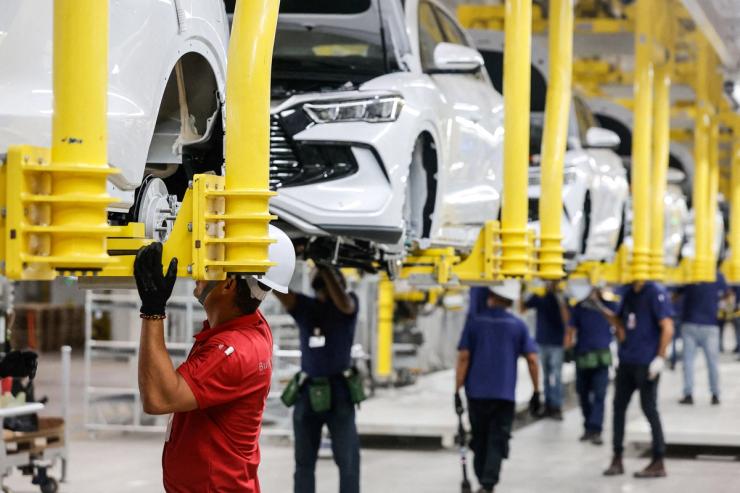
Chinese EVs aren’t just cheaper, they’re often better. The Wall Street Journal’s recent review of the Xiaomi SU7 Max gushed that it was a spacious family vehicle with an “absurdly large” infotainment screen, wireless karaoke mics, a backseat mini-fridge, and stunning acceleration. Yet the car is unavailable in the US, except with a temporary permit. The review’s headline? “I Test Drove a Chinese EV. Now I Don’t Want to Buy American Cars Anymore.” The punchline: In China, SU7 Max, a luxury car, sells for $43,000; in the US, the average car costs more than $50,000.
Stephen Rattner, the US “car czar” who helped save General Motors and Chrysler during the 2008 financial crisis, points out that price differences of this kind add up to big numbers in the huge US market: If the roughly 16 million cars sold each year in cost $10,000 less, that would save buyers $160 billion.
To compete with cars like the SU7 Max, Detroit will have to learn how they’re made. That will require teaming up with Chinese players.
Big Pharma has figured this out; when lives are at stake, second-best won’t do, so Western pharmaceutical giants are licensing innovative therapies for cancer and other diseases that are pouring out of Chinese labs, even as these US and European firms invest more in their own R&D. Critics argue this creates dangerous dependencies. But as Pascal Soriot, the CEO of AstraZeneca, told Semafor’s Andrew Edgecliffe-Johnson: “If we don’t compete with Chinese companies, we’re going to lose.” Collaboration and competition, he says, go together. Detroit must do both.
The US more broadly is in a strategic bind: Its chief geopolitical nemesis has built a centrally organized industrial ecosystem, with dense and interlocking supply chains, one which produces world-beating products at prices no other country can match. But keeping them out risks American firms languishing, failing to innovate against the products that are setting the standard worldwide.
Without a world-class EV industry, the US will also fall behind on other, related technologies critical to national security. Take, for example, the batteries that are essential for modern industry and warfare. In Ukraine, battery-operated drones keep Russian invaders at bay. Modern combat troops use batteries to power walkie-talkies, night-vision goggles, and satellite communications.
In the end, a US auto industry focused on high-priced gas-guzzling trucks and SUVs will wind up technologically marooned in a world racing at speed toward an EV future. More than half of all new cars sold in China are now electric.
There is some prospect of a shift on the horizon. At a summit in Beijing in April, Chinese leader Xi Jinping will be pressing US President Donald Trump to lower tariffs, drop Chinese companies from US blacklists, and relax curbs on semiconductor sales. For his part, Trump has hinted he’d like more Chinese investment: In Detroit recently he said he’d “love” to see Chinese carmakers opening factories and creating jobs in America.
A deal on EVs could model a more sustainable US-China economic relationship. Of course, it will take hard bargaining: China won’t easily hand over its intellectual property, a necessary condition of market access along with local content rules and, possibly, minimum pricing for imports; the US will be wary of American automakers being caught off guard by sudden, new Chinese competitors. Finding technical fixes to protect national security from connected Chinese vehicles — and, for that matter, Chinese fridges, washing machines, and home security equipment — will also be difficult, though not impossible.
Perhaps a tougher challenge will be persuading skeptical US politicians of the benefits of Chinese investments; Ford’s multi-year deal with Chinese battery giant CATL to license its technology created a political storm, resulting in wrangles over tax credits and other government incentives.
Ultimately, it may take a consumer rebellion — or the prospect of industrial collapse — to change their minds.

Room for Disagreement
Rush Doshi, a Biden-era National Security Council official, views China as an economic predator that has built an industrial base through protectionism, massive subsidies, forced technology transfers, and outright theft of US intellectual property – a $1 trillion heist over the years. The correct response, in his view, is even tighter controls on Chinese investments in the US, and closer collaboration with friends and allies to build industrial scale. Doshi told a US Congressional hearing that, “If we pool our markets, protect our technology, coordinate our research, and create defensive barriers to PRC excess capacity, we can handily weather the ‘second China shock,’ reindustrialize, and lead in technology.”