




The News
Cantor Fitzgerald is rejecting claims that it sold a product that would pay off if the Supreme Court ruled, as it did Friday, against tariffs imposed by the Trump administration, where Cantor’s founder is Commerce Secretary.
Wired reported in July that Cantor was among the Wall Street firms pitching a financial product tied to the outcome of the Supreme Court case. It cited an email sent by a Cantor salesman that said the firm had “already put a trade through representing about ~$10 million” of tariff-refund rights “and anticipate[s] that number will balloon in the coming weeks.” Two Democratic senators called for an investigation and the CEO of one of the country’s largest import-logistics firms amplified the story.
Cantor’s founder, Howard Lutnick, is Trump’s Commerce Secretary, and the firm is run by his two sons. The elder Lutnick announced the sale last year of his stake in the firm to them and other investors.
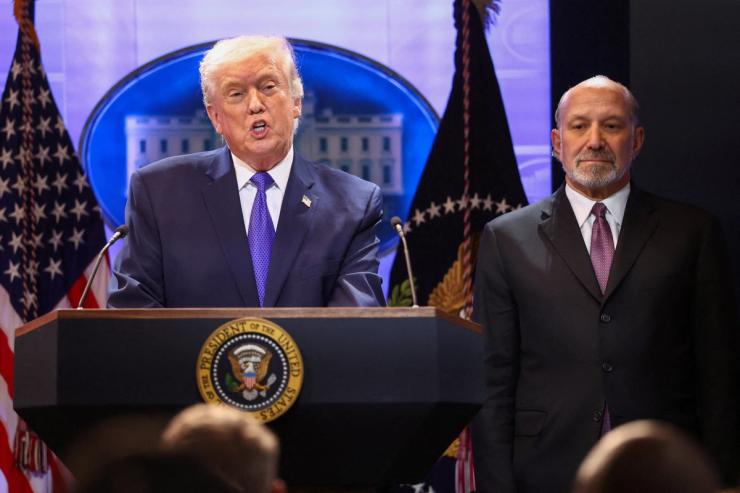
The Supreme Court on Friday invalidated many of Trump’s tariffs, a ruling that ignited criticism of Cantor’s activities from widely followed finance accounts and the left-leaning The New Republic. The president said at a White House press conference, flanked by Lutnick, that he would reinstate the tariffs on different legal grounds.
Cantor did consider the product — which has existed for years and was a humming trade on Wall Street during Trump’s first-term tariff push — but decided against it after weighing the political sensitivities, according to a senior banker familiar with the matter.
A Cantor spokesman said the salesman “erroneously” believed that the firm was likely to greenlight the business, then went out looking for the other side of the trade. “Cantor Fitzgerald has never executed any transactions or taken risk on the legality of tariffs,” he said. “Any report suggesting otherwise is completely false.”
In this article:

Liz’s view
This appears to be rooted in a common Wall Street practice: A salesperson gets an inbound bid and goes out to gin up the other side of the trade, ideally first checking with higher-ups to make sure this is business the bank wants to do.
Ironically, this is business Cantor should have been doing. It bought and sold claims during the collapse of crypto exchange FTX in 2022 and is active in the broader universe of financing legal-risk trades. Connecting companies that might be owed tariff refunds to hedge funds that are willing to buy those future payments at a discount is what investment banks do with their time.
The fact that Cantor didn’t suggests it’s keenly sensitive to the optics of Lutnick’s role. Trump critics and the media have documented plenty of cases of self-dealing around the Trump White House, but this doesn’t appear to be one of them.

Room for Disagreement
Cantor has clearly benefitted from its ties to Lutnick, becoming a big underwriter of deals aligned with the administration’s crypto, AI, energy, and national security agenda. As the lead banker to, and investor in, stablecoin company Tether, it holds billions of dollars of Treasury bonds, which has brought criticism from Bill Ackman and others about a conflict of interest. (Trump’s pressure on the Federal Reserve to cut interest rates would make existing bonds more valuable.)

Notable
- Cantor’s 250 dealmakers earned more than $1 billion in revenue last year, a firm record and four times as much, per head, as the average Wall Street firm.
- Conflict-of-interest criticism has dogged Lutnick since before inauguration, when as Trump’s transition co-chair, he allegedly used meetings on Capital Hill to push matters impacting Cantor Fitzgerald, including crypto deregulation, Politico reported in 2024.