



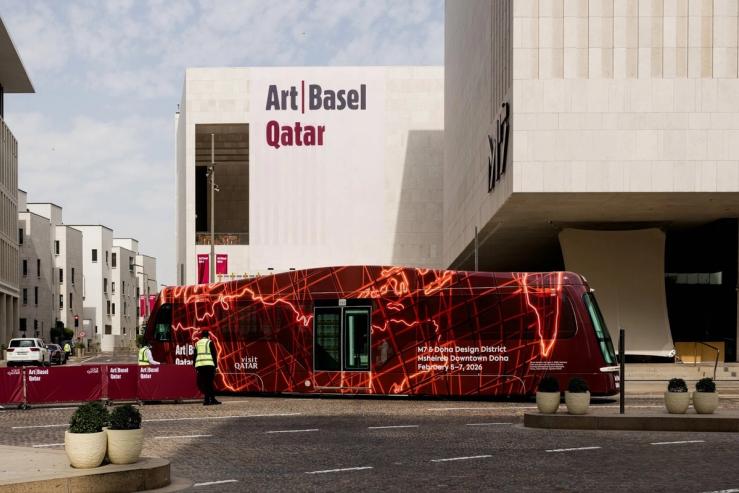

The Scene
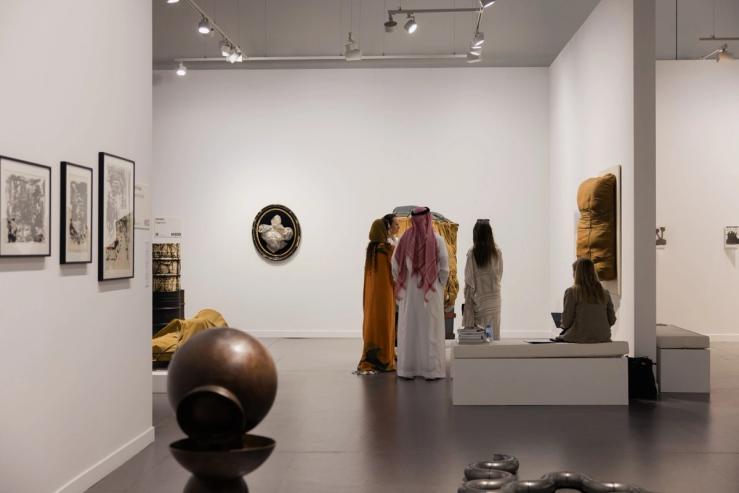
At Art Basel’s first Middle East edition in Doha, the usual choreography of an art fair felt strangely absent. No desks stacked with laptops, no hurried haggling over prices in tight booths, no sense that collectors were racing against the clock.
Instead, the fair read more like an exhibition: visitors wandered through open-plan galleries where single-artist presentations unfolded like small museum shows. Amid Picassos and Basquiats hung photographs of the Kaaba and works by regional artists such as Ahmed Mater and the self-described “non-commercial” Lina Gazzaz.
The shift was deliberate. For the first time in any Art Basel edition, an artist — Egypt’s Wael Shawky — was appointed to curate the fair. His theme, Becoming, explored transformation and identity, and the structure followed. Each gallery was limited to one artist (a format that is novel to Art Basel), and transactions were moved to private exhibitors’ lounges away from the floor.
The inaugural edition brought together 87 galleries and 84 artists from 31 countries, with more than half of the participating artists being from the Middle East and South Asia. Globally renowned galleries such as Gagosian, Hauser & Wirth, and White Cube appeared alongside regional peers like Qatar’s Al Markhiya and Saudi Arabia’s Hafez Gallery.
In this article:

Manal’s view
Doha hosted an art fair that understood where it was. It didn’t try to be Miami or Basel, and the format acknowledged a simple truth: The Gulf art market is still in its early stages. For many visitors, this was their first encounter with an international fair of this scale, and the organizers designed around that reality rather than pretending otherwise.
“This is a young ecosystem, and with that comes the opportunity to reimagine traditional structures,” Saudi artist Manal AlDowayan, whose work spans collaborations with Dior and installations at the Venice Biennale, told Semafor. “Usually, art fairs can feel a bit overwhelming, they’re hectic and massive, and artworks don’t always get the space they need to really come alive. But Art Basel Qatar felt different.”
Removing transaction desks from booths and pushing business into discrete lounges was more than a curatorial gesture. It reflected the cultural nuance of how deals often happen in the region: through conversations in a majlis rather than public negotiation. The lounges — high-end and intentionally private — became the fair’s commercial engine while allowing the main halls to remain calm and approachable.
International dealers viewed the week as an introduction to a new audience. “It takes the sales pressure out of the conversation,” Charlotte Panis, director of sales at New York-based David Kordansky Gallery, told Semafor. “We’re all participating here because we see potential in the long term.”
Globally, collector behavior is shifting. A recent Art Basel-UBS report noted that younger buyers increasingly value meaning and cultural alignment over pure prestige. The Gulf has already shown early signs of that change. At Sotheby’s Riyadh auction last week, a painting by Saudi pioneer Safeya Binzagr sold for more than a Picasso did.

Room for Disagreement
 Courtesy of Art Basel
Art Basel’s leadership rejected the idea that the calm atmosphere meant a lack of commercial seriousness. “We are a commercial platform,” CEO Noah Horowitz told Semafor. “No number of new connections and positive contextual experiences works over the medium to longer term without generating commercial outcomes, and by commercial outcomes I mean selling art.”
Horowitz said the museum-like feel was intentional. Limiting galleries to single-artist presentations and removing desks was meant to prioritize engagement first. “We want people to look and appreciate and see relationships with artists unfiltered,” he said. “But that is what we’re here to do to build a market.”
He predicted that sales would unfold gradually in the coming weeks rather than happen immediately.

Notable
- Art Basel Qatar arrives as global art sales remain sluggish, pushing dealers to look beyond the saturated markets of the US and Europe toward the Gulf’s wealthy-resident and expatriate base.