




The News
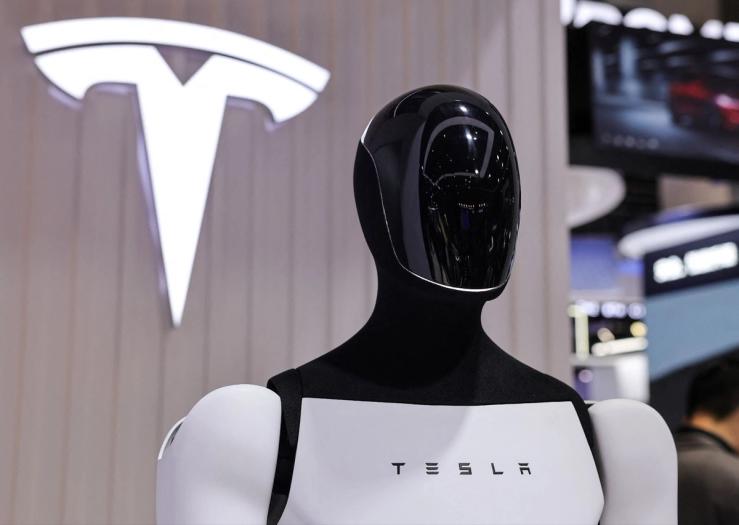
Elon Musk’s Optimus robots have been spotted handing out candy in New York City’s Times Square and serving popcorn at the billionaire’s Tesla-inspired diner. But the faceless, industrial robot isn’t exactly disarming.
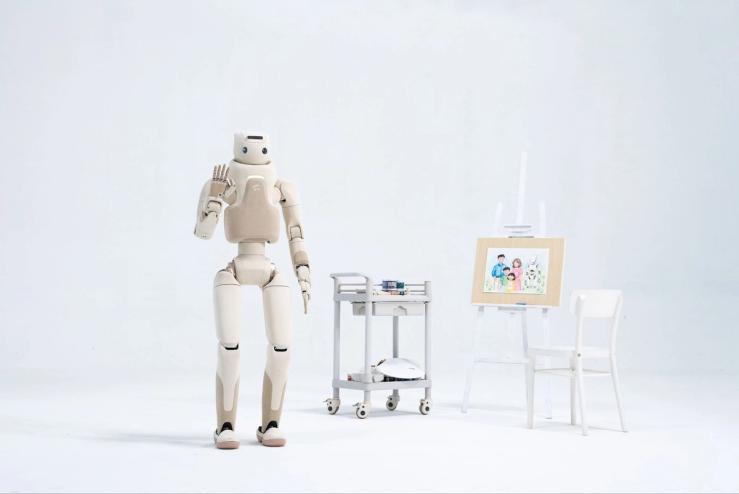
Trying to change that are companies like Texas-based Apptronik and China’s Fourier, which are designing a new generation of humanoids with approachability in mind. In a bid to engender connections between humans and the bots, companies are designing robots with more emotive eyes, smiles, and subtler features intended to evoke feelings of warmth and positivity.
“If people continue to fear them, they’re not going to embrace the robots,” said Jeff Cardenas, CEO of Apptronik.
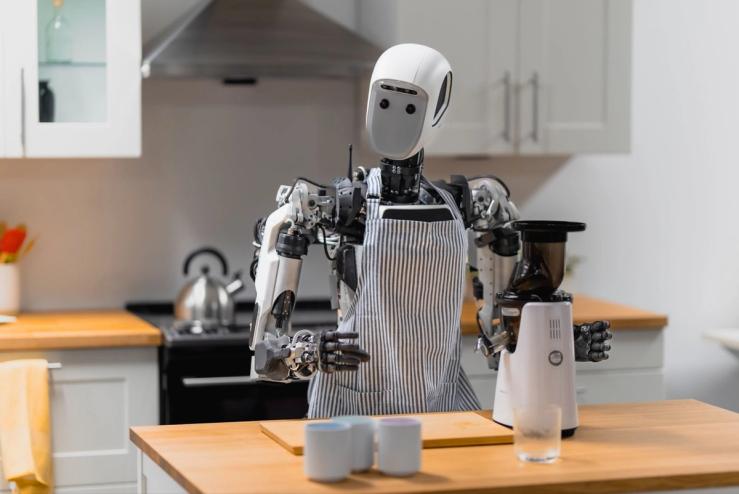
The company’s latest robot, called Apollo, has a flat face with two cameras for eyes. Instead of a mouth, a screen delivers information, and a brain-shaped cutout through the center of the head serves to cool the compute inside. Anthropomorphizing “is something we naturally do, and you have to lean in,” he said. “If not, the robots will feel cold.”
 Courtesy of Apptronik
In this article:

Know More
The tech industry has pounced on the idea that robots will soon be sophisticated enough to replace humans in a host of tasks, with more than $3 billion in venture funding going to humanoid development last year. Tesla — a top humanoid developer in the US — is so bullish on the sector it’s shifting its long-term business away from cars and toward robots, linking Musk’s own compensation to the development of the latter.

But to reach mass adoption, companies are going to have to create robots people actually want to be around.
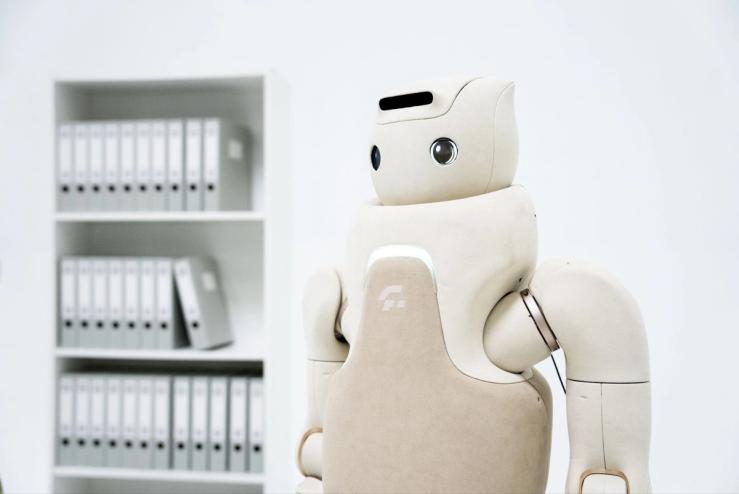
Fourier’s “care-bot,” intended for companionship and at-home help, is designed with two eyes to convey emotions like “friendliness, curiosity, hesitation, or excitement, making interactions feel more natural, intuitive, and emotionally engaging,” a spokesperson said. “Eye contact plays a crucial role in human communication.”
The care-bot’s exterior is also softer to the touch than the humanoids designed for industrial tasks, with upholstery and foam padding. The company shortened the robot by four inches compared to its other models, because testing revealed robots taller than 5 feet and 6 inches created feelings of “physical pressure and intimidation,” it said.
 Courtesy of Fourier
Room for Disagreement
Robots’ real-world efficacy and scalability have yet to be proven, with viral videos of humanoid failure all over the internet. Making robots look more like humans isn’t going to make the machines any better at performing physical tasks, said Guy Hoffman, a Cornell University professor who studies human-robot interaction.
“Walking is difficult. If you’re in a warehouse, you probably want a bottom-heavy, wheeled robot to lift heavy objects,” Hoffman said. “That’s why forklifts don’t have two legs.”
 Maxim Shemetov/Reuters
 He also said efforts to add human features like eyes are inappropriate, calling faceless robots like Tesla’s the most “honest” design. “It should be approachable like an elevator is approachable. You don’t want to feel like you’re going to die going into an elevator,” but it doesn’t need to be “cute,” he said.
Some companies have intentionally avoided humanizing features on their robots to curb users’ anthropomorphizing of the bots.
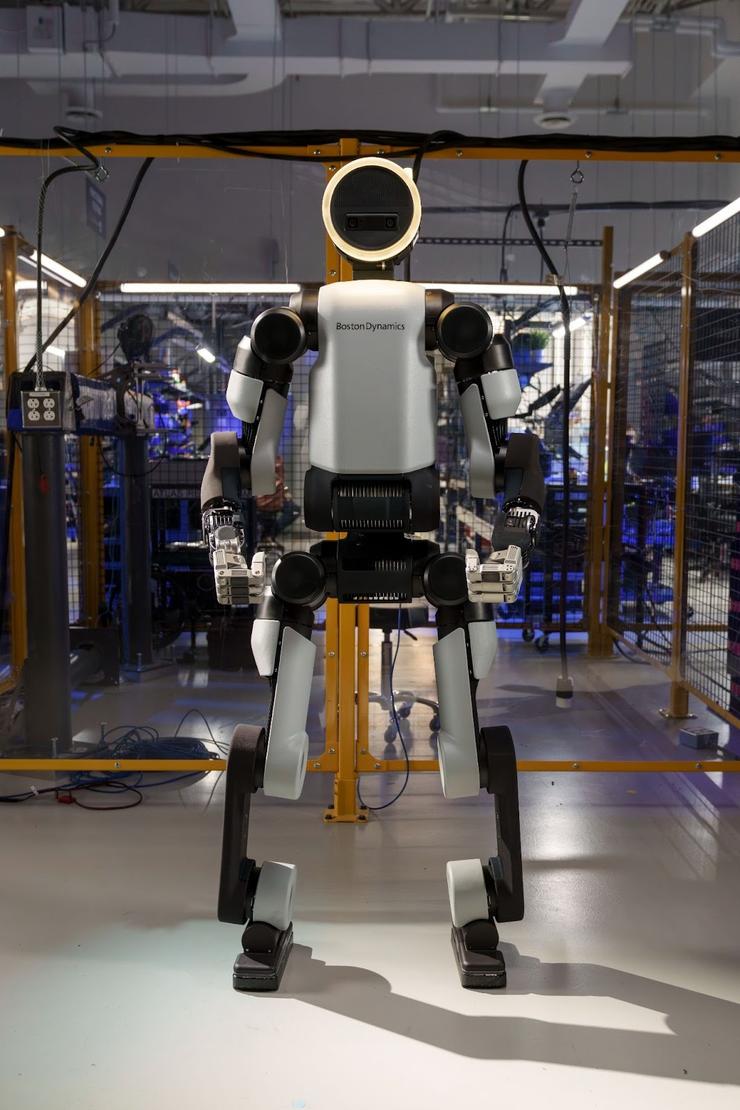
Boston Dynamics’ latest design, called Atlas, used in car manufacturing and other industrial applications, has no eyes. Its head doesn’t resemble the shape of a skull, like most other humanoids, but instead a cylinder with a flat face encircled by a ring of light. It is meant to function like the lens of a camera, with the movement indicating where the robot is looking and what it’s about to do, according to the company’s Director of Robot Behavior Alberto Rodriguez.
 Courtesy of Boston Dynamics
 Atlas can also spin its torso, head, and limbs a full 360 degrees, which expands its range of motion when moving items in a warehouse setting. For example, if Atlas picks up a large car part to transport, rather than taking steps to turn around with it, it can rotate its torso to the opposite direction and begin walking “backwards.”
Parts of its limbs are connected horizontally at the joints with actuators — which make the parts move — giving it a clunkier feel than other robots whose arms and legs extend linearly from their bodies.
“We wanted to do the best we could to remind people Atlas is a robot,” he said, noting this design saves the company time and money on parts, assembly, and repair.