



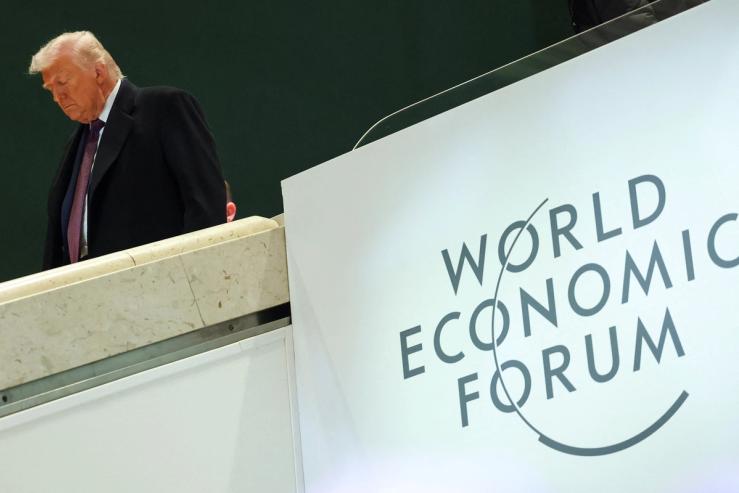

The News
A year ago in Davos, Nasdaq’s President Tal Cohen explained to me the value of proximity to Donald Trump: “The last voice in the room is the most impactful.” Back then, pilgrimages to Mar-a-Lago and cameos at the inauguration were, CEOs thought, a way to influence the president, whose bid-ask approach to governing endeared many in the business community to Trump during his first term. Show up, say the right things, shape policy.
A year later, that two-way radio has become a megaphone. There is still value in showing up, but any hope of influence is gone. “Being in the room enables me to get that feedback,” on what clients can expect on issues like tariffs, Tim Walsh, chair and CEO of KPMG US, told my colleague Andrew Edgecliffe-Johnson this week, but “I’m not sure we’re getting new information.” Or as GE Vernova CEO Scott Strazik said on stage at Semafor Haus: “I’m always just trying to listen.” Trying to “find opportunities” to plug into the White House’s agenda means “listening carefully and consistently, and find[ing] that pattern recognition as best you can,” he said.
Real influence over Trump costs money, if it’s available at all. The best executives and investors can do is try to separate signal from noise. Markets are getting better at that: pre-pricing in the TACO trade, for example, explains the lack of market swings on swing-worthy headlines. But it casts masters of the universe as passive participants in what many had expected to be a bustling marketplace for influence-peddling.

Notable
- In an on-stage interview with Semafor’s Ben Smith at Davos Thursday, California Gov. Gavin Newsom brandished ‘Trump Signature Series’ kneepads for CEOs and politicians who were ‘selling out’ to the president.
- Although the president has unsettled some business leaders with his threats to acquire Greenland, “many bankers still argue, however, that M.&A. will go up this year, and that the gloomy talk is a distraction, not a threat,” Andrew Ross Sorkin wrote in The New York Times.