




Yinka’s view
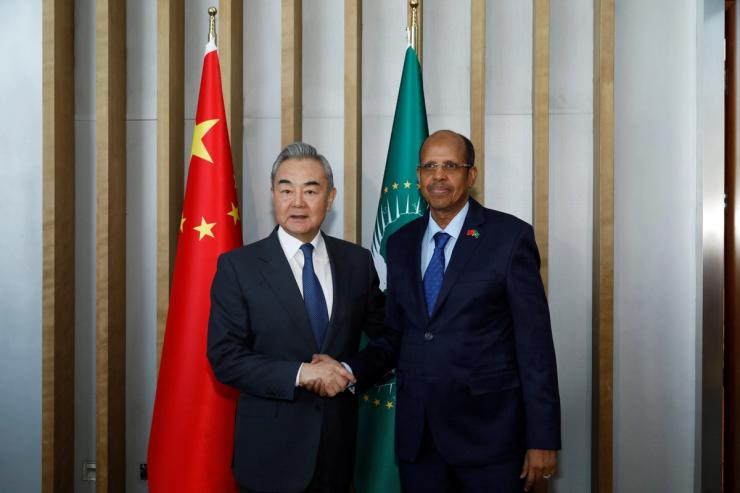
Chinese Foreign Minister Wang Yi landed in Ethiopia this week, beginning a four-country African tour that marks the 36th consecutive year Beijing’s top diplomat has opened the calendar with a visit to the continent.
The tradition is often cited as proof of China’s steady commitment to Africa. But it would be naive to pretend that recent shocks — and intensifying great-power rivalry — do not shape which capitals make the itinerary.
This year’s stops — Ethiopia, Somalia, Tanzania, and Lesotho — all sit, in different ways, on the fault lines of US President Donald Trump’s revamped foreign policy.
Tanzania is still recalibrating after violent elections in October triggered an unusually forceful US response that caught its diplomats off guard. Lesotho, briefly hit with steep US tariffs last year, still faces uncertainty over the future of AGOA, the preferential US-Africa trade pact that underpins much of its export economy. For both, China offers a measure of stability.
However Wang’s first stop in Addis Ababa — also home to the African Union — carries broader significance. The AU’s recent reiteration of support for Beijing’s “One China” policy has fresh salience following Israel’s recognition of Somaliland, the breakaway region of Somalia. The issue resonates not only at the AU, but in Ethiopia itself, which has long eyed Somaliland’s ports as a strategic outlet for the landlocked country.
In Mogadishu, Wang is expected to underscore China’s support for Somalia’s territorial integrity, a position Beijing reiterated just days after Israel’s move. The stance aligns with China’s own sensitivities over sovereignty and separatism.
China’s Africa policy has not fundamentally shifted. But abrupt changes in long-held US positions — on trade, elections, and even religion — have sharpened the geopolitical stakes. Wang’s annual January tour now looks less like a diplomatic ritual, and more like an exercise in strategic timing.

Notable
- Chinese Foreign Minister Wang Yi and African Union chief Mahmoud Ali Youssouf issued a joint call to uphold an international law-based order, the South China Morning Post reported.