• D.C.
  • BXL
  • Lagos
  • Riyadh
  • Beijing
  • SG

Intelligence for the New World Economy

  • D.C.
  • BXL
  • Lagos
Semafor Logo
  • Riyadh
  • Beijing
  • SG


On clean energy, the smart money at Davos is betting against the most powerful person here.͏‌  ͏‌  ͏‌  ͏‌  ͏‌  ͏‌ 
 
cloudy Davos
sunny Beijing
cloudy Brussels
rotating globe
January 22, 2026
semafor

Energy

Energy
Sign up for our free email briefings→
 
Hotspots
  1. EQT’s global aspirations
  2. BHP hiring for AI
  3. Europe’s fusion race
  4. Renewables beat fossil fuels
  5. BYD’s global push

John Kerry’s takeaways from Davos.

PostEmail
↓
First Word
First Word

On clean energy, the smart money at Davos is betting against the most powerful person here.

US President Donald Trump used a lengthy portion of his World Economic Forum speech on Wednesday to launch a familiar tirade against renewable energy, calling wind turbines “losers” that only appeal to “stupid people,” and complaining that “you’re supposed to make money with energy, not lose it.”

In general, the clean energy transition is largely absent from the agenda here. Yet in numerous conversations I had with energy-focused executives from major banks and private equity firms this week, they all agreed that the outlook for making money from renewables in the US and around the world is better than ever.

Counterintuitively, Trump is actually doing them a favor: When climate action was popular with the Davos elite a few years ago, there was a stampede of investment into renewables that drove frothy valuations for developers and steep reductions in power contract prices. Now the vibe has reversed, suppressing some of that froth. Meanwhile, skyrocketing power demand for data centers and other users, plus a renewed focus by fossil fuel importers on achieving energy security by producing more electricity from domestic renewables, are driving power prices way up.

The result is a disconnect between the message coming from the White House, and the opportunity that seems obvious on Wall Street. “We’re busier in renewables than we’ve been in the last 10 years,” Brandon Freiman, head of North American infrastructure at KKR, told me.

PostEmail
↓
Semafor Exclusive
1

EQT’s global aspirations

 
Tim McDonnell
Tim McDonnell
 
EQT Corporation President and CEO Toby Rice
EQT CEO Toby Rice. Kaylee Greenlee/Reuters

EQT, one of the top US natural gas producers, has no plans to explore drilling opportunities in Venezuela, but does see overseas markets as potentially more promising for its future sales growth than the domestic market, its CEO told Semafor.

US demand for natural gas is growing much more quickly than the pipeline and tank infrastructure needed to transport and store it, Toby Rice said at Davos, largely because of permitting bureaucracy. As a result, he said, the “drill, baby, drill” ethos won’t work as a solution to high energy prices, and until Congress passes permitting reform legislation — rather than anything the White House can do alone — “the natural gas market is going to be incredibly volatile in the US.”

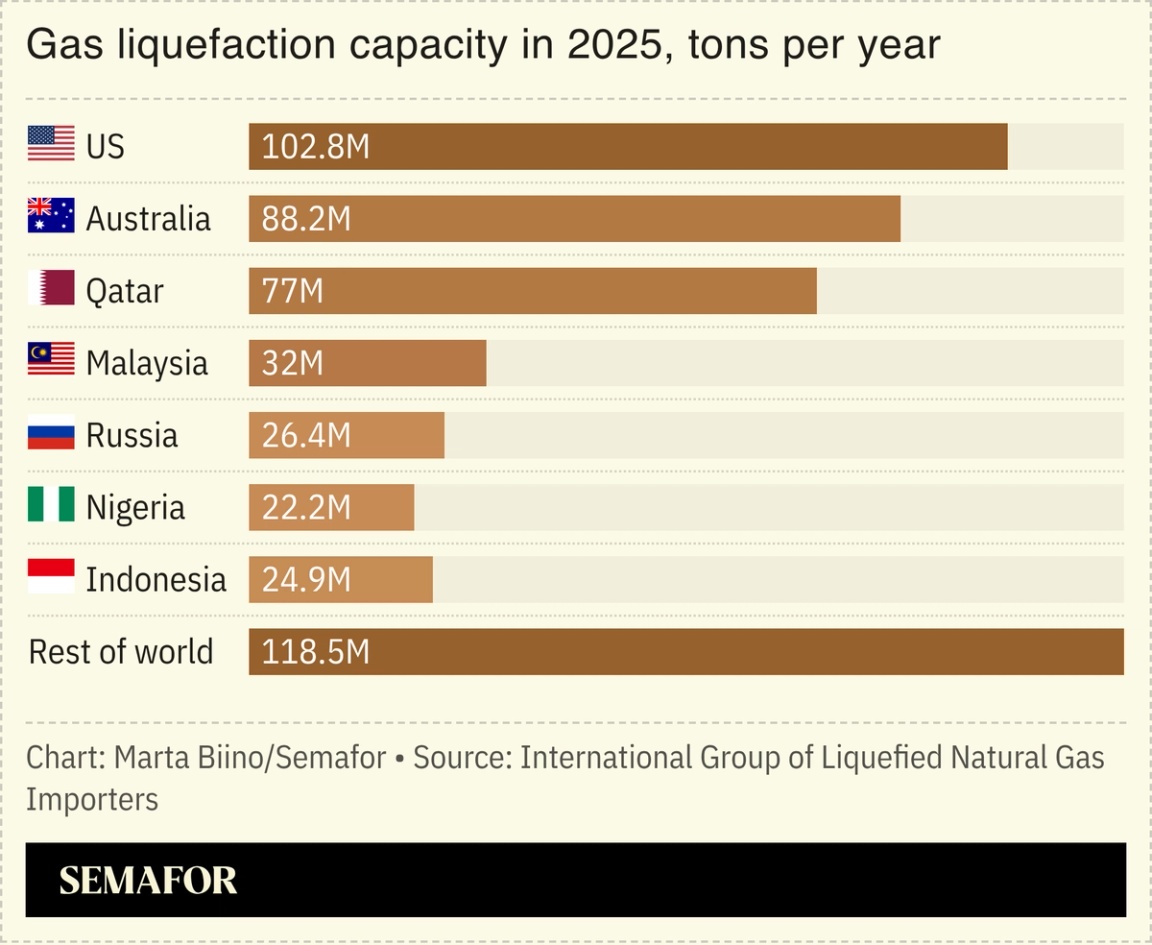
New LNG export terminals are moving ahead, however, and overseas gas prices remain significantly higher than US prices, which makes the global market a highly attractive and attainable target. “We’re a huge fan of renewables,” Rice said. “The more we put in, the more natural gas we can export to the world.” New drilling projects abroad, however — including in Venezuela, whose gas reserves could be almost as vast and more readily obtainable than its oil — aren’t on EQT’s radar.

PostEmail
↓
Semafor Exclusive
2

BHP’s AI push

BHP
Hollie Adams/File Photo/Reuters

The world’s biggest mining company is competing with Big Tech to hire high-level AI talent. Johan van Jaarsveld, chief technology officer at BHP, told Semafor the company recently built a dedicated AI team to find new ways of making the company’s operations more efficient.

AI can be useful for identifying new mineral deposits, but the development time for new mines is so long that for now AI-driven exploration isn’t a focus for the team; instead, he said, “we identify which domains give us the biggest wins the quickest,” which for now means steps like streamlining the company’s maintenance operations and making more strategic decisions about where and how to conduct blasting in mines.

There aren’t many AI programmers who also understand geology, he said, which makes hiring a challenge. “We’re more in competition with tech companies than we are with other mining companies,” he said. “It’s been really hard to build this team, so we incentivize them properly. When we find people we need to keep them.”

PostEmail
↓
Semafor Exclusive
3

Europe’s fusion race

A nuclear fusion reactor under construction.
Liu Haiyun/Chengdu Economic Daily via/Reuters

European nuclear fusion startups are making a play to beat China and the US to commercial-scale power generation. Francesco Sciortino, founder and CEO of Germany-based Proxima Fusion, studied in the same MIT lab that produced one of the leading US fusion startups, Commonwealth Fusion Systems. But he “lost faith” in the prevailing technology there, he said, and set out to design a better system using a “stellarator,” a device that produces power using a superheated plasma contained by magnets. The company has raised about $230 million and plans to demonstrate its custom magnets in the next 18 months, with a functioning demonstration plant by the early 2030s.

While fusion efforts in the US and China have drawn most media attention and investor dollars so far, he said, Europe actually has more functioning fusion labs and more consistent government backing. But there’s a race against time to make progress ahead of competitors: “There’s a Darwinian selection at each phase” of R&D, Sciortino said. “Once other companies start to raise more than a billion dollars it becomes harder for others to keep up.”

PostEmail
↓
4

Renewables beat fossil fuels

Wind and solar power overtook fossil fuels last year as a source of electricity in the EU for the first time, a new report found.

The milestone was hit largely thanks to a rise in solar power, which generated a record 13% of electricity in the EU, according to Ember. Together, wind and solar hit 30% of EU electricity generation, edging out fossil fuels at 29%. The shift is especially important with the bloc’s alternative to Russian LNG — Washington — becoming increasingly unreliable and willing to weaponize economic tools. The US Commerce Secretary threw shade at the bloc’s renewable push during Davos, warning that China uses net zero goals to make allies “subservient” by controlling battery and critical mineral supply chains.

Still, renewables now provide nearly half of EU power, with wind and solar outpacing all fossil sources in more than half of member countries. “The stakes of transitioning to clean energy are clearer than ever,” the Ember report’s author said.

—Natasha Bracken

PostEmail
↓
Plug

Natarajan Chandrasekaran, Chairman, Tata Sons, is joining the Semafor World Economy Global Advisory Board — a forum of visionary business leaders guiding the largest gathering of global CEOs in the US. The expanded board represents nearly every sector across the US and G20.

Joining the Advisory Board at this year’s convening will be our inaugural cohort of Semafor World Economy Principals — an editorially curated community of innovators, policymakers, and changemakers shaping the new world economy with front-row access to Semafor’s world-class journalism, meaningful opportunities for dialogue, and touchpoints designed for connection-building. Applications are now open here.

PostEmail
↓
5

BYD’s global push

Chinese EV giant BYD is deepening its global push, despite political headwinds, in a bid to cement its dominance in the sector. The Shenzhen-based company, which last year beat Tesla to be the world’s top EV seller, is filling a void left by Western manufacturers who saw “EVs as a luxury good” and priced them accordingly, The Wire China noted. By offering more competitive prices, “politics, not market forces,” became the biggest obstacles to Chinese automakers, The Wall Street Journal wrote, as the US and EU threw up trade barriers. But that may be changing, bolstering BYD’s expansion plans. Canada and the EU are poised to drop tariffs, and BYD is already making inroads in Mexico despite 50% duties.

For more on BYD’s EV exports, subscribe to Semafor’s forthcoming China briefing. →

PostEmail
↓
Power Plays

New Energy

Fossil Fuels

  • Venezuela plans to discuss oil reforms that would ease the government’s current monopoly of the industry and give private companies more leeway to drill and sell oil.
  • Russia’s oil exports fell to their lowest level since August as India’s imports dropped to a three-year low in December after the incentive to buy ahead of US sanctions on Russia’s energy giants expired.
  • The Trump administration upended a years-long deal among local leaders, environmentalists and industry by issuing an emergency order forcing the last coal-fired power station to stay open instead of converting to natural gas as planned.

Finance

Minerals & Mining

PostEmail
↓
One Good Text

John Kerry was the 68th US Secretary of State and First Special Presidential Envoy for Climate during the Biden administration.

PostEmail
↓
Semafor Spotlight
Semafor Spotlight

PostEmail