




The Signal Interview
An influencer-filled crowd nibbles on caviar-topped canapés and listens to a DJ as Michael Fiddelke, Target’s CEO-in-waiting, explains how an opening night party for a refitted Manhattan store might inspire a retail empire that has lost its swagger.
People entering the SoHo store at the height of the holiday shopping season now walk through a red tunnel resembling a line of Target bullseye logos, that features artful displays of selected merchandise, from soft leather handbags to giftable scented candles. Further into the store are items curated by local “tastemakers,” an aspirationally stocked beauty bar, and installations staged to be shared on social media.
“These are our very best finds and a really elevated experience,” enthuses Fiddelke, who is dressed for the occasion in a Dad-in-a-Target-ad cream sweater and bold red sneakers. “I kind of view this store as just a punctuation point on when we’re at our best.”
Target has not been at its best for a while. Its stock has fallen 60% since its 2021 peak, its sales have been slipping quarter after quarter, and its brand has been caught in America’s culture war battles over gender and race. On the day in August when Brian Cornell said he would hand over the CEO baton to Fiddelke on Feb. 1, Target’s stock fell 6% as investors asked whether someone who has been with the company for 23 years could deliver the shake-up many of them thought it needed.
How an insider plans to bring ‘fresh eyes’
Fiddelke joined Target from business school, rising from a finance internship through merchandising, human resources, and operations roles to become its chief financial officer and then chief operating officer. Asked how someone who has been so central to its former strategy can bring the “‘fresh eyes’ mindset” Target’s lead independent director hailed on his appointment, he replies that he brings “a powerful combination” of knowing the company in detail and yet having “the candor and humility to take an honest look at where we have work to do.”
Fiddelke describes himself as “a big ‘two things can be true’ guy.” Target is “playing a stronger hand than anyone realizes,” he argues, and at the same time, it can’t afford to wait for the economic cycle to turn in its favor. “We’re going to have to approach it with urgency.”
In October, months before officially taking over as CEO, he announced that Target would eliminate 1,800 jobs, or about 8% of its corporate workforce. Analysts took the news as a welcome early sign that he was serious about making change.
Sitting in front of an Instagrammable display in the SoHo store, Fiddelke repeats the three priorities he has set out for turning things around: “leading with merchandising authority, elevating the experience, and then using technology to do those two things faster and better.”
Target’s recent troubles, he says, have been in part the consequence of its success during the pandemic. Its growth was “just explosive” in 2020 and 2021, with same-store sales growing at unprecedented double-digit rates. Target’s grocery offerings allowed it to stay open when other chains were shuttered early in the crisis. Then, consumers started spending their government stimulus payments on everything from beauty products to barbecues, in store and on its fast-growing ecommerce site. “We went from a $70-some billion dollar company to a $100 billion company [almost] overnight,” Fiddelke recalls. But when inflation hit Americans’ discretionary spending in 2022, Target was caught out with shelves of electronics, sporting goods, and toys it could no longer sell without discounting them heavily.
The boost to Target’s digital business had lasting benefits, but “it allowed us to take our eye off a great in-store experience,” Fiddelke says. “The growth of the digital business added a lot of complexity, so now we need to remove some of that complexity. And we need to make sure we’re making the right investments in the store experience, so that we can do both things well.”
He has pledged to step up capital spending from $4 billion to $5 billion next year to freshen up tired stores and open new ones. But he knows the execution of his strategy will be critical. Fiddelke, who grew up on a farm in northeast Iowa, says he learned early that “there’s no substitute for doing the work.”
Running the race in your own unique lane
Fiddelke will start as CEO at the same time as John Furner — another longtime insider —- steps up from leading Walmart’s US operations to succeed Doug McMillon as CEO of the world’s largest retailer. The two rivals’ fortunes — and share prices — have diverged since the start of 2023, with Walmart’s scale and supply chain prowess allowing it to entice both cash-strapped consumers and the affluent shoppers who once favored Target.
Fiddelke says he’s not worried about Target having sufficient scale to compete. But, he adds, “we have to play our game, and that’s going to look different than other retailers’ playbooks.” What Target can do uniquely well is curate stylish but affordable merchandise in appealing store environments, he reiterates.
Even with annual revenues of more than $100 billion, Target’s market share in its biggest categories is only about 3%, he notes. “We could double the size of this business and not be a [6%] share. And so the runway for growth if we’re clear about who we are and how we grow, I’m pretty bullish on it.”
Asked what lessons he learned from watching the company go adrift, he avoids anything that could be read as a critique of Cornell, who has led the company since 2014 and will stay on as executive chair of Target’s board of directors. Instead, he says, the experience showed him that the company must be “crystal clear about who we are and how we win.” Target has “a really unique lane in retail,” he says, and needs to run its race there.
He is similarly guarded about Target’s experience of being attacked — first by conservative commentators over a 2023 Pride Month collection that featured clothing for transgender customers, and then by voices on the left for its retreat this year from the diversity, equity, and inclusion goals that had led it to hire more Black employees and spend more with Black-owned businesses.
“We’re always listening and learning, and so there’ll be lessons to be learned,” Fiddelke says, while affirming that Target is as committed as ever to a culture that is welcoming for all. “We’ve got a good story to tell there, and it’s important that we tell that story, and when we don’t and others do, that’s when we can disappoint,” he adds, noting Target’s decades-long commitment to giving 5% of its profits to communities where it operates, in products, cash and philanthropy.
Simplifying the message to ensure it is heard
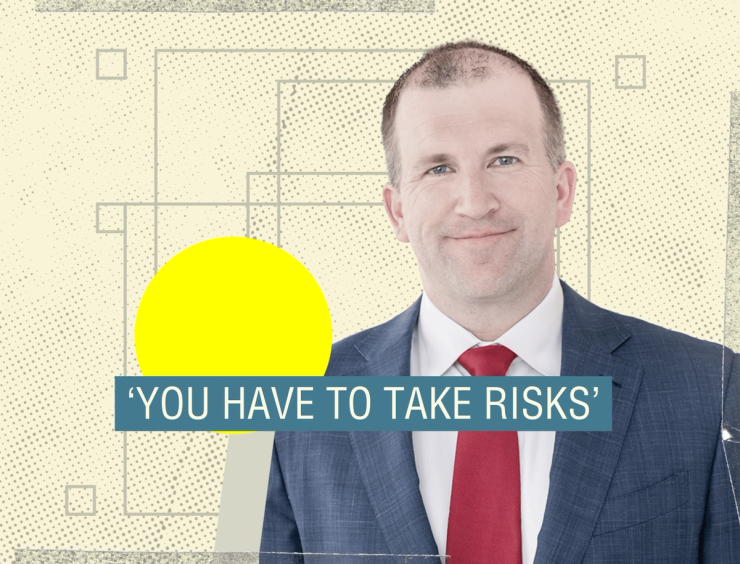
Fiddelke’s parents ran the local liquor store and managed motels, as well as tending to the family farm, so their dinner table conversations often revolved around business. “Some of what sticks with me from that was that you have to take risks,” he says. Target is always placing bets — on how many Christmas trees to buy for a season, or where to build a new store — and he has realized that “you don’t just get to get out of bed and grow. You’ve got to make bets, and you’ve got to take risks.”
He has also learned that executives need to do so with some humility. Five years into his Target career, he recalls, he thought that he understood the business well. When he was moved to a role overseeing its stores from its Minneapolis headquarters, though, “I got my knees knocked right out from under me… I learned real quickly that I didn’t yet know the first thing about what it takes to bring the strategy to life in the stores every day.”
The best advice he received was that if you focus on the team, then the business outcomes will follow, he recalls. But another piece of feedback stuck with him. “I had a leader in stores once tell me, ‘Whatever you guys come up with at headquarters is great, [but] if I can’t explain it on a walk between the registers and the back room, it’s not going to fly.’”
What that remark taught him was to keep his messages simple, he says, explaining why he has repeated each of his key points several times in a half-hour interview.
“It’s my job with the team to be crystal clear on what the priorities are, to simplify, so the team has the space to focus on doing those things really well.” The team will get tired of hearing his three-part formula, but it’s memorable, he says. And if his prescription sounds simple, “to execute it at the level of ambition I have won’t be easy.”
That pressure explains why he is not waiting for his Feb. 1 start date to begin the work of sharpening up Target’s merchandising, stores, and operations, he adds. “Like I said, we’ve got work to do.”

Notable
- Insiders promoted to the CEO role consistently outperform outside hires, according to a recent study by the Yale School of Management. “An outsider really doesn’t know who the sycophants are [and] who genuinely is an enthusiast of the new mission,” explained Yale Professor Jeffrey Sonnenfeld.
- Fiddelke told Bloomberg last month that he and his predecessor are completely aligned about his succession: “We both know that I — with the team — need to grab the pen and write the next chapter.”