




The News
Ukraine’s grid is in its most dire state since the first year of the full-scale invasion, and a total collapse into prolonged, nationwide blackouts is possible as a result of ongoing bombardment by Russian forces, the CEO of the country’s state-owned grid operator told Semafor.
A combination of new distributed energy resources, clever engineering, and military defenses are so far working well to keep Ukraine’s battered electric grid relatively protected, Vitaly Zaichenko, the newly appointed boss of Ukrenergo, said in an interview. But new bureaucratic measures are needed, he said, to defend his company against the corruption that remains pervasive in Ukraine’s energy industry, despite recent high-profile investigations of officials close to President Volodymyr Zelenskyy.
In this article:

Know More
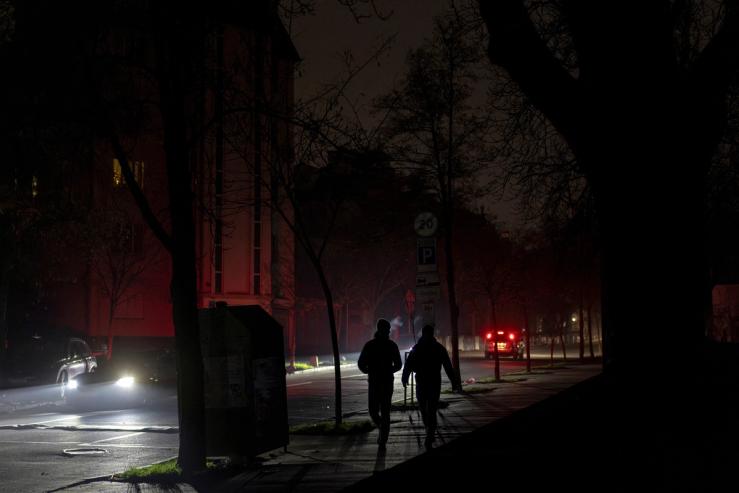
In recent weeks, Kyiv and other cities have faced daily power cuts spanning 12 or more hours, in some cases for days at a time. But a true “blackout,” in which the entire system shuts down for all users, outside the company’s control, has not happened since 2022, Zaichenko stressed. The power cuts Ukrainians now experience in their homes and offices, he said, are strategized to keep power flowing to critical social and military infrastructure, and to keep the flow of electrons one step ahead of incoming rockets.
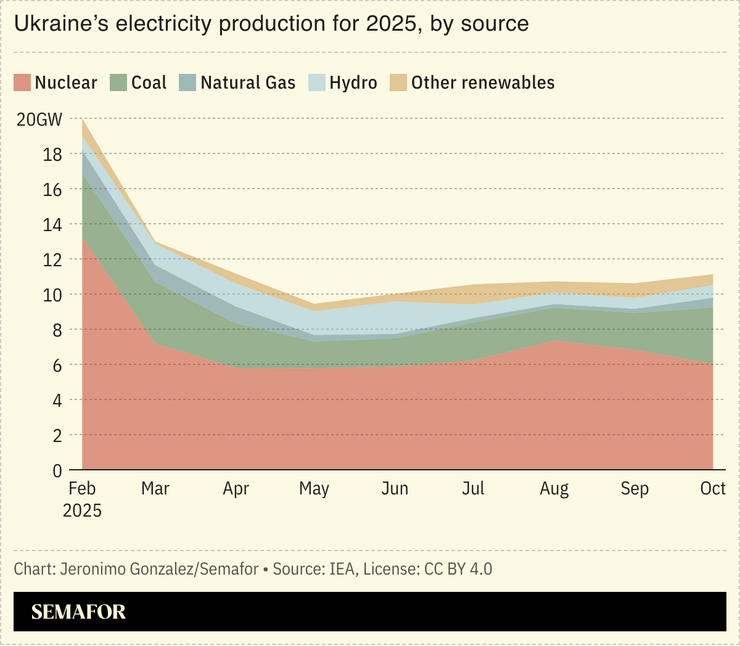
Still, he added, Russian forces are increasingly honing in on a relatively small number of transmission stations that keep the eastern half of the country connected to nuclear power plants in the west, which after the devastation of many large coal plants are Ukraine’s most vital remaining source of baseload power generation. When these substations face a barrage that often includes dozens of drones and several ballistic or cruise missiles at once, he said, “no air defense system in the world can protect from that kind of attack.”

Tim’s view
It may not be easy to tell from the stream of doomsday headlines about power cuts and missile barrages, but in important ways Ukraine’s energy system is much better protected now than it was when the first major grid attacks began in October 2022.
Anti-missile batteries were virtually nonexistent then, and although they remain supplied far below the level Kyiv’s military planners would like, they do work well where they can be deployed. Most of Ukrenergo’s transformers — enormous machines that push power through the grid — now sit behind thick concrete fortifications that perform surprisingly well under attack. Zaichenko said that during a recent barrage near Odessa, one of these fortifications was hit simultaneously by two missiles from opposite sides, and remained standing. The company often has to replace smaller pieces of equipment connected to a transformer, but rarely the transformer itself, which is good because they are expensive, time-consuming to build, and extremely cumbersome to transport.
Ukraine also has far more decentralized power than it did in 2022. That includes several new gigawatts worth of wind, solar, and grid-scale storage; about a gigawatt of midsized gas turbines; and innumerable diesel generators parked on sidewalks, which may be obnoxious and expensive but beat sitting in darkness — all of which, crucially, are not shown on any Soviet-era maps available to Moscow.
Ukrenergo has also worked out a system, Zaichenko said, through which it quickly processes information about incoming threats and redirects power away from the targeted substations to avoid bottlenecks. And the company is sitting on what is likely the world’s biggest stockpile of spare grid parts; “at this point I think we’ve taken every spare piece of equipment that was available in Europe,” Zaichenko said. The company’s engineers have learned to work at top speed, including in extremely dangerous settings close to the front line, often completing construction projects in a matter of days that engineers in the US and Europe would take weeks or months to do.
An important reason power cuts remain so pervasive, Zaichenko said, is that most of the country’s hydropower dams have been destroyed or are under occupation. Prior to the war, these dams were used in tandem with the nuclear plants to quickly ramp up or down in response to changes in demand. Now the nuclear plants still work (not counting the one in Zaporhizhzhia, which is under occupation) but the only way to balance the grid is by cutting demand, not adding more supply.
At this point, it’s unlikely that a significant escalation in grid attacks will be forthcoming, Oleksandr Kharchenko, managing director of the Energy Industry Research Center, a Kyiv think tank, said. Russia has few new targets other than directly attacking the nuclear stations themselves; that can’t be ruled out, but it would mark an escalation that would risk a globe-threatening nuclear meltdown and certainly derail any peace talks. “I’m absolutely sure [Russia is] already in the most intensive trajectory it can possibly manage,” Kharchenko said. “So I don’t think an apocalypse will happen, unless we reach an extreme shortage of air defense missiles.”

Room for Disagreement
Another major threat to Ukraine’s grid that could prove harder to manage comes from within: corruption. The recent ouster of the current and former energy ministers, among other top officials, following allegations that they helped orchestrate a scheme in which companies were forced to pay kickbacks in order to be paid for energy-related contracts, is most likely the tip of the iceberg, rather than the end of the issue, Western and Ukrainian officials have told me. The recent turnover will probably improve the country’s energy security, one European official said, because the various schemes involved were “a drain on everyone’s resources,” including aid money that was likely siphoned off and time wasted planning bogus energy projects. “Only with a big cleanup is there a chance of success,” the official said.
Zaichenko, whose predecessor was ousted from his position for standing up to the same officials later accused of corruption, said Ukrenergo is trying “to provide new barriers to protect our company from these issues,” without elaborating on what those would entail exactly. “We understand that without transparency, we will not be trusted by our partners.”

Notable
- European officials are working to sanction dozens more Russian oil tankers suspected to be part of the country’s growing “shadow fleet.”