




The Scoop
Ancestry released an AI-powered feature Friday allowing users to create narrated audio stories based on their lineage, marking a deeper step into genealogy companies’ embrace of generative AI.
The product offers to deepen users’ connection to their families’ history — but opens up difficult questions about how to accurately handle and analyze records of a person’s family lineage that carry emotional, personal weight and relate to complex historical topics.
“What you find on our platform is based on historical records that are factually correct,” CTO Sriram Thiagarajan said of the AI Stories tool, which he said may add a video component in the first half of next year. “We want our AI to reflect those facts and the ground truth, and not hallucinate and make up stuff about your ancestors just for the heck of it.”
Launched as a publishing service in 1983, the Utah-based company has used machine learning for years to digitize records through proprietary models that can, for example, detect and read handwriting. The latest feature reflects how companies across the popular genealogy sector — which are effectively data management firms — have reoriented around generative AI as they hunt for new consumer-facing applications. Ancestry competitor MyHeritage has an “AI Biographer” feature that promises “Wikipedia-like” summaries.
In this article:

Know More
The AI Stories tool, for now, only applies to the portion of Ancestry’s business that sources and presents historical records, not the DNA sample and analysis component.
“We don’t want to manipulate people’s DNA with AI and all that stuff,” Thiagarajan said. “So we’re not touching any of their personal DNA.”
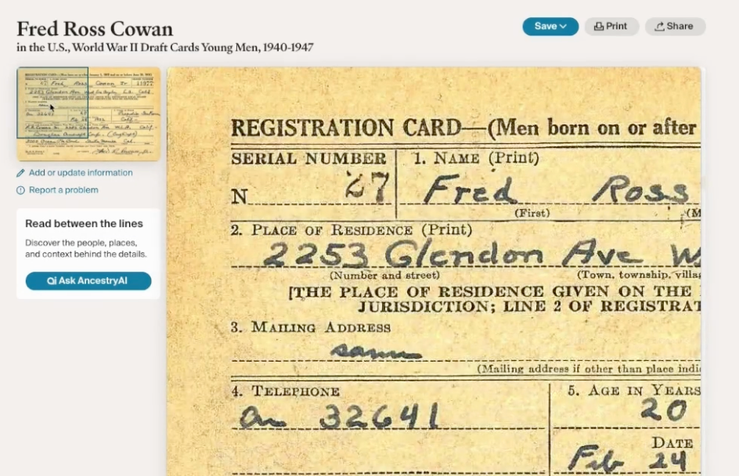
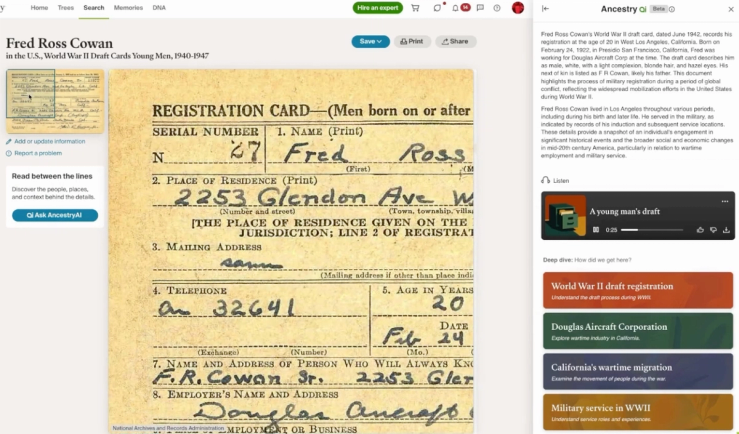
With the new feature, still in beta, an Ancestry customer can examine a document pertaining to an ancestor, like a census record or draft card, and quickly generate a short audio story that adds historical context.
The AI-generated audio clips, naturally, contain some typical AI-speak — “This record brings the past close enough to touch,” the AI audio said about my great-grandfather’s 1950 Census form — but it can also fill in interesting details on the significance of a family member’s employer, or what was happening in the world at the same time.
Unlike its proprietary machine-learning tech, Ancestry’s newer AI features are powered by third-party AI models. The company is “agnostic” about which it uses, and might switch depending on which LLM is better at a given time, Thiagarajan said. He is open to using open-source Chinese models, too, so long as the right security guardrails are in place, he added.

J.D.’s view
The Audio Stories feature is a logical and less risky application of text-to-audio tech, but Ancestry would be smart to remain cautious about how quickly it merges generative AI into its products. The stakes here aren’t literally life or death — unlike, say, AI-powered drones — but family history carries a personal significance that many other AI use cases don’t.
The company is far from alone in using audio tools to create personalized experiences, but applications beyond that, including video, may not play as well with customers.
Thiagarajan acknowledged as much, saying he’s not in the business of “bringing your ancestors to life” and making “dead people dance.”
Hallucinations pose another challenge: AI inaccuracies are “never going to go away,” he said, noting the continued need for guardrails. The AI model is trained, for example, not to assume someone served in a war just because Ancestry found their draft card.

Notable
- The Washington Post is among the businesses leaning into personalized, AI-generated audio, but its top standards editor decried “frustrating” errors in its new AI podcasts, whose launch has been met with distress by its journalists, Semafor’s Max Tani reported.
- Genealogy is a massive industry, and Americans in particular have an “obsession” with researching their roots, The New Yorker wrote in 2022, noting how ancestry “inflects the social, material, legal, and medical conditions of nearly everybody’s life.”