




The News
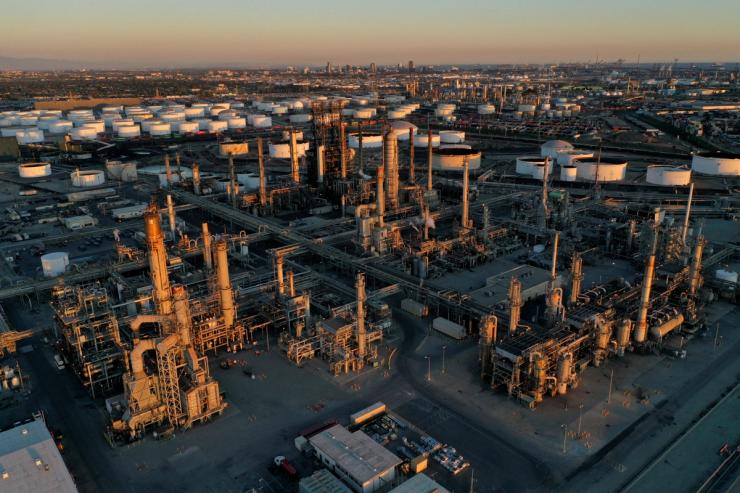
The White House has elevated the role of fossil fuels to a cornerstone of US national security, arguing in a new strategy document that increasing domestic oil and gas production is vital to keep the country and its allies safe, while playing down the risk from Beijing and brushing over the low-carbon technologies now a bulwark of China’s own security strategy.
The National Security Strategy downplays the interest that previous administrations, including President Donald Trump in his first term, had expressed in having the US act as a guarantor of democracy, instead framing geopolitical competition in more narrowly commercial terms. It places fossil and nuclear energy at the center of that effort, arguing that a key strategy for countering rivals is to outcompete them in legacy energy markets. Decarbonization “ideologies,” meanwhile, are dismissed because they “greatly harmed Europe, threaten the United States, and subsidize our adversaries.”
The document provides a clearer picture of what energy “dominance,” the administration’s oft-stated goal, looks like in practice, said Richard Goldberg, who until August was a senior counselor for the White House National Energy Dominance Council. Dominance, he said, means “producing enough and selling enough American energy for partners and allies so that you can unhook them from adversaries and put the squeeze on adversaries, or use that energy in moments of crisis.”

Tim’s view
The document aims to “rebalance America’s economic relationship with China, prioritizing reciprocity and fairness to restore American economic independence.” Yet it makes that goal more difficult by ignoring the new energy technologies — renewables, batteries, and electric vehicles — that China views as crucial to its own security strategy. As former US climate envoy John Kerry argued in a recent Semafor column, electrification and low-carbon energy are the new keys to energy sovereignty. That message resonates loud and clear in Beijing, but has been suppressed in Washington — a blind spot that risks the US losing leverage and security advantages in the years to come.
The strength of China’s strategy was made clear this week when the country announced its global trade surplus had surpassed $1 trillion for the first time, despite the torrent of US tariffs over the past year. About 15% of the trade surplus growth is attributable to clean tech exports, according to Lauri Myllyvirta, co-founder of the Centre for Research on Energy and Clean Air. China is aggressively using its hegemony in these technologies in the same way Trump envisions using US fossil fuels: To strengthen alliances, undercut rivals, and insulate itself from energy imports. What the US might view as anti-competitive dumping of low-cost clean tech exports, countries across the global south are eager to welcome as, simply, cheap energy.
That’s not to say there are no strings attached to Chinese exports (there are), or that oil and gas have already lost their geopolitical relevance (they haven’t, by a long shot). But Beijing is actually guiding, rather than simply responding to, the direction of travel for the global economy by seizing new technologies where it has a decisive advantage. The US, by comparison, seems to be betting on a continuation of the status quo. President Joe Biden’s response to China’s strategy was to launch a new era of US energy tech protectionism, through the tax credits and federal subsidies of the Inflation Reduction Act. The Trump administration dismantled many of those initiatives. Its new security strategy emphasizes the need for greater investment in critical mineral supply chains, but without articulating a vision for how those minerals should be used.
“In the clean-tech sector, the Western response to the ‘China question’ — whether to reject, scrutinize, or learn from and benefit from Chinese know-how, products, and capital — is oftentimes inconsistent, certainly misaligned with global climate interests, and perhaps not even well-suited to the West’s own long-term interests,” said Li Shuo, director of China Climate Hub at the Asia Society Policy Institute.

The View From Europe
When it comes to Europe, the strategy — which views the continent as a potential long-term customer of US liquefied natural gas — seems to miss one of the key lessons that European leaders have deeply internalized since 2022: That it’s not just unwise for Europe to rely on Russia as a primary energy supplier, but unwise to rely on any one supplier.
Europe has certainly welcomed the surge in US LNG imports that started under Biden — including through his support for the new “vertical corridor” gas pipeline in southern Europe — and have continued under Trump. But the EU isn’t eager to recreate with the US the same gas trade dynamic it suffered through with Russia, and has maintained its push into alternative energy sources that, even if they are more expensive, at least aim to diminish future opportunities for exploitation.
Set aside that some members of Trump’s inner circle are reportedly intent on actions like reviving the Nord Stream 2 pipeline that would work in direct opposition to the new National Security Strategy. A larger problem is that the strategy, rather than reinforcing a constructive role for US energy trade in Europe’s security process, seems to threaten the very weaponization that had been deployed by Russia: US LNG is here to help, but only if Europe can resolve a long list of problems that put it out of step with the Trump administration’s values.
“It is hard to convince allies that your energy exports are intended to bolster their security while at the same time portraying them as adversaries — not just for economic or military failings but as cultural and social forces eroding ‘Western’ values and hastening Europe’s ‘civilizational erasure’,” Jason Bordoff, director of Columbia University’s Center for Global Energy Policy, wrote in a note this week. “The [strategy] is a radical departure from any prior version of this document, giving allies incentive to reduce their dependence on the US.”
Moreover, the wartime scarcity conditions that justified a rapid ramp-up of US LNG imports to Europe after 2022 are no longer a main concern, Kadri Simson, the former European Commissioner for Energy, told Semafor. “Europe’s current willingness to purchase more US fossil fuels and replace remaining Russian sources isn’t primarily driven by reliability concerns,” she said. “Rather, I see it as a strategic move to strengthen their negotiating position in tariff discussions with the Trump administration.”

Room for Disagreement
Apart from its castigation of non-fossil energy, the strategy document in some ways departs from the Biden administration more in style than substance. US oil and gas production reached record highs in the last administration, and the Biden White House leveraged both following the full-scale invasion of Ukraine to support Europe and undercut Russia, in much the way envisioned by this new document. Biden’s national security advisers may not have used the same language in public, but boosting US oil and gas production as a means of countering the influence of Russia and Gulf states has been a common goal for US presidents going back at least to the Arab oil embargoes of the 1970s.
Now, the real barrier to more effective cooperation between the US and Europe on energy and security is the EU’s green policies, Goldberg, now director of the energy and national security program at the Foundation for Defense of Democracies, a think tank, said: “It’s hard to take Europe seriously about wanting to get out from under Russian energy and embrace American energy imports, while it works at the United Nations and other international organizations to tax, regulate, and inhibit the growth of fossil fuels.”

Notable
- The Trump administration’s national security strategy is “largely consistent” with Russia’s vision of international relations, a Kremlin spokesperson said, adding that the document looks like “a positive step.”
- European policymakers agreed on Tuesday to significantly limit the scope of new corporate sustainability reporting rules, which had come under intense criticism from US energy companies and the Trump administration.