



The News
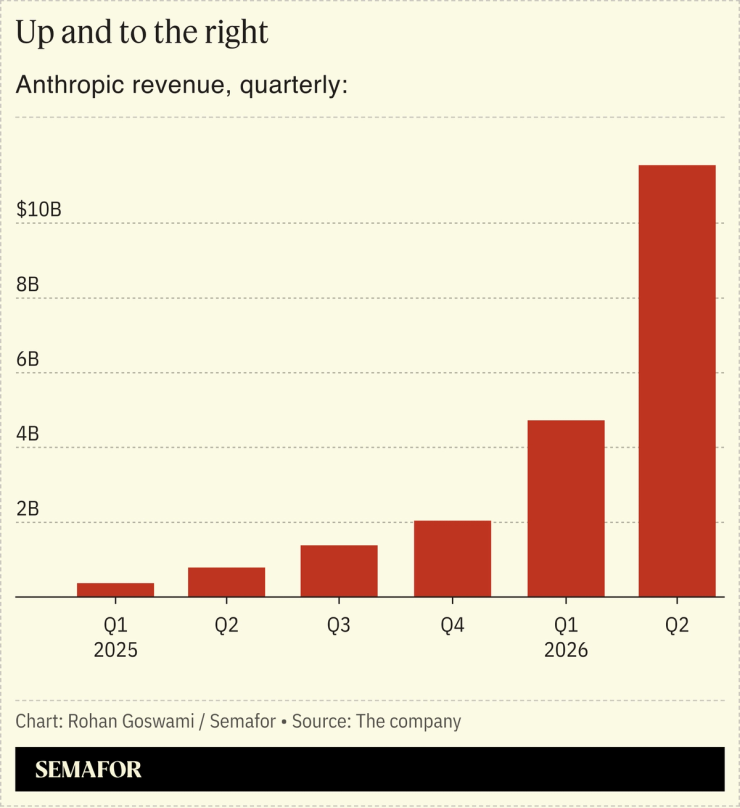
Investors got a look for the first time at just how much money Anthropic is losing and how deeply entwined the frontier lab is with other players in the AI ecosystem.
The company’s net loss was $81 billion in the first half of this year, according to its long-awaited IPO document released on Monday. It’s also on the hook for more than $400 billion in future obligations for chips and data center leases, many of which haven’t even been built yet.
There’s a lot riding on Anthropic’s trading debut. It will test investors’ desire to keep funding an AI boom with no clear sight to profits, huge political risks, and an ambivalence toward traditional corporate governance rules that stands out even among founder-led tech giants.
Other companies, like Nvidia and Alphabet, offer safer ways to play the AI boom, and much of Anthropic’s pitch is that a company with a single product — one it admits is dangerously uncontrollable and unpopular — can justify a $1.5 trillion (or so) price tag.
Here’s what else stood out to us in the filing.

The Filing
- The first-of-it-kind IPO has a novel governance structure to match. Anthropic’s seven co-founders will control the company through one golden share of supervoting stock — yes, just one share. A simple majority among the group of seven is enough to decide how that share is voted in most corporate matters. A separate council of “financially disinterested trustees with expertise in AI safety” will choose a majority of the board of directors, with the rest chosen by the founder group. Even compared with tech peers that afford their founders significant control, Anthropic’s setup stands out for how little say it gives shareholders whom the company is now asking to put up tens of billions of dollars. Amazon and Google, which were early investors in Anthropic, will receive nonvoting stock.
- The company owes a lot of people a lot of money. Anthropic’s compute liabilities could hamstring the company: As of June, it was on the hook for $417 billion in future compute and infrastructure leases. The company also expects to pay out $24 billion in stock-based compensation to its 5,300 employees — an average of $4.5 million apiece.
- A big key-man risk: US President Donald Trump. The filing calls out the February spat between Trump and CEO Dario Amodei over the use of Anthropic’s models in war. If the US government were to restrict its models again like it did with Fable and Mythos in June, or invoke export controls or the Pentagon’s Defense Production Act, it would limit its ability to do business. Anthropic said it doesn’t plan to stand down from its positions, and that its own policy advocacy could be costly.
- The other key-man risks. Anthropic’s five largest customers represented roughly a quarter of revenue — and largely aren’t locked into contracts. Nearly half its revenue comes from cloud service providers like Microsoft Azure, Google Cloud, and Amazon Web Services.
- Skynet becomes self-aware. The self-appointed arbiter of AI safety warns of existential threats in its risk factors, highlighting that flags have been raised internally among its own staffers. “Sufficiently advanced AI systems could, if not developed, deployed, and operated with appropriate safeguards, oversight, and security measures, pose catastrophic or existential risks to humanity, particularly if such systems were misused, replicated, weaponized, or allowed to operate with a high degree of autonomy.”
- Notably absent. China only made a few cameos in the 318-page document (11 times to be exact) despite competition between the two superpowers dominating the AI conversation around the world. Although the filing alludes to open-weight models “released by state actors” and frames distillation as a competitive and national security risk, Anthropic doesn’t directly call out Chinese firms.
- Anthropic’s founders aren’t meat proxies. An analysis from AI slop-detection tool Pangram found that the intro letter from the company’s leadership is human-written, rather than Claude-authored. As Claude would say, it’s not just noteworthy — it’s striking.
J.D. Capelouto and Ellen DiMauro contributed reporting.