




The News
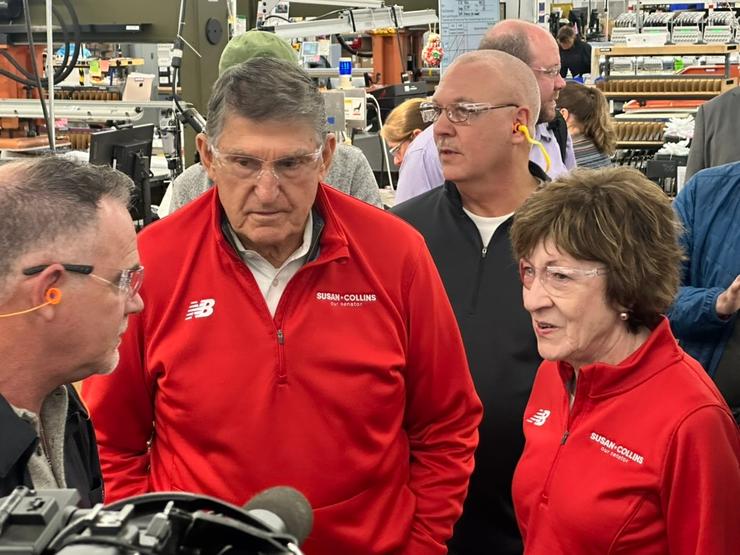
NORWAY, Maine – Susan Collins and Joe Manchin arrived right on time – Maine’s Republican senator and West Virginia’s last Democratic senator, in matching red fleece, making a cheerful Wednesday stop a New Balance factory.
Collins celebrated how she’d helped the “best shoemakers in the world” ink a deal with the Pentagon: “For years, we have argued that our American troops should wear American-made athletic shoes.”
Manchin celebrated Collins. “She is the soul of the senate,” said Manchin.
One day later, Troy Jackson, the Democrat challenging Collins, brought his own guest to Maine: Rep. Alexandria Ocasio-Cortez, D-N.Y.. They rented Portland’s State Theater for a “students versus billionaires” town hall to fire up progressive Mainers, and reject the idea that Collins made the Senate work.
“There are a lot of consultants out there in Washington that would tell him to not sit next to [me],” said Ocasio-Cortez. They took more than a dozen questions – on trans rights, on public transportation, on student debt, and on whether they were “Israel First or America First.” Both said “America First,” and Jackson promised to end “blank checks” for the Jewish state.
Whatever Senate Democrats wanted in Maine, this is the race they got: Collins talks proudly, with character witnesses, about the benefits of a veteran senator who can work with both parties. Jackson is running against the very idea of Senate comity —half a loaf when voters deserve to tax the rich and get the whole buffet.
Both camps thought that Manchin’s visit helped their campaigns. Both thought the same about Jackson campaigning with Ocasio-Cortez, as well as with Sen. Elizabeth Warren, D-Mas., and Sen. Bernie Sanders, I-Vt..
“His people he’s had up here have been three extreme liberals,” said Manchin of Jackson’s progressive surrogates. “I know who they are. I like them. I do! I just don’t agree with any of them. And if that’s who you are, you are who you’re associated with.”
In four debates, Collins worked to portray Jackson as an angry lightweight who wouldn’t be effective in the Senate. Jackson called her corrupt, denounced her vote for Justice Brett Kavanaugh, and said that fighting President Trump would get more for Maine than the tariff carve-outs she got by negotiating with him.
“You can’t eat rock salt,” Jackson said —landing an unplanned zinger that lowered some progressive angst about his campaigning. In Portland, Ocasio-Cortez wore a button reading “Mainers Can’t Eat Rock Salt.”
Jackson isn’t telling voters that he can deliver as many incremental wins as Collins, or that he could carry on her bipartisan record. Instead, he argues that Maine needs to clip Trump’s wings by taking away his Senate majority – then, to revoke tax cuts on the rich and get serious about redistributing wealth. His harder edges and less-than-soaring rhetoric, peppered with “you knows,” become proof that he’ll never be a smooth beltway operator.
“They’re afraid of a waitress in the House and a logger in the United States Senate,” said Ocasio-Cortez. “So they want to critique how he talks, how he looks, the way he says things – because if you’re not one of them, they at least want you to act like you are.”
In this article:

Know More
Jackson isn’t running to be the “soul of the Senate.”
Unlike Sara Gideon, the Democrat whose 2020 loss to Collins still haunts Maine’s progressives, Jackson isn’t touting his ability to work across the aisle. He still hasn’t secured the endorsement of Gov. Janet Mills, after an unsuccessful campaign for governor where he chastised her for vetoing some of his progressive bills; or of Rep. Jared Golden, the retiring Democrat who once worked for Collins; or of Sen. Angus King, an independent who caucuses with Democrats but stays neutral when Collins is on the ballot.
That’s made it easier for the Collins campaign to portray Jackson as a left-winger who can’t work well with others – especially female colleagues. Collins got a gift at the last of her four debates with Jackson, when a protester jumped up and interrupted her, and she suggested it was one of Jackson’s supporters. The Democrat told her to “shut up,” a moment now circulating in Collins’s ads, as proof that Jackson is a “bully” and a “creep” who puts women in danger.
The audience for that line is the bloc of liberal Maine women who’ve voted for Collins before, and will almost certainly vote Democratic on the rest of their ticket. Jackson, who was already getting tagged as a sexist hothead in GOP ads, hasn’t really tried to soften his image. His rebuttal is that a working class logger-turned-politician will never be as smooth as Collins or her donors. And anyway – what good is decorum if it doesn’t get people healthcare?
“I’ve had four debates with Sen. Collins, shook hands with her every time,” Jackson told CNN, when asked about the debate moment. “What I’m not going to do is, I’m not going to be talked down to by Senator Collins.”
Republicans have had an easier time reintroducing Collins. They took full advantage of the Democrats’ disastrous primary, which ended with flawed phenom Graham Platner quitting and party activists choosing Jackson, a backup QB who shared his politics. She travels between campaign stops in a bus wrapped with her slogan, “Our Senator.” When it parks, young volunteers bound down the stairs in red Susan Collins fleeces, to cheer for her, and the senator shakes every hand she sees.
On Thursday, when she arrived to accept the endorsement of the Professional Fire Fighters of Maine, she greeted voters and talked about the wonderful reception she was getting in western Maine. At the mics, she talked at length about what she’d done for their members, while the union explained why it backed Jackson for governor and wouldn’t back him now.
“He’s a friend of ours,” said the union’s secretary-treasurer Michael J. Crouse. “We were always a friend of Sue Collins. We endorsed her in the very, very beginning because she has been supportive of firefighter and EMS issues. And one of the things that we’re not going to do is, we’re not going to leave one friend to go to another.”

David’s view
The basic Democratic theory for beating Collins is that her state voted for Kamala Harris by seven points, and when the president was much more popular. Convince those voters that it’s no longer worth it to have “our senator” cutting bipartisan deals, and they win.Of course, Collins isn’t running like Trump, and Jackson isn’t running like Harris – who said she’d put a Republican in her cabinet, and who campaigned in three swing states with Liz Cheney. Gideon’s loss in 2020 and Harris’s national loss in 2024 convinced Maine Democrats that the DC-based party had no idea how to win in Maine and that teaming up with conservatives didn’t move votes. They nominated one Sanders-endorsed candidate, then replaced him with another.
The result is a campaign progressives have wanted to run for years: A working class candidate who’s moved their way on issues of immigration and gender, framing his opponent as a crooked insider. Like Platner, who lives on in Collins’s attack ads, Jackson suggests that the money brought home by a respectable senator is less meaningful than the top-to-bottom change – Medicare-for-All, ending wars and support for Israel – that he and his progressive allies could achieve.

Notable
Tyler Austin Harper, a Maine-based writer for The Atlantic, followed Jackson on the trail to study whether his “left maximalism” can actually win working class voters.
In the Washington Examiner, David Sivak talked with rank-and-file Maine Democrats who are still frustrated that they’re not getting out the vote for Graham Platner.