




The Scene
China is key to global manufacturing across a range of sectors, but foreign capitals — increasingly worried about domestic industry being hollowed out in the face of cheap, high-quality goods from the country — are cracking down.
Few are doing so more aggressively than India, which has set deadlines for local firms to source more of its solar power supply chain domestically, even as it seeks to add a whopping 200 gigawatts of non-fossil fuel capacity by 2030.
Beijing is mounting its defense against that strategy: This month, it proposed export controls on several technologies used to make solar equipment, and has reportedly restricted Indian firms’ access to key parts of the solar supply chain.
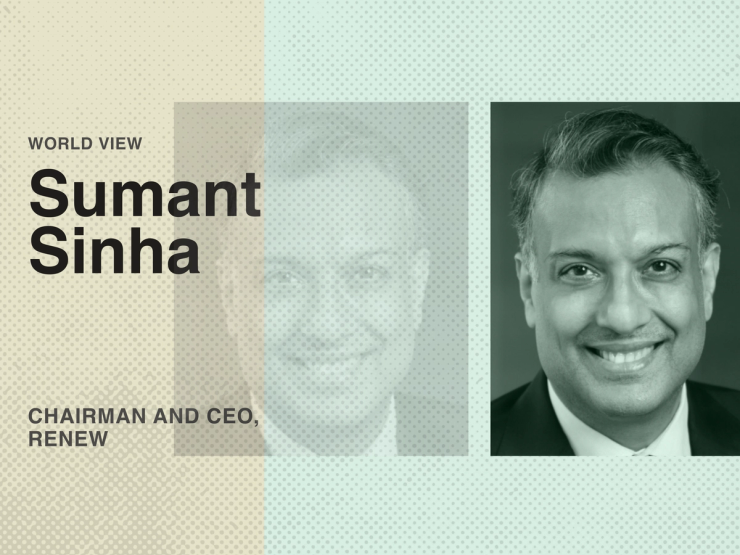
“There’s nowhere else for us to go but to go to China and to get equipment from them that allows us then not to buy the end product from them,” Sumant Sinha, the chairman and CEO of Indian renewables firm ReNew, said in an interview. “Of course, they’ve wised up to this fact.”
Ultimately, though not directly comparable to the Strait of Hormuz crisis, overreliance on China is its own bottleneck, Sinha warned. “We all talk about increasing electrification … But it’s fully based on dependence on China. And that’s not a healthy thing.”
So, as a result, countries such as India can only wean themselves off China if China allows them to, he noted. And so, “why would they?”

Q&A
This interview has been edited for clarity and brevity.
Prashant Rao: Can you describe the kind of broader pressure, either from yourself, your offtakers, whoever, to get off the Chinese supply chain? How much does the Chinese supply chain loom over you?
Sumant Sinha: It’s more of a sovereign issue than it is an individual company issue. For us, if you tell us to buy from China, we buy from China. Does that increase our dependence on China as a country? Of course it does. I think the sovereign, that is the Indian government, took a view that we did not want to have that reliance. And I don’t disagree with that because, why should you have that?
Especially when your own domestic market is big enough. And there are all sorts of geostrategic issues that are going on as well with China.
What they’ve done is actually pretty interesting, which is that they give you a forward notice. And that’s what they did for solar modules. They said two years from now, they’re going to stop imports of Chinese modules or any other modules from outside India. So, you have two years to set up capacity.
Lo and behold, at the end of that time period, we now have close to 200 gigawatts of solar module manufacturing. Which is great.
Now they’ve also done the same thing for cells. So that cell restriction is coming into place this December. And from two years from now, they’re going to do the same thing for wafers and ingots. So they’re slowly, slowly going further up the value chain. They may do it for polysilicon as well at some point in time, or they may give some other incentives.
I would say that three to four years from now, they’ll have a fully domestic supply chain for solar. And they’re trying to do similar things for batteries and the battery components and so on as well.
How does that affect your costs?
Obviously our costs are higher than China’s costs. Because let’s say the cost of production in China’s here, our cost of production is slightly higher.
What would you say the ratio is? Like 1.2?
It’s 20%. But they are selling at a price of 80% to 90%. So, they’re selling at massive discounts, which they can, by the way, increase if they want to make sure that no Indian manufacturing comes in. And we are selling at whatever is the regular margin to sell at.
So, on a sales price to sales price basis, we’re probably 30% more expensive than that. But that is because Chinese [companies] are making massive losses.
Bottom line is our costs are a little bit higher. But as long as it applies to everybody in the industry, it doesn’t matter. Because what that then means is that we just pass on the cost to the end consumer.
Therefore, the end consumer ends up paying that cost. Now, you may argue why should the end consumer pay a higher cost? The end consumer pays a higher cost because ultimately that allows us to localize the supply chain.
How would you characterize your current reliance on Chinese technology?
We are still importing equipment. So, even if we start making cells ourselves, which we are doing right now, we will still have to buy wafers until such time that we start manufacturing wafers in India, which will take us another two years.
A lot of the equipment to manufacture all these items comes from China. And so, we need to import from China. So that reliance is there. Because over the years, what’s happened is that China not only started making modules and cells and all of these clean tech equipment, but they also started making the capital equipment to make all of these things. And then over time, the R&D to make the capital equipment, and so on.
They’ve done that very intelligently. There’s nowhere else for us to go but to go to China and to get equipment from them that allows us then not to buy the end product from them. Of course, they’ve wised up to this fact.
So, it’s functionally impossible to wean yourself off the Chinese green supply chain?
If they allow us to transfer technology from China, [but] why would they? That’s the point. We have to see what to do about it. It’s not that straightforward.
The thing that I find very surprising is that the rest of the world is fully dependent on China for supply chains in clean tech. We all talk about increasing electrification, and we have this whole COP process and tripling renewables targets. But it’s fully based on dependence on China. And that’s not a healthy thing.
We’ve all seen what’s happened to concentrated supply chains. When you look at what happened to Europe on gas and is still happening to Europe on gas from the US and so on, it’s not a healthy situation. We need diversified supply chains.
But the problem is that nobody else in the world is trying to develop or encourage the development of the supply chain outside China. Because people are just buying the cheapest thing that they can buy, which is Chinese.
And so we are heading into a world of dependence and vulnerability on supply chains. And if you think that the Strait of Hormuz is a chokehold…
It’s slightly different though, right? Because if you buy a solar panel, you still have the sun.
Yes. That’s flow and this is stock. But obviously, this is just the beginning of trying to clean our energy system. Electricity represents maybe about 20-25% of energy. And in electricity, we have as a world maybe only 15-20% at max clean, which means 15-20% of 25%, which means maybe four or five percent.
The balance still has to be done. It will take decades for us to do that. But if that entire situation revolves on a supply chain that is based on one country, then that is clearly not a healthy situation.
I can buy fossil fuels from 10 different countries. Pricing is globally determined based on global demand and supply. In clean tech, I can only buy solar modules from China, or Chinese-controlled companies. They set the price, they decide who to sell to. My entire move away from fossil fuels eventually or towards having cleaner energy supply systems is entirely dependent on China.