




The Scene
MIDLAND, TX — This should be a glorious era for Diamondback Energy. In the 15 years since the oil company went public, it has leveraged savvy fracking skills and astute acquisitions to grow from a scrappy West Texas driller — its stock ticker is FANG — to a behemoth responsible for about 4% of US oil production. This year, thanks to the surge in oil prices caused by the war in Iran, Diamondback’s second-quarter profits per share more than doubled from last year; Wall Street expects another boost when third-quarter earnings are released in a few weeks.
But CEO Kaes Van’t Hof isn’t celebrating. “We don’t like when prices are too high,” he told me. Oil prices north of $100 per barrel — the US benchmark is around $99 this week — “are great for a month or two, and then I get called to Congress and called a price gouger.”
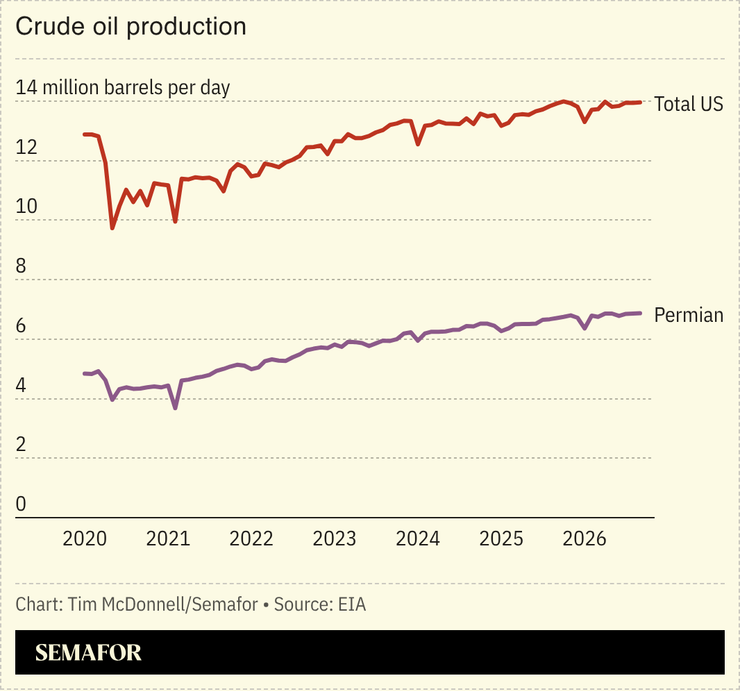
High fuel prices could be a decisive disadvantage for US President Donald Trump in the looming midterm elections. As he scrambles abroad for barrels, the Permian Basin — the country’s biggest and richest oilfield, the bedrock of US energy security at a time of unprecedented turmoil in global markets — remains the place where his battle will be won or lost. And indeed, production here is higher than ever.
But many Permian drillers are ambivalent about this growth. Diamondback, like its peers, has been hesitant to answer Trump’s repeated calls to “drill, baby, drill”; the company’s latest production target for the year is only about 4% higher than it was before the US-Iran war. Across the Permian, daily production is only 1.5% above where it was when the Strait of Hormuz crisis began in February, despite US oil prices rising 50%.
That circumspection is the result of some hard lessons from a century of booms and busts. Despite major engineering strides in driving down production costs, and a wave of industry consolidation that has concentrated resources and decision making in fewer hands, executives like Van’t Hof are less willing than ever to take billion-dollar gambles adding rigs just because the president wants them to. No matter how attractive oil prices look today, many in the Permian believe a price crash is inevitable, either because Trump’s daily “jawboning” keeps futures traders feeling bearish, or because of a genuine security breakthrough in Iran, evaporating consumer demand owing to high prices and the clean energy transition, or the influx of foreign barrels from places like Venezuela.
That’s a market reality that Washington often seems to miss: Trump’s overall “energy dominance” strategy relies on companies like Diamondback to drill more, but sets them up for failure if they do too much.
“We’re the only business in the country where neither side of the aisle wants you to make money,” Van’t Hof said. “‘Drill, baby, drill’ is basically drill as much as you can to commit economic suicide.”

Tim’s view
Standing on the site of Diamondback’s newest frack, I began to understand why an unprecedented oil supply crisis has not unleashed a corresponding gold rush in the Permian.
 Tim McDonnell/Semafor
Here, you can hear this vanguard of US oil drilling before you see it: the earth-shaking racket of a dozen semi-truck-sized gas generators, powering more than a dozen equally huge pumping machines, pushing sand and fluids into four brand-new wells. To get these wells pumping, three dozen people, including workers from Halliburton and several other subcontractors, work in round-the-clock shifts for at least a week, using explosives and high-pressure fluids to “fracture” deep shale rock formations along the length of a horizontal well that can run for miles parallel to the surface so oil and gas can be siphoned out. This is the basic technology that revolutionized US oil a decade ago, and made the country by far the world’s top producer. But it was always somewhat odious to oil company shareholders, who found it a money pit that didn’t make sense if crude prices weren’t high.
When prices picked up this year, no one expected Chevron or ExxonMobil to suddenly drill more in the US. Their monster capex budgets change direction slowly, and both companies have their hands full with far-flung global drilling adventures. But in booms of the past, small and midsize drillers would have jumped to cash in. The muted reaction to this year’s market spikes reveals a fundamental shift underway for companies in the Permian, from chasing the most lucrative short-term barrels to chasing a kind of financial sustainability capable of returning cash to shareholders after the boom goes bust.
The only way to keep up production and stay economically competitive has been to obsess over cost efficiency, Hunter Landers, Diamondback’s senior vice president of well construction, told me as we walked the site: “We’ve been pulling all kinds of rabbits out of our hats to save money and stay resilient.” The core of that strategy is to drill deeper and longer, so that the fixed costs of the fracking operation are spread over more barrels per well. The frack happening beneath us was about half as deep as Mount Everest is high, in a section of oil-rich rock that used to be considered out of reach; other innovations allow for simultaneous fracks, minimizing downtime.
Others have different tactics: Brendan McCracken, CEO of midsized driller Ovintiv, said the company boosted its rate of production per foot to the highest in the Permian in part by pushing surfactants — essentially slippery industrial soap — into its wells. Companies are preparing wells that can be brought online more quickly when prices tick up. They’re using AI to scavenge for insights among vast datasets. They’re writing hedge clauses into sales contracts, to shield themselves from price crashes. They’re even sourcing frack sand locally rather than importing it from quarries in the Midwest. And the spate of M&A consolidation that rolled through the region in the past few years — Diamondback completed a $26 billion merger with its rival Endeavor Energy Resources in 2024, for example — means there are both fewer executives around to make rash decisions and fewer underground resources available for less-scrupulous wildcatters to jump on.
Kirk Edwards, CEO of the small Odessa-based producer Latigo Petroleum, lived through the bust of the mid-2010s, when reckless growth in US shale triggered a price collapse. “That was horrible,” he said. “Now you’ve got our president saying, ‘Hey, we’re going for $40 oil again.’ Well, that would be catastrophic. So nobody’s going crazy on drilling.” Instead, the name of the game is to create pockets of stability in an inherently volatile business.
“We’re all grown up now,” Van’t Hof said. “And I get screamed at less in meetings by investors.”

The View From Midland
Despite the year’s geopolitical turmoil, there’s a newfound sense of economic stability in Midland that, for the first time in the city’s history, doesn’t seem to depend on sustained high oil prices.
When I visited recently, the mood in the Permian, a storied expanse of muddy scrubland where innumerable fortunes in black gold have been won and lost, was mostly positive. All the drilling and oilfield services companies are busy. The new fancy steakhouse was full of guys with company-branded polo shirts tucked into their jeans, knocking back old fashioneds. There’s a gleaming hospital and a string of new downtown spots to supplement The Bar, the beloved dive that was supposedly among the inspirations for the Patch Café in the TV series Landman, which is set here. Landers, the Diamondback VP who grew up in the Texas energy industry, said the stereotypical “man-camps” of yore for transitory workers, while not entirely gone, have been supplemented by suburban housing for families with young kids, a sign Midland has made progress converting its natural resources into durable economic benefits for locals. On the weekend, you’ll weigh invitations to multiple crawfish boils hosted by roughnecks from Louisiana. Good luck finding a parking spot among the oversized pickups at Costco.
Still, this growth masks a widespread sense of anxiety, driven far more by Washington politics than anything to do with market fundamentals, according to a survey of regional oil companies by the Federal Reserve Bank of Dallas in late September. Half the companies reported no change in business activity compared to the previous quarter (44% reported an uptick), and 42% reported an increase in uncertainty about the path ahead. “We don’t like crises,” Ben Shepperd, president of the Permian Basin Petroleum Association, a trade group, told me. “The entire year was a roller coaster and predictions for where we go next are all over the map.” While booms and busts are as old as Big Oil itself, he said, “the uncertainty coming from our own policymakers in Washington is new.”
The View From Washington
White House spokesperson Taylor Rogers said that “thanks to President Trump’s energy dominance agenda, oil companies have been operating ‘pedal to the metal’ since the President’s first day back in office. President Trump’s call to ‘DRILL, BABY, DRILL’ has restored America’s position as the top producer and exporter of oil, and these companies are going to continue producing at record levels.”
Energy Secretary Chris Wright and Interior Secretary Doug Burgum have been in frequent contact with Permian executives for ideas about how to increase production, Van’t Hof said, adding, with evident relief, that he hadn’t been asked to discuss this directly with Trump, who usually lets the CEOs of Chevron and Exxon do most of the talking for the industry.
But ultimately, Van’t Hof said, “we’re talking about pouring a garden hose into a swimming pool. We can’t fill it up as fast as it’s being drained.” The good news, he said, is that the political backlash to high fuel prices has by now mostly shifted away from drillers to refiners downstream. “My job is to show confidence when oil prices are low,” he said, “and then keep everybody’s ego in check when it’s $100 oil, because everybody thinks they’re a genius there.”

Room for Disagreement
No matter what happens with Permian oil production, the region is set to see a windfall from the influx of hyperscale data centers, including an enormous one Chevron is building southwest of Midland. There’s no shortage of land. And digital infrastructure — although currently held back by a permitting pause instituted by Republican Gov. Greg Abbott — could solve two big problems that used to preoccupy Permian producers: excesses of water and natural gas, which are released underground by fracking. It may seem counterintuitive to view excess water as a problem in this arid region, but companies are often required to dispose of “produced” water by pumping it back underground, which can cause earthquakes. Data center cooling services could be a much better use. As for gas, it has usually been treated as a waste product to be burned off; because there are so few pipelines to bring it to market, West Texas gas prices have even dipped negative this year. But as gas demand from data centers and LNG export terminals on the Gulf Coast has surged, new pipeline deals are being announced every few weeks.
“Data centers are a huge boon, and could really be our next generation,” Latigo’s Edwards said.

Notable
- Department of Energy officials are pushing US refineries to produce more fuel, but the industry is already running at nearly 100% of capacity, executives say, as they push off planned maintenance to continue capturing high profit margins. But global refinery outages will likely keep fuel prices elevated next year, Morgan Stanley analysts warned.