


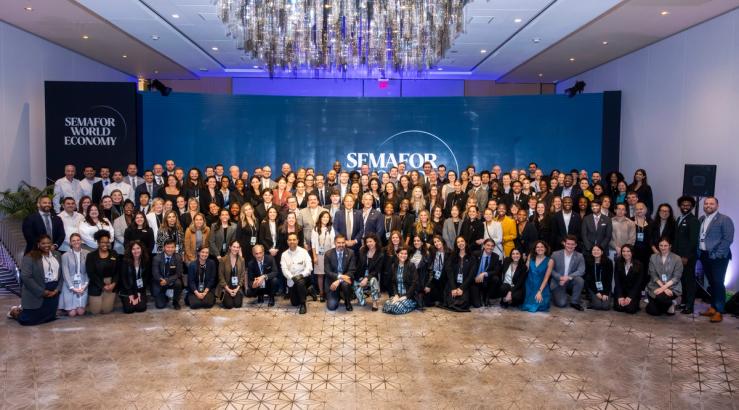
We hope you’ll forgive us on Semafor’s fourth anniversary for talking our own book, and for sharing here a lightly edited version of a note we sent Semafor’s staff earlier today:
We have been asked a lot lately: When we launched Semafor four years ago, is this what we were expecting? Did we think it would get this much traction, this fast? What has surprised us?
The truth is that we would have been pleased four years ago to know the current state of Semafor — a respected brand, a brilliant newsroom, a strong, profitable business. But surprised? The honest answer is no. It took a lot of optimism to launch a new media company in 2022. This was informed optimism, however: We share a deep belief in how much the talented people we hoped we could hire could accomplish through incredibly hard work. And we were always thinking big.
What’s so exciting right now is that Semafor is starting to emerge clearly as the thing that we hoped it would become — shaped and driven by our growing team in ways we couldn’t have imagined.
We launched with the insight that a leadership audience — CEOs and political leaders alike — was, paradoxically, the most desperate for efficient, fair, and sophisticated news. Then, no CEO or head of state had heard of us; now, we have 1.2 million subscriptions to our briefings, and more than 16,000 people have attended our convenings around the world.
We launched with global ambitions — but footprints only in the US and Africa, a start in the world’s most developed media market and one in its fastest-growing. Now we have journalists in 11 countries, scoops and email briefings and events with deep audiences in Africa and the Gulf, and we’re sprinting toward a launch in Asia next year.
Our thesis at launch was that “events” was a journalism business that could help power the business of journalism. Our biggest upside surprise is how fast that’s happened, and the extent to which we quickly outgrew the category of “media events” and moved into another one: signature convenings that set the global agenda and serve both as festivals of news and crucial spaces for conversation and connection.
Perhaps most important, we launched with a deep sense that audiences — buffeted by the hyper-polarizing, hyper-toxic environment in which social media had become the tail wagging the dog of journalism — wanted a new approach. And we’re so proud to have defined a style and brand of journalism that separates facts and opinion, has an eye on its own blind spots, and leaves space for reasonable disagreement, on stage, on the page, and in the other places our journalism appears.
This moment feels to us the way it did in 2022 — the bullet train has just left the platform, and everyone here at Semafor is finding their feet again. We anticipate closing this year substantially bigger than the last by tangible and intangible metrics — revenue and profitability and reach, impact, and brand. And, as everyone here can feel, we’re pressing for a defining fifth year, in which we start to feel the promise of a true global journalism brand that convenes the most important conversations in the world, starting this November in Silicon Valley.
We launched this project in 2022 with some ideas about what could be done. But as our colleagues have heard us both say: This is a business of people and execution. The ideas on paper are worth little. And none of it matters much without you, our community. Thank you for joining us here and please keep all of it — the ideas, tips, criticism, and feedback — coming.