




The Scene
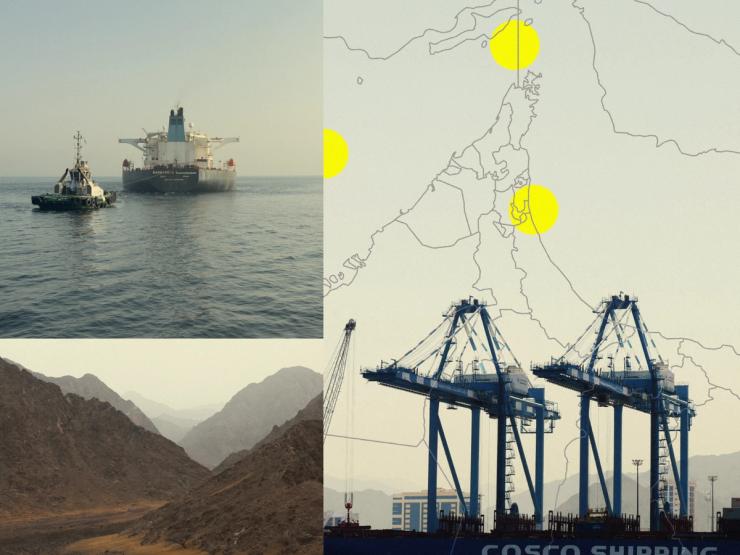
From the deck of one of the large tugboats used to guide giant crude tankers into Fujairah’s port, the UAE’s race toward its “Zero Hormuz” strategy is visible in every direction.
A carrier capable of moving two million barrels of oil was loading at the port’s lone jetty able to handle such vessels. Smaller ships occupied other berths, and one tanker was loading at an offshore mooring, with a UAE naval corvette standing guard nearby. On the horizon, in the haze, several more tankers lay anchored, engaged in ship-to-ship transfers, taking on oil shuttled through the Strait of Hormuz under US protection for delivery to customers around the world.
Fujairah — one of the UAE’s poorer emirates better known for its low-cost resorts and mountain escapes — is at the center of a regional push to reduce Iran’s leverage over Gulf trade through the Strait of Hormuz. Geography has become its biggest asset, and it’s not alone. Saudi Arabia is expanding its pipeline network, and Kuwait is in talks with Riyadh and the UAE to move crude through their respective links. Oman is also a likely beneficiary of the Hormuz disruption, with separate pipeline plans for its ports to safely ferry fossil fuels trapped in the Gulf.
For Fujairah, this race to bypass the strait could lead to a new liquefied natural gas plant, a refinery, and “a much bigger port,” Fereidun Fesharaki, chairman emeritus of energy consultancy FGE NexantEC, told Semafor. “This wretched war has created for Fujairah a once-in-a-lifetime opportunity.”
 Kevin Zweerink/Semafor
In this article:

Know More
Fujairah had been preparing for this opportunity long before the US-Iran war erupted on Feb. 28. Abu Dhabi opened a pipeline to the port in 2012 with a daily capacity of 1.8 million barrels of crude, giving itself an outlet beyond Hormuz, just in case. Photos of the port and coastline in the late 1990s show minimal oil storage and loading infrastructure. Today, tank farms line both sides of the coastal highway near the port, and a network of pipes moves products among terminals and to ships. A rail link from Abu Dhabi moves goods and recently began carrying passengers.
Glancing at a map of the UAE makes shifting assets east to the Gulf of Oman seem a relatively simple feat for a wealthy country dependent on exporting its resources. But the topography is a challenge: Craggy mountains press against the coastline, making land reclamation the only way to expand.
And while the opportunity is clear and few doubt the UAE government’s ability to execute, the territory is still subject to the same risks affecting the region.
Being outside Hormuz provides some protection for ships, but the vessels, tank farms, and port infrastructure remain vulnerable. Iran has attacked them all. War insurance has always been an issue for operators in Fujairah, and insurers have indicated they would need to see six months of stable peace before lowering premiums, according to two people familiar with the matter who have negotiated with insurance companies.
Thus far, Fujairah’s port has focused on the most valuable trade, leaving the import and re-export of building materials, consumer goods, and machinery to the much larger facilities in Dubai and Abu Dhabi.
That is changing. Cargo trucks now line the highway for some 10 miles, waiting for a chance to enter the ports. Ship-to-ship transfers are rising rapidly, from just a handful before the war to 80 in August and 120 in September, according to a person familiar with port operations. They mostly involve crude, but also aluminum, bauxite, and steel.
At a dinner during the Energy Markets Forum, organized by Dubai-based consultancy Gulf Intelligence, the word “resilience” was overused, but in this setting, it was appropriate: These are the people who have helped move oil consistently from one of the world’s most volatile regions for almost a century.
The business’s boom-bust cycle also came up. Fujairah’s historic advantage was as a link for ships coming through the Strait of Hormuz, but there are other ports to call at in Oman, which has friendlier relations with Iran than anyone else in the Gulf, and the question no one could answer was whether the boom during a crisis would carry on once shipping companies could return to their old routes.
For the people of Fujairah, though, the vacant plots of reclaimed land near the port that may soon accommodate an LNG plant and other productive assets may be enough to help them catch up to their wealthier compatriots in Abu Dhabi and Dubai.

Mohammed’s view
Iran has been threatening to close Hormuz for decades, and while Gulf states didn’t necessarily ignore the threat, they largely operated as if freedom of navigation through the waterway would remain the norm. Saudi Arabia’s and the UAE’s investments in pipelines were prescient. But like their neighbors without outlets beyond Hormuz, they concentrated most of their investment in cities and industrial zones inside the Gulf, within reach of Iranian missiles, opting to prioritize domestic economic development.
Today, the direction of travel in the region is redundancy and resilience. Gulf states don’t have much of a choice other than to invest in different routes and use whichever works best. If there’s peace, some pipelines and ports could lie dormant at times. That’s the price of keeping energy and goods flowing when enemies strike at the lifeblood of their economies.
All these contradictions are evident in Fujairah’s boom, where its geographic blessing offers no immunity from conflict. Iranian attacks there and on other pipelines in the region signal a future where Gulf states may also need alternatives to their alternatives.

Room for Disagreement
Fujairah and Oman are beneficiaries of efforts to keep oil and other exports flowing. But making the Strait of Hormuz, in US Treasury Secretary Scott Bessent’s words, a “worthless piece of water,” has always been hyperbole. It’s true that crude flows have largely recovered thanks to pipelines and US military escorts of tankers. But liquefied natural gas, fertilizer, metals, helium, and other exports, as well as all the imports that more than 60 million people rely on, can’t all move efficiently through alternative routes.
Qatar’s energy minister, meanwhile, has been emphatic in rejecting gas pipelines and relocating processing facilities to other countries, committing instead to LNG expansion in Ras Laffan. For other exporters, the trucking math doesn’t work: The CEO of Fertiglobe, one of the world’s largest exporters of urea and ammonia fertilizers, told me a typical ship carries 50,000 tons of fertilizer. Replacing it would take some 2,000 truckloads.

Notable
- Fujairah’s wartime role reflects years of investment in pipelines, ports, and trading capabilities, energy expert Robin Mills writes in The National.
- Abu Dhabi Crown Prince Sheikh Khaled bin Mohamed is leading the push to implement the UAE’s “Zero Hormuz” strategy, using the sovereign wealth fund he chairs to invest in logistics, Bloomberg reported.