



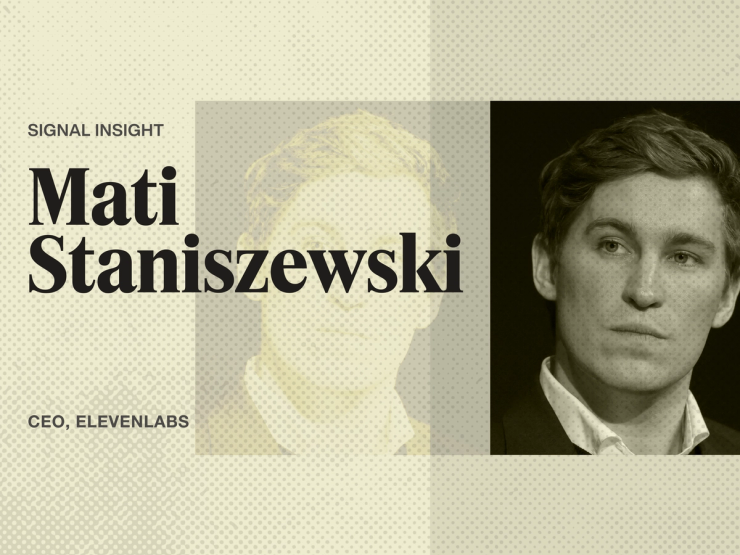

The Signal Insight
When Italian Prime Minister Giorgia Meloni moved to trademark her voice last week, she highlighted growing fears about AI deepfakes sounding ever more convincingly like the people they impersonate, from politicians to CEOs. But she also shone a spotlight on the fast-developing business of helping prominent individuals secure rights to their voice likenesses — and on the companies that say “voice AI” will soon become how many people handle customer service and corporate sales calls or interact with devices from cars to robots.
ElevenLabs established itself as one of the most highly valued of those startups this month with a $300 million employee tender, at a $22 billion price tag.
The London-based company has worked with celebrities from Matthew McConaughey to Sir Michael Caine to trademark their voices, and created a custom voice for Yahoo based on its co-founder, Jerry Yang. It says it has developed comprehensive safeguards to detect and prevent unauthorized voice cloning or other abuses.
Most of ElevenLabs’ revenues come from corporate customers like Deutsche Telekom and Revolut, and co-founder Mateusz “Mati” Staniszewski says businesses should prepare for a world in which customers increasingly expect to speak to AI agents rather than type with chatbots.
“Voice will be one of the key interfaces in the future; for a lot of use cases, the primary interface,” he predicts. “Voice is easier, it conveys a lot more information than text would, and it allows the technology to be present but not overwhelming.”
This conversation has been edited for clarity and brevity.
Andrew Edgecliffe-Johnson: Give us an example of the benefits you see in voice AI.
Mati Staniszewski: We have an AI interviewer for [sales and development representative job candidates]. Usually you go to the website and fill in a form. We added [the option] to speak with an agent, and a lot of people started engaging through conversation, and two things happened. One, the ease of making it quicker for you to speak than to type resulted in us having a lot more people [applying]. Two, people started leaving a lot more information than they usually would. We’ve had more than 3,000 leads come through this so far, and more than 500 were qualified, so they were good leads.
What should CEOs do to make sure their human employees are getting the most out of their AI agents?
If you don’t get this right, the other parts won’t matter. Ultimately, for an agent to work, it needs the right knowledge. It needs the right set of steps and workflow. It needs to understand what it’s doing. Like a human, it needs a lot of coaching in the early phases to make sure it works. And it needs the right guardrails and safeguards, so it doesn’t go off-script.
You don’t want competition between [humans and agents.] You want to find a way to bring people to manage the agents and be rewarded fairly for doing that well. And it’s not a one-and-done process. You keep improving, you keep iterating, and sometimes [you] need to jump in. You want to make sure that there is a loop: agent to human to agent. The key thing across all those efforts is that the AI agent needs to know when to bring in a human agent.
Are you looking to go public anytime soon?
We would love to go public one day. We would like to be ready — ready, but not necessarily go public — in the next 18-24 months. And then decide based on the wider side of triggers.
What’s the advantage, do you think, of going public when there’s been plenty of capital to power your growth so far?
We would love for [our users] to have the ability to be part of the journey, and the later you do it, the lower ability they will have. We see a lot of people building with ElevenLabs, and we’d love for them to have an ability to be part of that. There are other [advantages], but we are building a company to stand the test of time, and the companies we work with are looking for partners that are planning to be here in 50 years, in 100 years, and we want to be that company.
Sir Michael Caine’s voice is a big part of his identity as an actor. Why did he decide to work with you rather than against you?
We created, effectively, a marketplace where people can [record] their voice, we authenticate it, they can share it, and they earn compensation as a result. So we’re trying to bring the industry on board, and [people like Michael Caine] want to be part of that future too, assuming you find a way to respect their work and give them the ability to earn compensation [from it].
CEO impersonation scams seem to be very prevalent. Have you ever had that problem with your technology?
With our technology, you always have transparency into how [an AI voice] was generated. You can take action. So, if somebody [was scammed], we could assist. I’m not familiar with any CEO that was impersonated, but we have guardrails. So if you try to ask about money, that gets either blocked or detected and flagged for human review, so we can proactively take action. And then, if you want to clone a voice to a high [quality], you need to go through an additional authentication mechanism. So you cannot just clone a voice that easily.

Notable
- Staniszewski sees his company’s European roots — it was born in Poland and is based in London — as “a huge advantage.” London has plentiful talent which wants to “build something ambitious on a global scale,” he says. And because ElevenLabs focused from the start on the polyglot European marketplace, creating a model that could work equally well in many different languages “was never an afterthought.”