




Andy’s view
The Australian sinologist Geremie R. Barmé wrote that “autocrats and patriarchs share a fateful dilemma”: Once in power “the countdown to their demise is on.”
Mao Zedong’s long descent into ill health and madness brought China to the brink of civil war. Deng Xiaoping went out peacefully, though the decade before he died was marked by political upheavals, including the Tiananmen Square protests. Now, the Xi Jinping “death watch” has begun.
Of course, the big difference is that today China is at the center of everything.
As it drags on, the Xi “death watch” will become a global spectacle, moving markets, affecting investment flows, and shaping defense priorities. China’s internal risks are now the world’s risks.
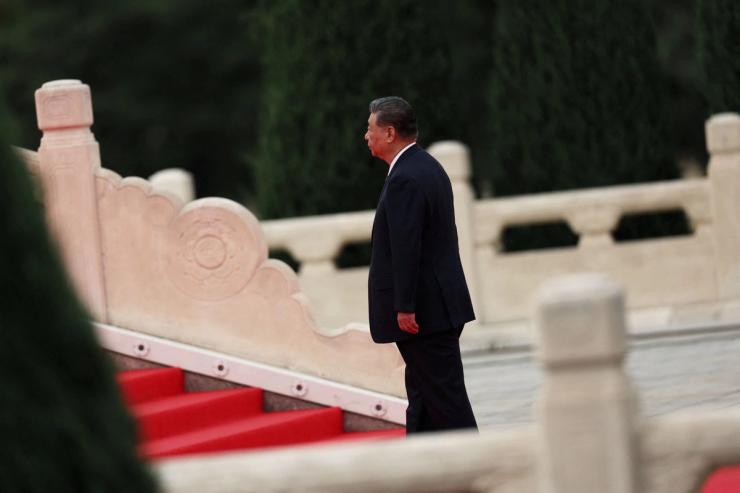
Xi’s physical condition is one thing. At 73, he’s visibly slowing; he looked fragile descending the stairs of his plane at Air Base Andrews when he arrived for a summit with US President Donald Trump last month, clasping the hand of his wife, Peng Liyuan, for support. The Wall Street Journal reported that Chinese officials made a highly unusual request for a “hold room” for Xi at the White House where he could take breaks between meetings, and his talks with Trump were surprisingly brief.
But the pressures building inside the Chinese system are largely unseen: Leadership politics, including the health of the top man, are as much a black box today as they were in the Deng era. But we can assume that from now on, everything that happens behind the high red walls of the leadership compound in Beijing will be connected, one way or another, to the vexed issue of how a post-Xi China will be governed.
Political transitions are the midnight hour for all autocratic regimes. But Xi’s dilemma is particularly acute: If he names a successor now to carry forward his policies and protect his legacy, he risks triggering a political knife fight years before he’s ready to relinquish power.
Wait too long, though, and he creates a dangerous political vacuum.
Either way, Xi will have to pick a relative unknown — all the current members of the Politburo Standing Committee are too old to step into his shoes — raising a host of troubling questions. Would a designated successor catapulted to the top be strong enough to command the loyalty of the powerful military? Could he hold the Party together?
Or could Xi himself turn on the chosen one? One of Mao’s designated successors, Liu Shaoqi, died of diabetes and pneumonia in solitary confinement, lying in his own filth. Deng cycled through two successors before settling on Jiang Zemin.
Xi has grown paranoid about those around him, his ruthless purges targeting some of his oldest, and most trusted, comrades. That doesn’t bode well for any potential second-in-command.
China now faces a period of prolonged political uncertainty. Carl Minzner, a US legal scholar and senior fellow for China studies at the Council on Foreign Relations, predicted a “long twilight” with the economy sagging, social discontent rising, and the state using “grid management” — surveillance techniques used to maintain control over Xinjiang and other restive border areas.
A succession struggle is unlikely to remain within China’s borders, Tyler Jost, a professor at Brown University, and Daniel Mattingly of Yale University argued in Foreign Affairs last year, noting that Xi’s prize goal is unification with Taiwan and “if he hears the succession clock ticking, he could become more willing to gamble on war.”
I’m betting that the end of the Xi era will look a lot less like Deng’s, whose passing created hardly a ripple — by then, he’d handed over power and put in place a system to ensure smooth leadership transfers — and more like Mao’s, a drama that involved a bloodless coup (the arrest of the so-called “Gang of Four” led by Mao’s widow), intervention by the People’s Liberation Army, and show trials.
We had a foretaste of this kind of turmoil when Xi took power in 2012. A carefully constructed power transfer was upended by the arrest of Xi’s main Politburo rival, and there were wild internet rumors of a military coup, tanks in the streets of the Chinese capital, and gunfire near the leadership compound.
Xi has wrenched China back to an era of one-man rule. But having attained the pinnacle of power — next year he’ll likely get a fourth five-year term in office — Xi now has to reckon with the consequences for his country. As Deng himself warned, “building a nation’s fate on the reputation of one or two people is very unhealthy and very dangerous.

Notable
- In 2025, during Russian President Vladimir Putin’s visit to Beijing, a hot mic picked up a conversation between Putin and Xi in which the two discussed organ transplants and the possibility of living forever. Musing on such procedures, Putin told Xi (through a translator) that with modern technology organs could be transplanted again and again so that “(you can) even achieve immortality.” While a largely hypothetical conversation, it hinted that staving off old age and death — maybe for eternity — is top of mind among the world’s most powerful autocrats.