




The Scoop
Every Thursday afternoon, a cadre of state AFL-CIO leaders meets on Zoom to advance a shared project: the “Contract with Working Americans,” a populist economic platform they devised independently of the national AFL-CIO.
These calls are a new organizing tactic for labor, which historically leads top down from Washington, and the goal is new, too: to mobilize not only workers who belong to unions, but the many more American workers who do not.
“We’re trying to connect two segments of a group that, quite frankly, should be naturally aligned, but just haven’t,” said Derrick Osobase, vice president of Communications Workers of America District 6, which covers Texas. “We are actively talking to working-class people who are not affiliated with the union, and wrapping them into an agenda that they have said will make their lives different.”
The idea for the “contract” was born of a paradox: Union membership has declined from 20% of all workers in 1983 to 10% last year, even as union popularity hovers at 90-year highs. Seventy-one percent of US adults approve of unions, according to Gallup, including 52% of Republicans.
The widening gap between those figures is where organizers see an opportunity.
“For years the labor movement, for understandable reasons, has fought for a narrower set of issues,” said Francis Eanes, executive director of the Maine Labor Climate Council. “But I think it’s made it easy for some folks to say we’re just another special interest out there fighting for our own.”
Skeptics of labor, he said, say a union is “a private welfare state that provides benefits to its members and no one else. I think it’s an unfair characterization, but it’s not entirely unfair.”
The Gallup numbers suggest Americans of different political shades seem to be concluding that private welfare states aren’t such a bad idea.
In a moment of declining trust in Congress, political parties, the media and many other institutions, labor activists believe a union-led movement whose stated aim is to agitate for the benefit of all workers could have real juice in setting a new national agenda as audacious as Newt Gingrich’s 1994 “Contract with America,” which helped produce a sweeping congressional majority for Republicans that year.
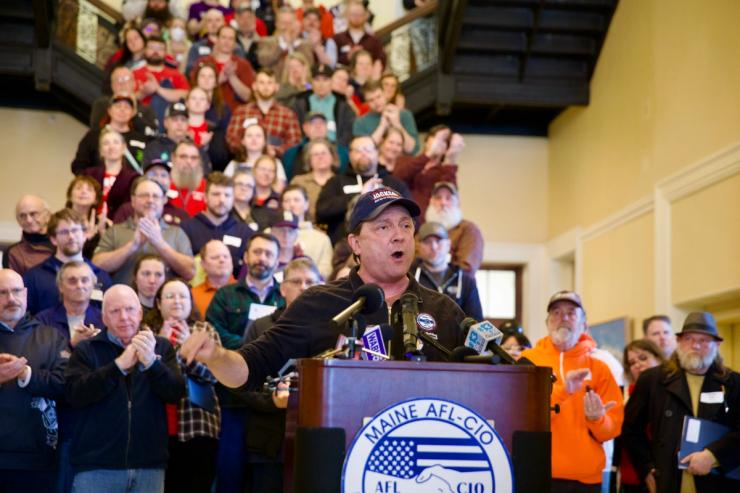
“Both political parties are wildly unpopular. Unions are more popular than ever,” said Matt Schlobohm, executive director of the Maine AFL-CIO. “It is really important that we — working people, the labor movement — define and put out an agenda and demand it. Or somebody else will define it for us, and it’ll be culture wars, or it’ll be some mealy-mouth opportunity agenda.”
The main tenets of the “Contract with Working Americans” were born out of a series of canvassing surveys led by state AFL-CIOs and affiliates. But there is no single document; iterations of it vary somewhat from state to state, to account for local trades and industries. (The national AFL-CIO did not respond to a request for comment.)
The “contract” framework was inspired by negotiated union contracts and is meant to establish policy commitments from candidates in exchange for the movement’s support. All versions include a set of economic priorities: Signatories must support lowering prescription drug costs by expanding the government’s power to negotiate directly with companies, expanding healthcare coverage, capping childcare costs, bringing down the price of gas, and raising the minimum wage.
The contracts adopt a populist tone throughout. They include shared language demanding a congressional stock trading ban and a ban on lobbying by elected officials after leaving office; a tax on billionaires; and, in a time of rising AI anxiety, a ban on AI surveillance, to prevent “robots deciding your paycheck, hiring and firing you, or monitoring your work.” The language does not include identity- or criminal justice-specific provisions, and largely steers clear of climate topics.
Several candidates with national profiles have signed on to versions of the contract so far this cycle, including in Texas, where Democrats hope that Senate nominee James Talarico and gubernatorial nominee Gina Hinojosa could make the state ground zero for a Blue Wave next month. Troy Jackson, the Democratic Senate nominee in Maine, delivered a public “Pledge to Working Mainers” adopting the demands in Maine’s contract.
Independent Alaska candidate Bill Hill, a commercial fisherman and teacher challenging Republican Rep. Nick Begich, told Semafor he supports the ideas in the contract, though there isn’t an Alaska-specific version of the contract to sign.
“This is about an agenda that delivers for the hardworking people of this country, by lowering costs, making sure hardworking people get the value of their hard work, and building a system where billionaires and big corporations play by the same rules we do,” Hill said in a statement.
Another state AFL-CIO, and its endorsed candidate for statewide office, have agreed to sign on as soon as this week, and more are circling.
No Republicans have backed one of these contracts. Organizers in North Carolina and Maine said that the campaigns for Republican Michael Whatley and Sen. Susan Collins had not responded to their outreach.
Still, organizers said they see progress. In interviews, most said they believe labor has long been too aligned with the Democratic Party, leading to a kind of “mutual malaise,” in the words of North Carolina AFL-CIO President Braxton Winston.
Eanes touted the contract’s potential to inject what he saw a bit of virtuous transactionalism back into the democratic process by energizing votes around specific policy demands, building back a kind of feedback loop that unions have down to a science.
“They have committed. We’re going to hold them to the fact that this contract has to be an essential part of how they govern,” said Osobase of Hinojosa and Talarico, though he declined to say whether that could entail supporting primary challengers in the future if either candidate gets elected and fails to deliver.
In this article:

Know More
State AFL-CIOs and affiliates conducted thousands of surveys of union members and non-union workers over 2024 and 2025, gleaning insights that were then distilled down to the bullet points that appear in the contracts. The Maine, North Carolina, and Texas AFL-CIOs and their affiliates have knocked hundreds of thousands of doors already this cycle, presenting voters with the contract and where the candidates stand.
“This project for us is about reviving the best of the labor movement,” Eanes said. “If you go over the arc of the last 200 years, we win more when we’re fighting for everyone: When the demands are broader, when the demands speak to the needs of all working people, that’s where we have the most power and resonance, and frankly, at a moment when most people don’t trust any institution, they still see organized labor as something that can be trusted.”
The contract’s most striking divergence from progressive ideological currents is on AI: No version of the contract reviewed by Semafor demands a data center moratorium.
The buildout has been an “enormous boon” to the building trades, Eanes said.
“At its best, [a moratorium] is something that buys you time to actually come up with what the terms of engagement for this entire new industry and enterprise ought to be,” Eanes said.
Instead, Maine’s contract makes a series of requirements: Data centers must pay their own way, supply their own water and electricity needs, and, of course, tap union labor — demands echoed by organizers in other states. And the contract wraps the argument in populist language; The point is to “ensure working people determine the AI future, not Mark Zuckerberg and Elon Musk.”

Room for Disagreement
Though it produced sweeping gains for Republicans, control of both chambers — and, in the House, 12 years of uninterrupted Republican rule — little of Gingrich’s original “Contract with America” ever became law.
Jimmy Williams, head of the International Union of Painters and Allied Trades, which represents some 140,000 workers across the US and Canada, told Semafor that he felt that organized labor had “been left at the altar way too many times” by the Democrats. (“I believe personally that the Republican Party has done such a better job at being principled.“) But the fact that the contract exists and has adherents in Jackson and Talarico is an improvement, he said.
“The candidates that are emerging within the Democratic Party are getting the message right when it comes to how to reach working-class voters that have been divided now for the last 20-some years,” Williams said. “It’s the start of a real conversation about how to build a movement to meet this current moment, and the Contract with Working Americans is the best place to start having those conversations.” But it also “needs to go a little bit further” by “adopting real labor law reform.”
The organizers’ theory is that the Contract with Working Americans could prove more enduring than Gingrich’s 1994 platform, especially if it gains more pickup and high-profile signatories in swing states this cycle and after Nov. 3.
Its potency, they believe, comes from the fact that it’s decentralized, not organized around a personality or set of personalities, and policy-first. Immediate results on the scale of the 1994 off-year elections would be nice, but are not essential: Everyone I spoke to made clear they didn’t see this as a project that ends on Nov. 3.
“I was trained that politics is not just something you do every two to four years around election times,” said Scott Cooper, chief of staff at UNITE HERE, a North Carolina AFL-CIO affiliate. “It’s something that continues on between the cycles.”

Notable
- At The New Republic, Monica Potts profiled some of the union members running for statewide office this cycle. “Working people are tired of politicians who talk about their struggles without having lived them,” an AFL-CIO spokesperson said.