




David’s view
Prick up your ears, and you can hear it — the sound of many different kinds of Democrats grabbing credit for midterm victories that aren’t official yet.
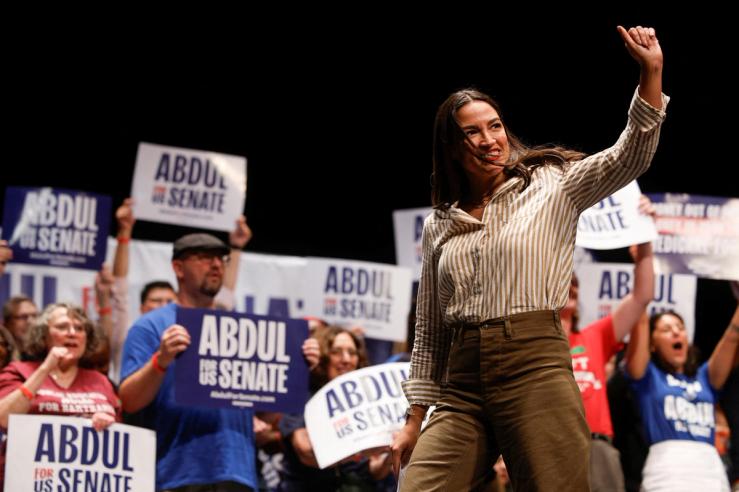
There’s Alexandria Ocasio-Cortez, assessing that when (not if) Abdul El-Sayed wins his Senate race in Michigan, the left will “break open the entire political calculus in America” — i.e., that progressives like them can win the Midwest. There’s Pete Buttigieg, making sure we know how many states he’s campaigned in (37) and how many candidates he’d endorsed (more than 100).
At this time in any campaign cycle, groups, candidates, and strategists pepper reporters with early claims that they were right. The election, they say, will be a referendum on their issue, a validation of their spending strategy, proof that their ideas moved votes.
These takes aren’t immaculate. I’ve never deleted the October 2017 email from a strategist who was ready to explain why Ralph Northam lost the election for governor of Virginia. In fact, Northam won easily, and that strategist got strategically quiet.
As preposterous as it is, though, the pre-spin cycle matters, because anyone not ready to contextualize what happened to their benefit will lose face.
It mattered in 2020, when centrist Democrats burst out to blame “defund the police” activists for their party underperforming the final polls. It mattered after President Donald Trump’s win in 2024, when Sen. Bernie Sanders instantly blamed defeat on the party having “abandoned the working class.” That quick analysis shaped the conversation.
Populism won. This is the Sanders project — progressives’ entire project, really. The goal of recruiting swing-seat populists and getting them through primaries was to prove, as Ocasio-Cortez said, that their kind can win anywhere, which should matter for 2028.
This theory may be tough to sell. One of its proof points was supposed to be Maine, where Graham Platner humiliated the party establishment, then himself. Progressives won the insta-caucus that replaced him, nominating Troy Jackson to face GOP Sen. Susan Collins, and Sanders will campaign for Jackson this weekend after some internal grumbling about whether consultants not approved by the left were ruining his campaign.
Michigan’s the ballgame now. An El-Sayed win would, for progressives, be the story of the midterms. Most of the movement’s primary victories came in safe seats, but to take control of the 2028 story, they want to be talking about El-Sayed winning, Will Lawrence flipping back a mid-Michigan district, and Randy Villegas unseating Rep. David Valadao in California. They want to say that hand-wringing moderates were wrong, and pure populism can flip or hold swing seats.
But if El-Sayed becomes the first Democrat to lose a Michigan Senate seat this century, progressives will enter 2028 with empty hands. What to watch: MI-SEN, MI-07, CA-22
Gerrymandering didn’t matter. This will be the biggest conclusion if Republicans don’t hold the House. And they’re already conceding partial defeat. “We’re not gonna win all 13 of those redistricted seats,” House Majority Whip Tom Emmer, R-Minn., told Axios this week. Indeed, Democrats are competing for most of the seats that Republicans tried to lift beyond their reach z– three in Texas, three in Florida, one in North Carolina, one in Ohio, one in Alabama, and as of this week, one in Tennessee.
When Trump first urged Texas to eliminate five Democratic districts, the most ambitious response was that Democrats could moderate and compete for them anyway. That did happen. Four of the Democrats whose seats turned redder voted with Republicans on a recent transgender health proposal; a fifth, Rep. Marcy Kaptur, D-Ohio, is running the most critical ads about “transgender ideology” of any Democratic incumbent.
While it might not decide who controls the House, gerrymandering did matter. It won’t have mattered enough if most of the remapped districts don’t flip. What to watch: NC-01, AL-02, TN-09, TX-15
Anti-trans politics stopped working. This is a complicated topic to spin; both LGBTQ rights groups and more cautious Democratic strategists are trying to set themselves up for it. “I hope that the headline coming out of November 4 is that equality voters won and anti-trans ads lost,” Kelly Robinson, the president of the Human Rights Campaign, told reporters on Monday.
Robinson wants that to be proven by victories for candidates who followed her group’s playbook, of responding to GOP attacks on a candidate’s gender voting record by answering them and pivoting. A small group of Democrats, like Kaptur, have used the language that activists find offensive; the HRC is ready to point to those defeats as evidence that using a conservative frame won’t win votes. What to watch: TX-SEN and OH-SEN for the HRC’s playbook working; OH-09 for a more critical approach paying off with swing voters.
[Insert 2028 Candidate] was the strongest surrogate. There’ll be fast post-midterm calculations of which Democrats and Republicans endorsed, and campaigned for, the most winners in congressional races.
The model for taking a scorecard into a presidential primary comes from Richard Nixon, who refurbished his reputation by campaigning across the country for Republicans in 1966 and got some credit for a good GOP year.
But every would-be president has approached this differently. Rep. Ro Khanna, D-Calif., has endorsed scores of candidates, some of them extreme longshots. He’s not going for a batting average; he’s trying to show people that his politics, and the attention he got by releasing the Epstein files, give him broad appeal.
Buttigieg has gotten the word out that he can draw crowds in Republican districts, and that the candidates are happy to have him. So has Sen. Mark Kelly; he doesn’t have Buttigieg’s reach but he’s made it known that Democrats in the toughest seats are happy to campaign with the astronaut from a swing state. And isn’t it convenient that Kentucky Gov. Andy Beshear, who leads the Democratic Governors Association, has to keep going back to Nevada?
Every 2028 Democrat will get a scorecard, and there’s already some chatter about how few Democrats want to appear with Kamala Harris — the only potential candidate who several have said they won’t appear with. What to watch: PA-07, NH-01, NV-GOV
The Latino vibe shift is over. This argument is already being written: Texas Republicans, and maybe even Florida Republicans, misinterpreted the 2024 Latino vote as a permanent shift away from Democrats.
Public and private polling has found the Latino vote slipping back to Democrats, who are recovering to where they were in 2018 and 2020, wrecking the GOP’s congressional map. The clear reason for this is Trump’s aggressive immigration enforcement policy, which swept in people with no criminal records, but some Democrats are already warning the party not to celebrate too hard.
“The vote is probably moving somewhere in the neighborhood of 15 to 20 points or more back to Democrats,” said Chuck Rocha, a strategist working for Latino Democrats in Texas. “[It’s] not because they’re in love with Democrats, but more they’re just so angry about the economic downturn with the overarching fear of ICE in their neighborhood.” There will be time for Republicans to adjust before the next election. What to watch: TX-15, TX-34, TX-35, FL-09

Notable
- In Politico, Jonathan Martin got some pre-criminations from Democrats who are already worried that they’re leaving winnable races for governor uncontested, because their donors think Senate races are the way to “stop Trump.”
- For CNN, Edward-Isaac Dovere looked at El-Sayed’s campaign in Michigan, and how Democrats were already processing what might happen if he doesn’t listen to their advice.