



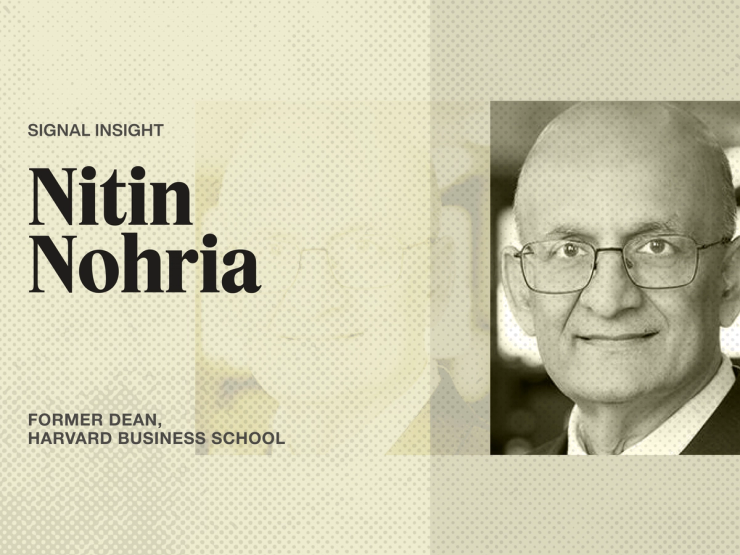

The Signal Insight
Nitin Nohria spent a decade as dean of Harvard Business School, and taught his first workshop there for new CEOs in 1997. Many of today’s business leaders think of that era as an easier one to navigate, but he rejects the idea that today’s technological and geopolitical upheavals have changed what companies need from their leaders.
The demands of the job have been “more constant than different,” he says: The people who respond well to the conditions of their time “end up writing a great chapter, and the people who respond to it poorly don’t.”
Nohria has distilled such insights into a new book, The CEO: The Role, the Reality, the Responsibility. Its most important message, he says, is that the CEO’s job is “not to make all the decisions, but to create the conditions that allow other people to make decisions well.” Leaders should invest their time “to multiply impact rather than to answer demands.”
Nohria also chairs Thrive Capital, whose founder and managing partner, Josh Kushner, recently backtracked on a plan with FIFA to commercialize the World Cup, after it generated a fierce backlash. Kushner has invested in OpenAI and SpaceX, and his former HBS teacher sees AI as the defining challenge for this generation of CEOs — even if it also offers an answer for those who find it lonely at the top.
The technology heralds a new era of decentralization, he believes, and that will make the people CEOs have surrounded themselves with feel threatened. But the leader’s job is “even more compelling” in a decentralized organization, Nohria argues. “Vision, alignment, purpose, culture — these things will become even more important in the future of these organizations, and that is uniquely the job of the CEO.”
This interview has been edited for clarity and brevity.
Andrew Edgecliffe-Johnson: AI is a transformational technology. What do you think it changes about the CEO’s role?
Nitin Nohria: We don’t have visibility yet into all the ways in which AI is going to play out in the lives of a Fortune 500 CEO, how much AI will rearchitect firms’ business processes and workforces, or where we will see opportunities for new revenue. But I’m sure that any CEO who comes of age today, if they haven’t come up with an answer to that by the end of the decade, will not be [a] great [CEO].
The second part, though, is that AI provides opportunities for CEOs to have a virtual board of directors, a new person on the team, and a way of interrogating their own thinking which may reduce the loneliness of being a CEO. If you end up using it as a substitution, I think you’ll probably end up making a mistake. But if you say, “It would be nice to have, out of the eight people in my executive team, two people who bring to us a superintelligence on an ongoing basis that informs our discussions, interrogates our discussions, causes us to think differently, and forces us to make judgment calls better,” that could be a plus.
To what extent does AI change the structure of the modern corporation? Companies have organized themselves in functional silos, and this is a cross-functional technology.
As a student of organization structure, it’s been striking to see the pendulum swing between decentralization and centralization over time. I think that this will be a moment of decentralization again. Because what was the reason to have a large headquarters? It’s because we could not hire enough CFOs or general counsels to put into every business. [Companies] say, “These are precious forms of expertise. We want to keep them in the center.” But now you could bring all of that intelligence to the edge. I think this is going to be another decentralizing moment in which we can bring the expertise that resided in the headquarters back out to the front lines.
Is that threatening for the central power of the CEO?
Some of the current friction in the adoption of AI comes from the fact that it does restructure power in an organization. When power changes in organizations, companies end up having friction to adapt to that power. Because there’s one thing that is eternally true about human beings: that nobody gives [up] power easily. I’m not sure that it makes the CEO necessarily less powerful. I think it makes the corporate infrastructure that CEOs have usually surrounded themselves with feel more threatened.
The subtitle of your book is The Role, the Reality, the Responsibility. Are we entering a new realm of CEO responsibility when some CEOs are overseeing technologies they say could end humanity?
AI will create yet another set of profound responsibilities to make sure that businesses’ relationship with society is not one in which society says business is harmful. All these CEOs will have an added [responsibility to] navigate AI so that people feel that this moment was to the benefit, in the end, of society, even though there are often some dislocations along the way. You do have to, as CEOs, be responsive to the fact that your license to operate comes from society.
How do you apply these principles in your role as chairman of Thrive?
My role at Thrive is at its core to remain a teacher. Josh [Kushner] and others knew me as a teacher, and the job of the teacher, in my experience, is much more to ask the right questions than say that I have the right answers, and to ask questions that interrogate our thinking, that force us to think more deeply.
What was your role in Thrive’s recent discussions with FIFA, and how does the way that investment idea played out map to the themes of your book?
A central part of my role as chairman of Thrive is to work with the leadership team, asking questions and helping them think through the choices they face. In my book, I write about how difficult it can be for leaders to revisit their own decisions, especially when they believe strongly in what an idea could achieve. CEOs will not get every judgment right, but that alone should not stop them from being ambitious. I believe what matters in these moments is having the courage to take responsibility within the organization and learn from the experience. That is what I observed in Josh: a willingness to acknowledge that things had not worked out as hoped and move forward.
What would you say, of all of the things that you’re covering in this book, CEOs struggle with most frequently?
Staying connected to the reality of the business. Its natural gravity is to draw you away from this reality. I studied how CEOs spend their time, and the giant surprise for people is how disconnected they are from the front lines of their own businesses. So a [typical] CEO will spend 30% of their time with their top management team, and less than 5% of the time with the front lines. Truth is closer to the reality of the customer, and it’s the front lines who are leading the customer. A CEO is at risk over time if they’re not spending any time there, and they’re getting all of that information filtered through the system. They have to be super disciplined to stay connected with the reality of the business.

Notable
- The skills that help someone land the top job aren’t necessarily the ones that make them successful once they get there, Nohria told an HBS podcast. One of the biggest surprises for new CEOs, he says, is realizing that they can’t — and shouldn’t — run the company themselves.