




The Scene
A prominent researcher is warning the world is on the verge of a massive transformation thanks to the emergence of a new technology that could drastically benefit society or cause massive destruction. No one quite understands how it works, or whether governments should step in.
It’s 1941 in Omaha, Nebraska, where the physicist Arthur H. Compton is giving a lecture about how the possibilities of sub-atomic energy are “so breathtaking that even those who know most about it are somewhat uncertain, and a little awed, about it,” according to a writeup of the event in The Lincoln Evening Journal.
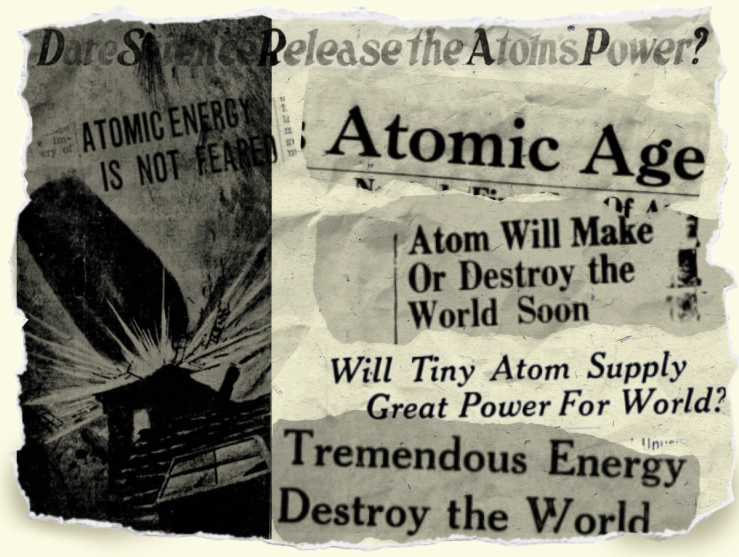
While not a perfect allegory, a review of newspaper archives from the early 1900s shows some striking parallels between the early days of atomic energy — which would later be called nuclear energy — and the public discussion around the danger of extinction from AI today. Just like there are today, there were doomers and skeptics, utopian boosters and scientists pleading for calm.
The look back shows the familiar societal cycle around powerful technology, spanning excitement, anxiety, and dread. But the past is also a warning to today’s AI executives and government leaders that it shouldn’t take mass destruction to force a consensus on human safety.

The View From 1919
In 1919, Sir Oliver Lodge, a prominent British physicist, told a British scientific society that there’s “enough atomic energy in an ounce of matter to destroy a continent,” per an editorial in a local Iowa paper, and that he hoped “good and wise men” would control it, rather than evil forces. That same year, Ernest Rutherford first split the atom. H.G. Wells had coined the term “atomic bomb” just five years earlier, in his 1914 novel The World Set Free.
In 1921, an English baron worried that future wars would be fought by someone in an office pushing a button.There was also skepticism around the technology and its potential that year: A 64-year-old Nikola Tesla said in an interview that “even if for purposes of destructive warfare we could liberate atomic energy, it does not follow that it would be deadly.”
The View From 1925
A Sunday feature that ran syndicated in newspapers across the country asked: “Dare Science Release the Atom’s Power?” It spelled out “fears that this tremendous energy might destroy the world,” alongside an image of an express locomotive, the most powerful machine of the time — evoking imagery of a runaway train. Atomic energy, the piece noted, held enough power in a drop of water to run 500 locomotives for an hour.
Six years later, Compton announced he was studying the release of atomic energy, which he said could bring “radical change in civilization,” in an article in the The Associated Press. This was a time of major scientific optimism that a world-changing breakthrough was near. One wonders what these pundits would have thought about microchips and data centers.
The View From 1939
Scientists had just confirmed nuclear fission — splitting the uranium atom and releasing its energy — on both sides of the Atlantic, and found themselves looking to calm an increasingly anxious public.
Physicists wanted there to be “no public alarm over the possibility of the world being blown to bits by their experiments,” the Science Service syndicate wrote, and blamed Wells for instilling a sense of doomerism. Scientists feared a “revolution” among the public, while insisting that the release of atomic energy could only be achieved “by direct intent, in the laboratory.”
The View From 1945
The atomic bomb changed everything. President Harry Truman said that scientists had created a monster that could wipe out civilization, and called for some sort of protection around the secret. Some physicists lobbied against dropping the bomb and had even previously suggested there be an international plan for controlling nuclear weapons.
Shortly after the explosions at Hiroshima and Nagasaki, media archives show there was a mix of public reassurance, worry, and debate over international nuclear governance. One physicist told a club in Australia that there was “no need to be afraid” of atomic power, while a historian told a Rotary Club in Missouri that the world might be destroyed “by a small group with nazi ideals or by an accident,” and proposed placing all atomic information under UN control.
The US would ultimately create the Nuclear Regulatory Commission in 1975 — three decades after Hiroshima — as an independent civilian nuclear watchdog. The international picture is patchier: Various treaties govern nukes, and the major players often can’t agree on terms. The last treaty limiting US and Russian strategic arsenals, New START, expired in February, leaving the world’s two largest nuclear powers without binding limits for the first time since 1972.

J.D.’s view
It can be overwhelming to think about whether AI is going to herald the end of the world, so it’s sometimes helpful to gather perspective and realize we’re not the first generation to have these kinds of debates. Not everything we’re living through is unprecedented.
In talking with folks across the tech ecosystem over the past week, I got the sense that the industry isn’t banking on US regulation, and that it will take a more drastic incident than the Hugging Face hack for lawmakers to take any sort of action. That’s not a comfortable thought.
The most worrying thing from reading the archives from the early 1900s was that serious discussions around governance and regulation for atomic energy didn’t happen until it was used to bomb Japan and kill an estimated 200,000 people. And that even today we don’t have a firm handle on nuclear weapons, let alone AI.

Room for Disagreement
There are some serious limits to the AI-nukes analogy, nuclear policy expert Ankit Panda wrote in February in his newsletter, Nukesletter. For example, unlike the fissile material at the heart of a bomb, AI compute is far harder to count and control.
It’s also unclear, he wrote, whether AI will “have its proverbial ‘Hiroshima moment.’” Instead, as AI adoption accelerates, its effects may instead come to resemble electricity or aviation, “with the effects shaping geopolitical dynamics and warfare over a more protracted period.”