



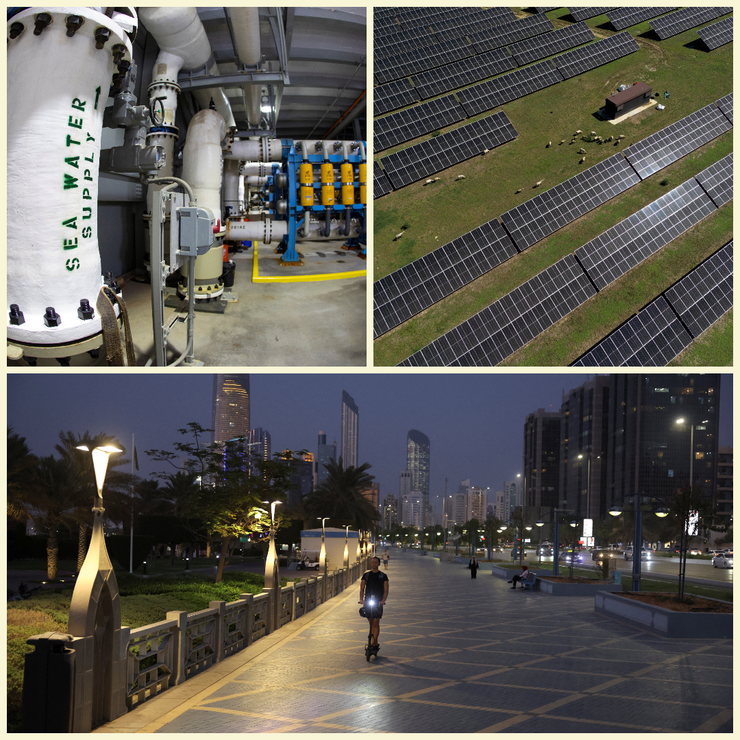

The News
Electricity use in Abu Dhabi reached an all-time high in August despite a summer exodus of residents, as demand on the emirate’s power grid remains on pace to nearly double between 2025 and 2035, Department of Energy Chairman Abdulla Humaid Al Jarwan told Semafor.
To meet the demand from a growing population, industrial expansion, and AI infrastructure, the emirate is investing 300 billion dirhams ($81.7 billion) by 2035 to add capacity and shift to cleaner sources, Al Jarwan said. It’s also transforming its water system to reduce reliance on gas and make seawater desalination cheaper and more efficient.
The UAE was the Gulf country most heavily targeted by Iranian drones and missiles in the early months of the war. This was a major test for power and water suppliers, Al Jarwan said. “I think it’s a privilege that we managed to test our system under real disruption in real time, and we perform[ed],” he said, adding that services weren’t interrupted during the conflict.
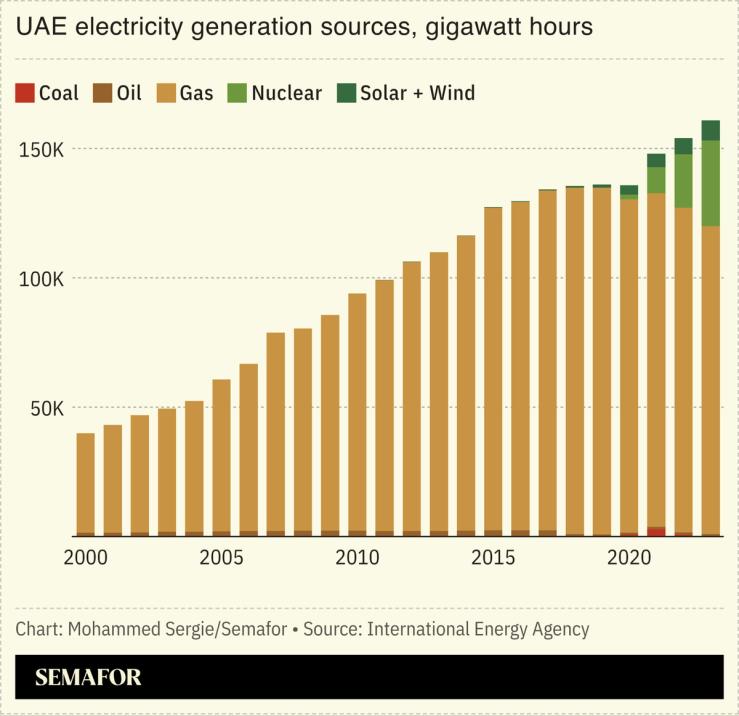
The Barakah Nuclear Energy Plant was targeted by a drone in May, but the strike didn’t cause a leak or major disruption. The Arab world’s first nuclear power plant, which supplies about a quarter of the country’s electricity, was built to withstand the impact of a large commercial aircraft.

Know More
Abu Dhabi is now focused on expanding solar power and reducing its reliance on gas to produce potable water. With about 6.7 gigawatts of installed solar across the country, Al Jarwan said the department aims to add 3 GW per year in Abu Dhabi, plus round-the-clock battery storage, over the next decade.
Clean energy, including nuclear power, rose from 1% to 47% of Abu Dhabi’s power mix in the last 10 years, Al Jarwan said. That shift matters for water, too.
Desalination is the UAE’s main source of fresh water, supplemented by strategic storage, aquifers, recycled water, and groundwater. The capital’s Liwa reserve could supply 1 million people with potable water for 90 days during an emergency.
Gulf desalination has relied mostly on thermal systems that boil seawater with waste heat from gas-fired power plants. Abu Dhabi is accelerating a shift toward reverse osmosis, which can run on electricity from any source. The emirate aims to use reverse osmosis for nearly all its desalination by 2035, up from around a quarter in 2022, according to the Department of Energy.

Step Back
Water is becoming the latest soft power tool for Abu Dhabi. The emirate wants to deploy its technology, expertise, and capital abroad, according to Al Jarwan, who has traveled to the US, China, Europe, and Singapore in recent months meeting with counterparts.
With energy and water systems needing to be more resilient, now “it’s all about us differentiating the Abu Dhabi system from other systems,” Al Jarwan said. The goals are to “deploy at scale, have a positive impact, and make sure that we globalize the message when it comes to water and energy.”
Abu Dhabi will co-host the UN Water Conference with Senegal in December, alongside the Department of Energy’s inaugural Water and Power Week, which expects more than 25,000 visitors. It will be a chance for Al Jarwan — and the UAE — to make their pitch for solutions to the global “water bankruptcy,” as UN researchers describe the crisis.
“If we create a sense of urgency, and Abu Dhabi manages to showcase the deliverables that are on the ground today, the world will learn a lesson that things are doable, water is manageable,” Al Jarwan said.

Notable
- Abu Dhabi renewable energy firm Masdar is constructing what it says will be the world’s largest 24/7 solar-and-battery power project. The $6 billion project is slated for completion in 2027, Semafor reported last October.