




David’s view
If you don’t appreciate how quickly Democrats are entering attack mode against AI, just count the groups they’ve started since our last edition alone.
There’s Tomorrow Together, the new PAC formed by veterans of the Bernie Sanders and Kamala Harris campaigns, working to make theirs “the party that wins on AI.” There’s Who Decides, launched by New York state legislator Alex Bores in the wake of his failed House bid, which became a proxy war between AI industry PACs.
Joining the list today: The Stop Bleeding the Future pledge. Developed by an array of progressive groups, it commits candidates to “refuse all money from” the most active AI industry PAC and to “condemn its efforts to stop commonsense AI laws.” Its first signatories include Rep. Greg Casar, D-Texas, who had warned for months that the party needed AI policies that weren’t written by the companies.
QuitGPT, the coalition that wrote the pledge, began circulating it in May. “We want to make them irrelevant and toxic,” Michael Baick, one of its organizers, said when we talked yesterday. “We want any politician or staffer who gets an email from these guys to think: This is bleeding the future.”
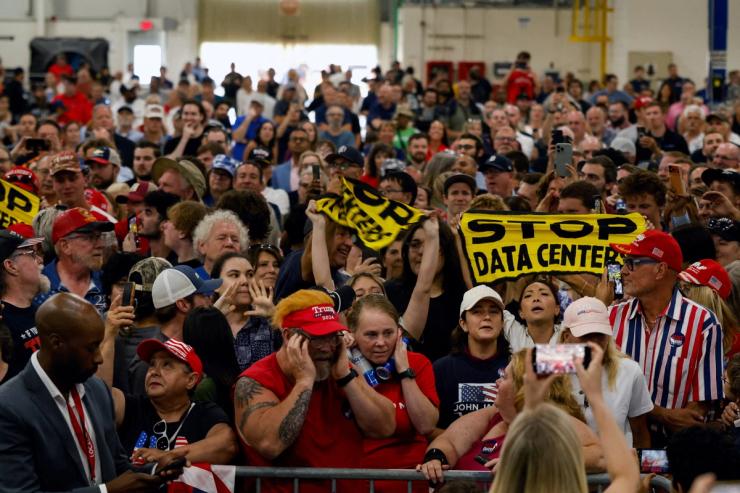
They might not need much pushing. In the year since I covered voter anger at data center construction in Virginia, AI angst has moved from the political frontiers to center stage. I spent most of Tuesday at the Pro-Human Assembly, where Steve Bannon and Sen. Bernie Sanders, I-Vt., anchored a day of nervous programming about the dangers of AI and the need for “guardrails” built by an accountable government.
“I don’t think a pledge should be limited to [the Leading the Future AI industry PAC], because they’re already finding ways to shift their money,” Bores told me. “But they’re toxic to this debate.”
Leading the Future chose not to comment on the “bleeding” pledge. Below the surface, there is a lot of contemptuous finger-pointing about where the anti-AI energy now coursing through the political-media landscape is coming from. What’s the role of Effective Altruism, and that movement’s money, in fueling “doomerism” that will advantage one company at the expense of another?
But we’re in the middle of an election, with ballots in the mail, and the Democratic Party’s conversation about this is pretty simple. They see a president who isn’t popular, an industry that’s less popular, and — when those are combined — a very straightforward story about wealthy job-destroyers using their political access to put everybody at risk.
“I say to them that if you believe in democracy, if you believe that the people have a right to determine their future, stop pouring hundreds of millions of dollars into super PACs,” Sanders said at the conference.
Sanders was one of the first left-wing politicians to understand the backlash against data centers. The topic came up during his “Fight Oligarchy” tours. He polled audiences on what was happening in their towns and what was making them anxious. The answer, quite often, was AI.
There are some Democratic skeptics of Sanders’ approach here, and his own thinking about the world-ending danger of AI — an idea that is pushed hard by Effective Altruists. But I am starting to see wide adoption of his people-versus-Silicon Valley approach.
I expect to see more after Tuesday, when Senate Democrats sank the Clarity Act, the top priority of the cryptocurrency industry for the last two years, without much worry about the consequences.
Republicans could resurrect the bill after the midterms, but it’s not likely after a failure this big. The crypto industry spent more than $130 million on the 2024 elections to put friendly politicians in office, from both parties — out of necessity, because the filibuster wasn’t likely to get busted for their bill.
Democrats like Sen. Ruben Gallego, D-Ariz., and Sen. Elissa Slotkin, D-Mich., got help from the PACs, on the expectation that they’d be amenable to collaboration if they won their 2024 races.
But the dynamics shifted quickly. The president and his family had made more than $1 billion from crypto. How could Democrats go home and tell their voters that they’d enriched the president on behalf of an industry that funded their campaigns? Gallego, speaking for a lot of Democrats, decided that Republicans care “more about making sure the president keeps making money than actually bringing regulations.”
The anti-AI push comes from the same thinking. The president can be counted on to denounce AI regulation. That makes it easier to run against when he’s unpopular, and impossible to support when Democrats want to win their own primaries.
“The industry still thinks soft dollars will buy them love, in part because of the mistaken belief that the crypto playbook is repeatable,” said Sam Silverman, a Democratic strategist advising candidates on AI messaging. “It’s not. Voters don’t give a f*ck about crypto. When AI is the defining topic of the election, do you think taking millions from Marc Andreessen, Greg Brockman, and Joe Lonsdale will be palatable to the base?”
In this article:

Room for Disagreement
Across the aisle, the president’s party is more divided over AI than it was over crypto. Florida Gov. Ron DeSantis, who got flattened by Trump when he ran for president, was also early to data center skepticism, and keeps warning Republicans that they don’t want to be identified as reflexively pro-AI.
“If they say, ‘Hey, we protected you against rate increases, we made sure local communities would be able to choose what type of, if any, they want in terms of construction, and then we want to have an AI bill of rights,’ that’s where you get huge majorities,” he said this week.
In a poll provided to Axios, the president’s pollster urged Republican candidates not to say clippable pro-data center things on camera, while endorsing consumer-friendly regulations on data center construction. That advice hasn’t really changed since the spring, when the president first started signing tech companies onto a “pledge” to help pay for their power use.

Notable
- Politico’s Jasper Goodman covered how Democratic frustration at the Trump family’s buckraking was making it much harder for Republicans to pass crypto legislation, despite the threat of crypto spending. “That war chest doesn’t loom as large as it did last cycle.”
- In The Washington Sun, Elena Schneider, Alex Roarty and Jeff Stein looked at how the 2028 Democrats were studying up on AI, and who they were talking to. “Even if potential candidates and their advisers are talking about them behind the scenes, not all are eager to discuss them publicly yet.”