




Andy’s view
The last time US President Donald Trump addressed the United Nations, he mocked the body for its “empty words,” and his administration has since exited 31 UN entities covering climate, gender, peacebuilding, and science.
China is only too eager to fill the gaps. Its diplomats are packing UN agencies to shape their agendas, especially those that deal with technical standards — Beijing wants to write the rules for AI and other frontier technologies — and human rights, where China feels vulnerable to Western attacks. Bloomberg reported last month that Chinese authorities are mulling a bid to host the UN climate summit in 2028. One senior Chinese academic says Beijing should press for the relocation of the UN headquarters from New York to Shanghai (or, as he put it, “from the Hudson to the Huangpu.“)
That won’t happen anytime soon. But Chinese leader Xi Jinping clearly sees history headed in that direction.
As he prepares for a summit this month with Trump in Washington, DC, Xi has embarked on a whirlwind tour of Global South countries to sell a story that the US has turned rogue, having given up on the progressive institutions it created after World War II, including the UN and its associated agencies. In his telling, Beijing is now the responsible steward of that system, standing firm against “double standards, exceptionalism, foreign interference, bullying, and law of the jungle.”
In effect, Xi is trolling Trump as he lobbies the world’s most populous and fastest growing economies. It’s a geopolitical power move aimed at shaping the dynamics of their meeting. Julian Gewirtz, a prominent China scholar, says Xi wants to show that Beijing has “friends and options around the world.”
Of course, it’s easy to see through the hypocrisy behind Xi’s messaging — just ask the Philippines about China’s bullying — but his pitch still resonates with developing countries that resent the US-led status quo, and it’s accompanied by pledges of trade, investment, and technology. In Kyrgyzstan last month, Xi inked agreements to integrate the economy of western China more closely with Central Asia, advancing an inter-bank payment system, border-crossing infrastructure, and a freight railway link that will require the construction of 50 bridges and 29 tunnels.
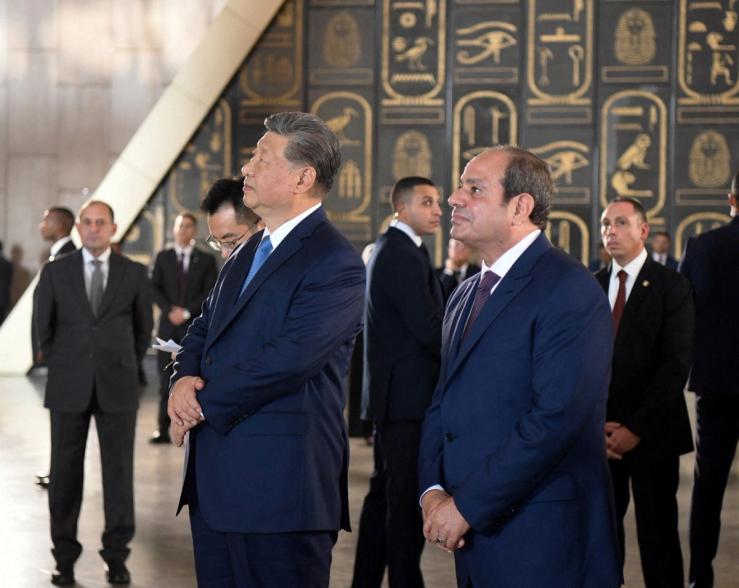
Days later in Egypt, Africa’s second largest economy now staggering under the impact of the wars in Iran and Gaza — Cairo’s revenues from the Suez Canal have cratered by 60% — Xi offered help on AI development. Huawei is reportedly bidding to construct data centers for the Egyptian government and supply high-end chips.
Among leading Chinese academics, there’s little doubt that a Sinocentric order is approaching. “Pax Americana is coming to an end,” asserts the international relations expert Da Wei, a professor at Tsinghua University. “America has not simply decided that it ‘does not want to be a hegemon’ any longer. More accurately, America is unwilling to continue bearing the costs.”
In fact, China has little interest in replacing the US as the chief financier of global “public goods.” Beijing is quite happy, for now at least, to watch as the US drains its treasure policing the world’s sea lanes, keeping transnational drug gangs and fraudsters in check, and maintaining global financial stability.
Even within the UN, China’s financial contributions are relatively modest. It funds 20% of the body’s regular budget, just behind the US, and is the second largest contributor to peacekeeping operations, but doesn’t come close to matching the US when it comes to underwriting global economic development and humanitarian operations. More than anything, Beijing is pushing the UN to mirror its political values both as a defensive strategy — autocracies have a pathological fear of democracy, “color” revolutions, and the liberal ideas that animate them — and an offensive play: China’s ultimate goal is to replace the US at the heart of global governance, which means challenging democratic norms.
In Washington, Xi’s ostensible agenda will be preserving the “constructive strategic stability” that he and Trump agreed upon at their last summit, in Beijing in May.
But his true ambition is immensely disruptive: One at a time, in the run-up to his White House talks and state dinner, Xi is winning over voting members of the UN, building the grand coalition he needs to move China, as he describes it, “closer to center stage.”

Notable
- A new book by China scholars seeks to fill a vacuum in the “vocabulary or concepts to understand” Beijing’s foreign policy strategy, the president of the European Council on Foreign Relations writes in the Financial Times.