





Yinka’s view
West African governments are competing for something that, by definition, belongs to the region as a whole: the descendants of Africans taken during the transatlantic slave trade.
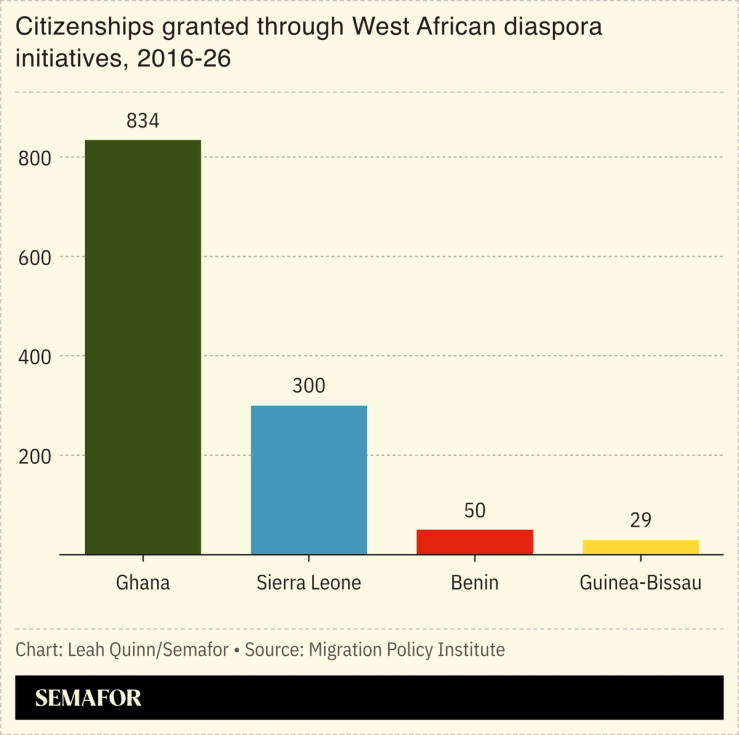
Benin, Ghana, Guinea-Bissau, and Sierra Leone have all created pathways to citizenship, hoping to turn ancestral ties into tourism, investment — and lasting connections. Benin has even recruited Hollywood director Spike Lee, who received citizenship and became an ambassador for the initiative.
There is a powerful historical logic to the effort. The West African coast was a major departure point for millions of forcibly removed people. For descendants, citizenship can be more than a passport — a formal restoration of a connection that was deliberately destroyed.
The economic logic is less proven. The programs are vying for a diaspora that is potentially enormous, yet only 1,213 people received citizenship through the four initiatives from 2019 through 2026, according to the Migration Policy Institute. The actual number may be higher, since there is no centralized data, but there’s still little evidence these programs have generated significant, sustained investment.
That doesn’t mean the opportunity is small. Diaspora communities can bring capital, business networks, skills, tourism, and political connections. Ghana’s “Year of Return” in 2019 showed the potential by boosting tourism, and the country has since formally recognized its diaspora as a “17th region.” The African Union has likewise made reparations a major political priority.
The question, then, is whether West Africa should be competing over this market at all. The countries share much of the same history and, to some extent, the same pool of potential returnees, investors, and tourists. Yet their rules, fees, ancestry requirements, and political rights vary widely, risking turning a powerful idea into a collection of competing citizenship sales pitches.
Ecowas or another regional body could fix that. A common framework for diaspora citizenship, residency, investment, and heritage tourism would give the region more credibility, ease the process, and reduce the incentive for governments to outbid one another.
West Africa shares a history with its diaspora. It might make more sense to build a shared economic strategy around it, too.

Notable
- A UN committee said that countries are legally obliged to consider reparations for the transatlantic slave trade, The Guardian reported, as well as other methods of compensation to address the legacy of racism.