




The News
Armenia is underscoring its commitment to the transit and energy corridor known as TRIPP, or the “Trump Route for International Peace and Prosperity,” while also seeking to keep ties to Russia and Iran, its ambassador to the US told Semafor.
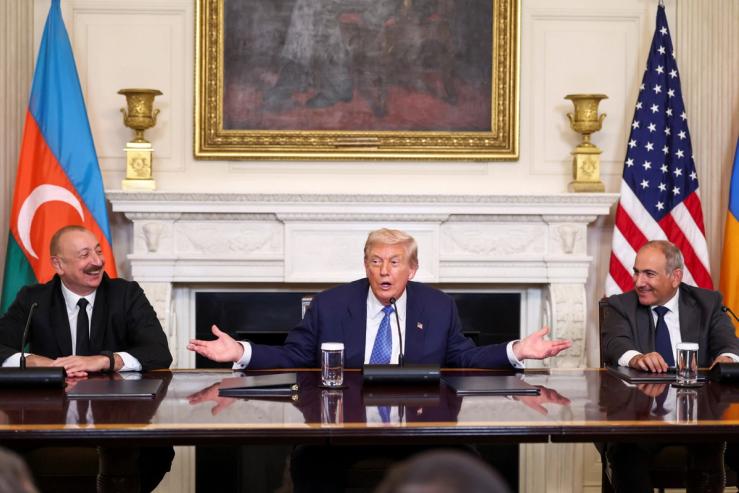
Ambassador Narek Mkrtchyan said in an interview that Armenia is comfortable with the US government’s 74% stake in the developer of the proposed corridor, viewing it as critical to the peace agreement that the country and Azerbaijan signed alongside Trump last year. The accord has yet to be formally ratified, and the ongoing war in Iran has sparked questions about progress on both the deal and the corridor.
But Mkrtchyan said that TRIPP is moving forward, with a feasibility study expected later this year and a groundbreaking possible as soon as early next year: “Without TRIPP, the conversation for peace would be impossible.” The US government has committed about $201 million so far to help fund it, with ultimate related economic development pegged at $1.5 billion.
The Trump administration is facing questions over its increasingly direct economic involvement in Venezuela after it ousted that nation’s leader; most recently, the US government took an equity stake in a private oil company developing fields there. Mkrtchyan professed no similar concerns about the US role in TRIPP, saying that “Armenian institutions” would retain decisionmaking power and that the Trump administration’s majority stake indicates it would remain a “key supporter.”
Simultaneously maintaining relations with its neighbor Iran and the US might seem like a daunting task given their ongoing conflict, but Mkrtchyan described it as a deliberate choice.
He added that Armenia is “ready to sign the final” agreement with Azerbaijan, though issues — like Azerbaijan’s insistence that Armenia remove a reference in its constitution — are still being worked out. The neighboring nations waged a brutal, years-long war followed by repeated clashes over the breakaway territory Nagorno-Karabakh, which Azerbaijan formally took control over in 2024.
“Both governments, like high-level politicians, they really want to put effort for the final peace treaty, but we need also to bring our societies closer,” Mkrtchyan told Semafor. “I think this is [the] most difficult part. It will take time because the pain [is] still fresh.”

Know More
Though the Trump administration has pressured most other countries to cut off economic ties with Iran as it seeks to ratchet up pressure on Tehran to return to the negotiating table, Mkrtchyan indicated to Semafor that Armenia has not had any such conversations with the US.
He said the bilateral relationship remains focused on TRIPP and upcoming goals for the project.
Asked how Armenia would respond if the US did make such a request regarding its trade relationship with Iran, which amounts to hundreds of millions of dollars annually, Mkrtchyan said simply: “Everything can be discussed.”
Armenia also has a close relationship with Russia, which Trump’s administration is considering steeper sanctions on as the Ukraine war drags on. Yet Mkrtchyan rejected the idea that his nation is shifting away from Russia in favor of the US by pursuing TRIPP and a host of other deals, describing Armenia’s recent economic initiatives as part of a “diversification policy.”
He acknowledged that Armenia’s push towards the US has created some nervousness in Russia, but said that Prime Minister Nikol Pashinyan’s government has “openly communicated” that its recent activity is not antagonistic toward Moscow.
“It’s not against Russia. It’s not against third countries,” he said. “And we are happy that now, in our diversification policy, we have [a] key partner like [the] US. We are also diversifying our policies with [the] EU.”
Armenia is also looking at normalizing relations with its neighbor to the west: Turkey. Mkrtchyan said one goal is to open the border with Turkey, which first closed in 1993, and use TRIPP to establish connections that could expand Armenia’s connectivity with neighboring regions.
“We are very close [to] normalization and having the open borders,” he said of Turkey.
That approach has come as Pashinyan’s government sets aside past tensions with Turkey over the 1915 killing of Armenians. Earlier this year, Vice President JD Vance raised eyebrows after he deleted a post that described it as a “genocide” — a term not formally used by the Trump administration.
Asked if that topic had come up in talks with the US, Mkrtchyan said that “the recognition of the genocide is not a foreign policy priority for Armenia,” even as he emphasized “the memory and pain of our people.”
“We need to look forward. We need to build relations and to find a way to have at least normal neighboring relations, and this is the main message,” he said.

Notable
- Pashinyan declared a reelection victory in June after campaigning against him by opposition parties favorable to Russia, in part by highlighting the importance of formalizing the peace deal, The New York Times reported.