




The News
Sen. Ed Markey, D-Mass., decisively won his primary on Tuesday, defeating Rep. Seth Moulton on a bad night for insurgent Democratic candidates.
Markey, who turned 80 this summer, defeated Moulton across the state, losing to the 47-year-old only in parts of Moulton’s northeast congressional district.
“Challenging the establishment and calling for a new generation of leadership isn’t easy, but it is necessary,” Moulton told supporters early in the night.
The Markey-Moulton race pitted an aging progressive against a younger Democrat with some more moderate views. It never settled into the generational change election that Moulton craved, as progressives and LGBTQ rights groups rallied behind the senator.
But no challenger to the all-Democratic Massachusetts delegation won on Tuesday. Two long-serving House members, Rep. Stephen Lynch and Rep. Richard Neal, held off younger primary opponents — both of whom ran to their left, portraying them as ineffective and compromised by campaign money.
In Moulton’s own district, former White House staffer Dan Koh won the nomination to succeed him, after running the only campaign ads this cycle that featured endorsements from Joe Biden and Kamala Harris.
In this article:

David’s view
Plenty went into Markey’s victory over a much younger opponent. Moulton didn’t have the goodwill or local Democratic support of Rep. Joe Kennedy III, who challenged Markey in 2020. He ran a more negative campaign than Kennedy had, with one attack that definitely backfired — pointing to mentions of the senator in “the Epstein files,” which suggested no wrongdoing by Markey at all.
But a defining issue in this race was transgender rights, and specifically the right of transgender girls to play girls’ sports. The week that Democrats lost the 2024 election, Moulton told The New York Times that his party was too afraid to “offend anyone” and had handed Republicans too many issues: “I have two little girls, I don’t want them getting run over on a playing field by a male or formerly male athlete.”
Moulton’s district had rejected Donald Trump by 21 points, and progressives there denounced him for “scapegoating” trans people. For a few weeks, Moulton embraced the controversy he’d stirred, calling for a debate inside his party that could help it develop a position on a tricky issue.
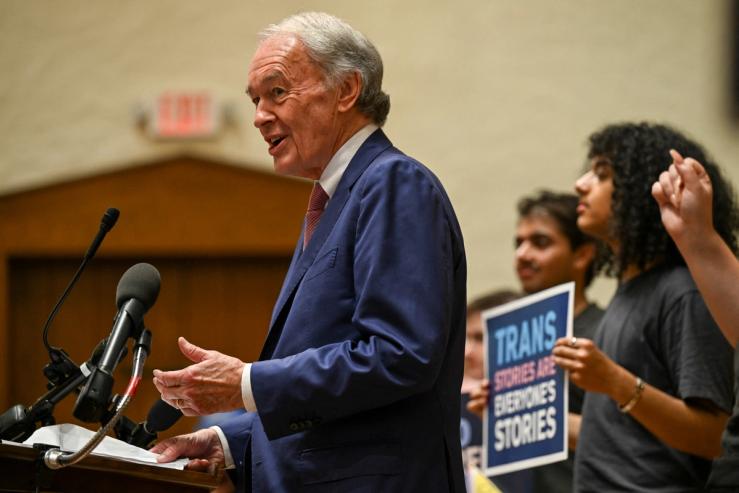
Then he stopped. In 2025, as the new administration and friendly courts wiped out the Biden administration’s pro-trans policies, Moulton basically quit talking about the issue. Days after Moulton launched his challenge to Markey, the senator spoke at Boston’s No Kings rally with a pink, white, and blue trans flag draped around his shoulders.
By the summer, when Moulton had gained some ground against Markey, the congressman had co-sponsored Markey’s Transgender Bill of Rights resolution, which would have called on Congress to ban discrimination based on gender identity, including in school sports.
When I asked Moulton what his position was now, he said that “my 5-year-old who plays on the co-ed soccer team” could obviously play against trans girls, and “by the way, that was going to be outlawed by some of the Republicans’ extremist, hateful legislation.”
“We also need to have a conversation about what those rules should be,” he continued. “And I don’t know what the right answer is.”
By the end of the primary, Moulton had apologized for his November 2024 remarks — and Markey’s steadfast support for trans rights was part of his re-election argument. He was the bold progressive on the right side of history, and his opponent blew with the wind.
“My opponent threw trans kids under the bus after the 2024 election, blaming them for our losing of the election,” Markey said in his final debate with Moulton. “I, on the other hand — I introduced the Trans Bill of Rights so that all of the constitutional protections for every other American [are] extended to the trans community.”
And on Saturday, at a rally in Dorchester with Sen. Bernie Sanders, I-Vt., and other high-profile endorsers, Markey gave the stage to Tyler Hack, the founder of the trans rights group the Christopher Street Project, who said that the election would be a referendum on whether people like her had a party to protect them.
“Every politician wondering whether abandoning trans people is good politics is watching,” Hack said. “And every trans kid who has spent the last two years watching adults debate whether they deserve healthcare, whether they deserve to play sports, whether they deserve to exist openly in this country and to grow old — they are watching, too.”
Markey and his allies won the argument in Massachusetts. The idea that the state is so reliably progressive, and needs to remain a bulwark against conservative federal politics, ran through the primary.
And while Markey campaigned, the Democratic nominees for governor in three Trump-won states — Ohio, Iowa, and Nevada — all said that they favored barring trans athletes from women’s and girls sports.
When Boston declared itself a “sanctuary city for transgender and LGBTQIA2s+” people, those were the kind of places they expected people to be fleeing. Moulton’s call for a debate on the question became, in Markey’s hands, a warning that he was too weak to fight when it mattered.
“I think across elections, voters are demonstrating that they want Democrats that are fighting for their principles,” Rep. Sarah McBride, the first and only transgender member of Congress, told me on Tuesday. “They can be pragmatic in how they do that, but they want Democrats who are fighting for their principles.”

Room for Disagreement
Markey’s win was disappointing to the small faction of Democrats who think the party must moderate its transgender rights positions.
“Rep. Moulton absolutely did the right thing in November 2024, saying that Dems across the board, elected and rank and file, need to have open and honest conversations,” said Kara Dansky, a member of the board of directors at Democrats for an Informed Approach to Gender, a group opposed to “gender ideology.”
“He never should have backtracked,” she said. “True-blue Massachusetts does not reflect the whole country. Voters across the spectrum, including rank and file Democrats, support female-only sports.”

Notable
- Markey sat for a few interviews as the campaign ended, telling Reid J. Epstein of The New York Times that “trans athletes should be able to play. That reflects Massachusetts and who we are.”
- In the 19th, Amanda Becker reported on the fight that broke out among Ohio Democrats after their nominee for governor backed the state’s current policy on excluding trans athletes.