




Andy’s view
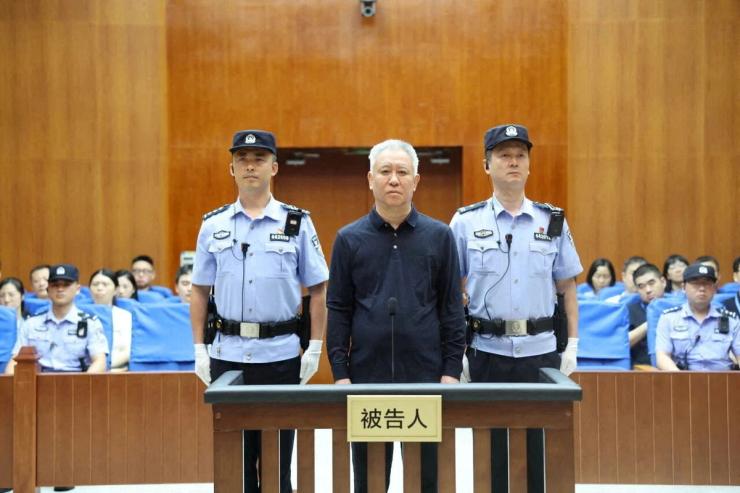
On successive days last week, exuberant investors hailed China’s latest corporate star — Wang Xingxing, the founder of humanoid robot maker Unitree Robotics, whose shares popped 460% in their market debut — while a court sentenced the fallen real estate tycoon Hui Ka Yan to life in jail.
Their backgrounds and personalities could hardly be more different: Wang is a self-described “tech supremacist”; Hui came up through gritty factory jobs. Wang represents China’s hopes of rejuvenating the economy through robots, drones, and smart devices; Hui, the founder of property giant Evergrande, which collapsed under liabilities of more than $300 billion, has become the poster child for its excesses.
But both share one thing in common: They are products of a system that concentrates massive resources at the command of the state, in the process generating colossal waste and leaving a trail of debt and industrial overcapacity. In sum, the pair represent how the business cycle in China plays out.
At its peak, the real estate sector accounted for 25% of the Chinese economy, filled the coffers of local governments through land sales, enriched state enterprises in steel and cement, and conjured vast service industries that employed millions as property agents, building managers, and mortgage lenders. Its collapse left up to 90 million vacant apartments and ended Hui’s career. Once Asia’s richest man — he owned a soccer team, a superyacht, and a fleet of private jets — Hui looked forlorn in the dock, white-haired, expressionless, and dressed in a simple navy blue shirt.
Profligacy has been a hallmark of subsequent buildouts, too.
An investment binge in solar has given China more than 90% of the global market, but eviscerated profits for Chinese solar players. Module prices plunged by half in 2023 and 25% again in 2024. The global battery industry, also dominated by China, had built up enough capacity to meet actual demand almost three times over. The auto industry is similarly afflicted. Brad Setser, a former US Treasury official now with the Council on Foreign Relations, calculates that China has the capacity to produce 55 million cars, close to two-thirds of global demand — and that number is rapidly increasing.
Today, Unitree’s pre-IPO investors are sitting on a windfall gain, although nobody really knows if there’s a commercial application for the gangly humanoid contraptions. The Chinese public is mesmerized by their athletic stunts — Unitree’s “Superman” robot can out-accelerate Usain Bolt and leap six-feet-six-inches into the air. But even state planners warn that with more than 150 companies all making similar products (50 have either listed or plan to), a bubble may be forming. One Beijing-based venture capital executive told the Financial Times that “humanoid robotics is approaching the peak of the hype cycle.”
Hui is the fall guy for China’s real estate meltdown. No doubt his crimes are real, but he was also only playing his part in what was essentially a Ponzi scheme that everybody — from village committees to the Politburo — relied upon to drive growth and generate employment. Real estate speculation wasn’t a flaw in the system; it was for a time China’s primary development model. Developers like Hui came to see the market as a one-way bet — why would the government spoil its own party? — and in a sense, loading up on risky debt was a rational strategy. Desmond Shum, the author of Red Roulette, posted on X that “the system created the incentives, rewarded the behavior, and profited from the boom.”
China’s roller-coaster business cycle has a long history of producing dizzying highs and painful lows for the country’s leading entrepreneurs. In the 2000s, a bricks-and-mortar retail boom ended with the jailing of Huang Guangyu, the billionaire founder of GOME Electronics, convicted of bribery and insider trading. A later outbound investment wave came to an abrupt halt with the jailing of several globe-trotting moguls, including Wu Xiaohui, the owner of New York’s Waldorf Astoria Hotel. Jack Ma, the co-founder of Alibaba, got off lightly when Beijing decided to crack down on consumer tech: Alibaba was hit with a whopping fine, and Ma lost perhaps half his assets but kept his personal freedom — and his yacht.
After Unitree’s spectacular listing, Wang is worth around $16 billion, at least on paper. But like many private fortunes in China, it’s a precarious one.

Notable
- Unitree’s Wang Xingxing suggested following the company’s IPO that despite all the hype, the humanoid robotics industry could still be a decade away from its breakthrough “ChatGPT moment.”