




The News
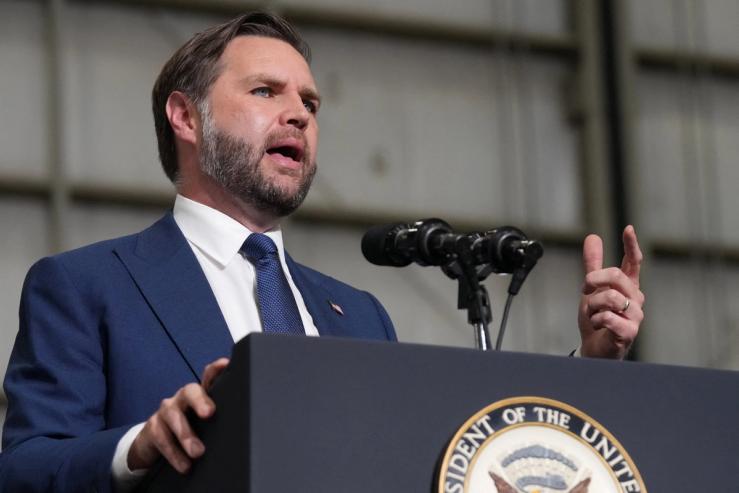
Economic historian Phillip Magness wasn’t expecting to go viral last week when he posted a clip of Vice President JD Vance criticizing the US dollar’s status as global reserve currency.
While researching tariffs, Magness unearthed 2023 footage of Vance telling the populist group American Moment that he’s “not sure” it’s “actually good” that dozens of foreign central banks store their reserves in dollars. The then-senator called reserve-currency status “a resource curse” like “coal in Appalachia” because it allows “consumers to consume very cheaply.”
Magness shared that video on X, followed by another clip in which Vance says that forsaking reserve-currency status could allow the US to “make enough weapons” to help Ukraine. Now “it’s all over the place,” he told Semafor: “I’m shocked.”
A self-described “critic” of Vance on trade, Magness is something of a libertarian gadfly among MAGA economists. But for allies of a vice president who’s uniquely willing to feed his online trolls, Magness struck a nerve by elevating Vance’s comments that the dollar’s reserve-currency status could be hurting the US’ ability to export goods.
Vance’s backers sense a growing campaign by free-market Republicans to discredit his economic policies ahead of a potential 2028 presidential bid — even as they double down on their concerns over the dollar’s reserve-currency status, later embraced by former Trump White House Council of Economic Advisers Chair Stephen Miran.
“The fact that you still have this bizarre kind of rump-libertarian right that thinks it’s … absurd mostly just speaks to how far behind the contemporary issues they really are,” Oren Cass, founder and chief economist of the populist-conservative group American Compass, told Semafor.
Yet even as he derided Magness’ critique as “half-baked and pathetic,” Cass acknowledged that “it clearly is starting to kind of lay out some of the contours for the conflicts that are going to emerge in the Trump administration over what right-of-center economic policy and thinking looks like in the future.”
Vance, who will travel to his home state of Ohio for a Friday speech on the economy, hasn’t explicitly called for displacing the dollar as reserve currency — nor is he in a position to act on it. His office did not comment for this story.
Importantly, his boss has vowed to protect the dollar’s reserve-currency status despite occasionally paying lip service to the related benefits of a weaker dollar, instead prioritizing tariffs aimed at boosting US exports.
President Donald Trump’s second-term administration has shown little appetite for deterring foreign central banks from holding their reserves in dollars, indicating that officials “may have been persuaded not to go that way over time,” Harvard University professor Kenneth Rogoff, author of “Our Dollar, Your Problem,” told Semafor.
Vance’s economic identity as the Republican presidential frontrunner for 2028, however, remains unclear. He spent his time on Capitol Hill flexing populist bona fides, teaming up with progressives as he touted proposals to penalize bank executives and rein in credit card companies (even if he later cooled on the latter).
That track record added weight to Magness’ posting spree.
“Welcome to the big leagues: If you’re going to run for president, your past statements are going to be scrutinized,” said Magness, adding that Vance’s Senate aides posted the vice president’s comments themselves.
In this article:

Know More
Vance made no secret after arriving in Washington that he was skeptical of the dollar’s reserve-currency status, which he called “a sacred cow of the Washington consensus” in a 2023 hearing.
Observing “our mass consumption of mostly useless imports on the one hand, and our hollowed-out industrial base on the other hand,” Vance continued, “I wonder if the reserve currency status also has some downsides.”
Rogoff said that while reserve-currency status “probably biases the dollar upward,” it also brings the US greater geopolitical power and lower interest rates (at least, before lenders factor in the national debt). Meanwhile, the US technology and agriculture sectors also boost its value.
“To say [Vance’s theory] shouldn’t be taken seriously economically is too strong, but I’d say it’s one factor of a dozen that make the dollar high or low, and it’s very hard to tell,” Rogoff said. “You can much more confidently say that the interest rate we pay is lower because of the dollar as the reserve currency.”
Importantly, Miran has also not followed Vance from skepticism to outright opposition when it comes to the dollar’s reserve-currency status. The former Federal Reserve governor emphasized last year that he believes “the best outcome is one in which America continues to … remain the reserve provider.”
As evidenced by foreign central banks’ actions during the 2008 financial crisis, their decision to store their reserves in dollars stems more from their perceptions of the US than the strength of the dollar on any given day. Any future administration would have limited options to sway them, especially since no other country could fill the role.
“I don’t think it’s possible to displace the dollar,” one former senior Trump administration official said. “Obviously, if you try hard enough and were reckless enough, you probably could — but I think the cost of that would be cataclysmic, and, rightfully, nobody even entertains the idea of doing so. Instead, you want to improve the tradeoff while leaving the overall structure in place.”
Members of the populist right argue it’s worth having the conversation regardless as part of a broader effort to rebalance global trade.
Cass described the dollar’s reserve status as “very beneficial to Wall Street,” since it gives US banks a competitive edge in international dealmaking, but “not beneficial to the manufacturing sector,” adding that it “doesn’t really do anything to help the ordinary family.”

Room for Disagreement
Some conservatives don’t view Vance’s comments as outside the GOP norm.
Robert Romano, executive director of Americans for Limited Government, argued in an interview that the vice president, a former venture capitalist, “is on pretty solid ground.” Any attempts to indicate otherwise are “2028 presidential politics,” he said.

Eleanor’s view
The administration’s critics might enjoy dunking on Vance for questioning the dollar’s reserve-currency status, which plays a big role in America’s economic success.
But it’s a hard view to whittle into a campaign-trail attack line; after all, he’s not advocating against it, he just wants to have the conversation.
“This is the type of thing that overeducated policy wonk people get all animated about,” the former senior Trump administration official said. “I don’t know how much of a political issue this is — and if it ever did become a political issue, all the vice president has to say is … I never said I want to get rid of it. I said that it has some costs and we should mitigate them. And he’d be right.”
For now, MAGA sees this as an intraparty fight, if not one it takes too personally.
“I think the people that are actually the most inclined to misrepresent things like this are actually the Never-Trump GOP folks,” the official added. “They’re orphans.”

Notable
- Columnists at The New York Times and The Bulwark weighed in on Vance’s comments this week. (They’re not fans.)
Update: This story identifies Cass — who has a law degree — as an economist. It was temporarily updated to say he wasn’t. But dictionary definitions and government usage do not typically require that economists have a masters degree or doctorate in economics.