



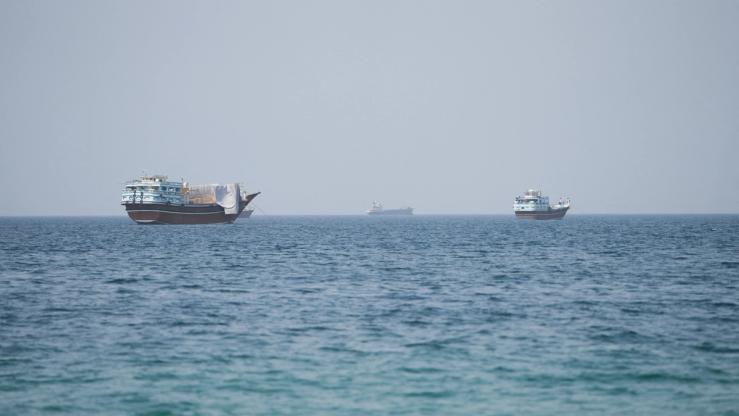
US President Donald Trump said this week the US effectively “owns” the Strait of Hormuz, but it might be more accurate to say that in practice, it belongs to the loose cohort of oil tankers that have established what could be a new status quo.
While hourly headlines send the price of oil hither and yon, a dedicated core of professional tanker trackers armed with satellite imagery, transponder data, and a host of proprietary AI tools are assiduously monitoring what’s actually moving through the strait. Michelle Weise Bockmann, senior maritime analyst at the intelligence firm Windward, told me this week that tracking ships in the strait is getting harder as more of them go “dark” and more commercial satellite imagery is withheld under pressure from Washington. But over the past month or so, she said, clear patterns have emerged.
There are roughly 70 very large oil tankers, each capable of carrying $150 million or so in crude, that now make up the core fleet making routine runs in and out. All of these use the southern, Oman-hugging corridor and stay dark during the trip. Most make “shuttle” runs, transferring their load to another tanker outside the Gulf, but some continue on to other global ports. Although they ostensibly have air cover from the US Navy, they are still occasionally attacked by Iran. Thirty-eight of these tankers belong to South Korea’s Sinokor Group, which went on a very public tanker-buying spree earlier this year, and 20 belong to various private Greek companies, including Dynacom. The rest belong to state-owned energy companies in the Gulf. All are turning handsome profits despite the high cost of insurance, danger pay for mariners, discounts to traders on high-risk barrels, and occasional drone attack. The UAE was the first exporter during the war to take a chance on the route, and in previous months was the source of two-thirds of the oil getting out that way. Now Kuwait, Iraq, Saudi Arabia, and Qatar have followed suit, and the UAE accounts for less than a quarter of the volume. “They’re all scaling up against a backdrop of very degraded maritime security conditions, which illustrates the importance of this route now,” Bockmann said, especially as other egress routes through the Red Sea and Suez Canal come under fire.
The total volume of crude leaving through the southern route is about 5 million barrels per day on average over the past month, by Bockmann’s reckoning. That’s about a third of pre-war volumes, and about half of what US Energy Secretary Chris Wright said on Tuesday. Bockmann acknowledges that some oil could be slipping out undetected either along the Omani or Iranian routes; as Bloomberg’s Javier Blas noted, even one clandestine supertanker would push the average closer to Wright’s.
Either way, it’s more than enough to be worrisome to Tehran, Bockmann said, whose leverage with the US is inversely correlated to outbound oil flows. For that reason, public statements of progress notwithstanding, Bockmann is skeptical Oman and Iran will be able to finalize a deal on new shipping lanes: “If Iran wants to maintain its leverage, they have to shut down that southern corridor. If Oman wants to uphold the principle of freedom of navigation, they have to keep it open. So we have a massive impasse.”
In the meantime, the current tanker status quo will likely drag on, she said, with great risk and reward for those shipowners, and their crews, willing to run the gauntlet. And Washington and Tehran will try to run down each others’ tolerance for economic pain. But Trump is the only player with an election looming in which energy prices could become a decisive factor.