



The News
Saudi Arabia has addressed most of the “problematic themes” in its school curriculum that were seen as intolerant of Christians and Jews, according to a review of 136 schoolbooks by an Israeli think tank that has been monitoring the kingdom’s textbooks for more than 20 years.
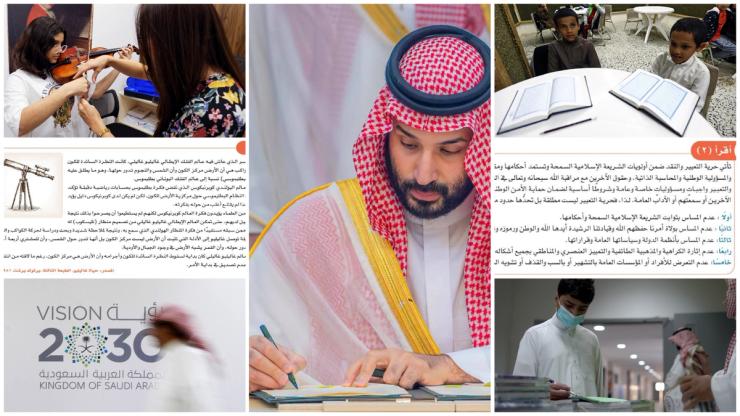
Gone is a hadith likening Christians and Jews to maimed animals; 11th-grade students now learn about coexistence from the Prophet Muhammad’s treaties with Christians and Jews. Ninth-graders study Galileo as a lesson in independent thought. Sixth-graders are asked to argue against the idea that kindness is owed only to Muslims.
The review by the Institute for Monitoring Peace and Cultural Tolerance in School Education (IMPACT-se) — an organization that has prominent critics who question its methodology and conclusions — tracked changes beyond religion. Lessons also encourage compassion toward migrant workers and people with disabilities, it noted. The report concluded that the curriculum has moved “toward greater moderation, inclusivity, and alignment with the broader reform objectives of Vision 2030.”
In this article:

Know More
Saudi Arabia’s educational system became a focus of international concern after the Sept. 11, 2001 attacks in the US, when the 9/11 Commission scrutinized the kingdom’s textbooks. US researchers spent years translating the curriculum, and Riyadh promised Washington it would make revisions as early as 2006.
The rewriting has accelerated under Crown Prince Mohammed bin Salman, who stripped the religious police of some of their powers in 2016 and promised a return to “moderate Islam” a year later. Critical thinking and philosophy entered high schools in 2021 to help combat extremism. Music lessons followed, and English instruction was extended to elementary school students.
The revisions have been incremental and sometimes inconsistent, according to IMPACT-se. An instruction to report “sorcerers” to authorities was removed one year but reinstated the next. A high school grammar exercise uses a Quranic verse describing disbelievers and polytheists as condemned to hell — a choice the researchers questioned given the same grammatical points could be easily explained through other sentences.
Geopolitics also features in the study. IMPACT-se said antisemitic language had been removed from textbooks, but “Israel’s nonrecognition and characterization as an occupying power” remain. One other constant: Students are taught that the term “Persian Gulf” reflects anti-Arab bias.

Room for Disagreement
IMPACT-se has documented troubling material, but critics argue that extrapolating from a few phrases and sentences across hundreds of books can lead to conclusions about intolerance or extremism that aren’t representative of the broader curriculum.
Nathan J. Brown, a professor of political science and international affairs at George Washington University, challenges the idea that textbooks alone drive extremism. Israel controlled the textbooks used in Palestinian schools from 1967 to 1994, but the generation educated during that period showed no less opposition toward Israel than Palestinians taught since then. Brown has described groups such as IMPACT-se as part of an “incitement lobby” that uses textbooks as fuel for broader political disputes.

Manal’s view
There is no question that the Saudi curriculum has been transformed. There was a time when a biology class would skip evolution, when religious censors would black out images of women or individual body parts. By my final year of high school in 2015, most of these restrictions were lifted; the following year, Saudi Vision 2030 was announced, setting the country on its current modernizing course.
As students, we never took the textbooks as gospel. In middle school, some of us would use computer class to figure out what the censors had obscured. But some students took the instruction seriously, and it wasn’t uncommon for kids to sneer “infidels” at their classmates who went to malls in a mixed group of boys and girls. While it’s impossible to attribute the changes in Saudi mannerisms — conversations between men and women are now normal in many settings — just to textbook reforms, it doesn’t hurt to teach tolerance.
The emphasis on respecting migrant workers is, to me, one of the most consequential changes. Dehumanizing attitudes toward domestic and other foreign workers have been prevalent in the region for generations. Over the past decade, that attitude has been shifting. Many have altered the language, using the term “helper” rather than “maid.”
There are limits to what textbooks can accomplish, though. Most of my peers don’t need a demarcated Israel in an elementary school textbook to understand the reality of our geography. No one pulls out the map they saw when they were 12 — they open an app. The transformation of Saudi society runs far deeper than its curriculum, but it is still significant that classrooms are increasingly pushing toward creating a more tolerant society.

Notable
- Washington has been reading Saudi textbooks for decades. Time’s account of the first wave notes the State Department calling the changes encouraging and Saudi officials promising more would follow.